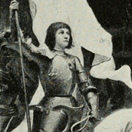
Saint Joan of Arc (Jeanne la Pucelle)
Saint Joan of Arc (1412-1431)
Item opusculum super facto Puelle et credulitate ei praestauda
("Concerning the fact of the Maid and the faith due to her")[1]
a book by Michael L. Bromley
Saint Joan of Arc called herself, Jeanne la Pucelle,[2] meaning "Joan the Maid." Her followers called her, simply, La Pucelle. Her antagonists disparagingly called her "the one who calls herself the Maid" or "Joan who calls herself the Maid."[3]
-_crop_folk.jpg)
Preface
| Saint Joan of Arc | |
|---|---|
 Joan of Arc entrance to Orléans through the Burgundy Gate, April 29, 1429 Joan of Arc entrance to Orléans through the Burgundy Gate, April 29, 1429 | |
| Honorofics: | Jeanne la Pucelle (Joan the Maid, Joan the Virgin) la Pucelle d'Orléans (Maid of Orleans, Virgin of Orleans) la Pucelle de Lorraine (Maid of Lorraine, Virgin of Lorraine) |
| Born: | January, 1412, Domrémy, Duchy of Bar, Kingdom of France |
| Died: | May 30, 1430, Rouen, English-held Normandy |
| Beatified: | April 18, 1909, by Pope Pius X |
| Canonized: | May 16, 1920, by Pope Benedict XV |
| Feast Day: | May 30 |
| Patronage: | France, soldiers, prisoners, virgins, those in need of courage, those ridiculed for their faith or youth |
| Signature: |  |
This book presents a Catholic view of Saint Joan of Arc that is consistent with the vetted historical record. It reviews the facts of the life and accomplishments of Saint Joan, as well as their historical context. It offers commentary and criticism of historical and academic views of her, including as regards the secularization and ideological contortions of her life and legacy.
The analysis here starts with faith not doubt, thus Joan's experiences and visions (which I will call her "Voices") are assumed as real. As opposed to skeptical treatments of Joan that begin from doubt, these pages accept their divine nature, which, applied prudently, enables important historical, typological, and scriptural connections to Joan's life and acts that otherwise go unconsidered. The approach here is faithful yet cautious.
This discussion of Saint Joan is analysis not narrative. Although the narrative is presented, the approach is thematic not chronological. To review a straight chronology of her life, please see the Joan of Arc Timeline or find a good narrative treatment of her from the Joan of Arc bibliography.
As with any valid historical analysis, this one weighs the evidence, adopts a perspective, and tests it against the historical and historiographic record. The extensive record of Saint Joan allows for cherry-picking and varied interpretation of witness motives, so, unlike many histories of Joan of Arc, mine will strive to avoid "proof-texts" to support a claim that may be countered elsewhere in the record, and will instead seek to evaluate the history across broader connections and textual evidence. While some conclusions may be speculative, they will always be grounded in the record and drawing from it, especially as regards some of Joan's prophetic visions that are open for interpretation. Just because an interpretation is arguable does not make it erroneous. The rule does not apply to Joan of Arc alone: historians engage in this type of interpretation all the time. It is the essence of the craft.
Finally, as my arguments are contingent upon larger historical context before and after the life of Saint Joan, I encourage the reader to explore the history more largely in the sources listed in the footnotes and bibliography.
Presented, as well, is the theory that Joan's mission was not to save France so much as to save Roman Catholicism.
Introductory Notes
Saint Joan of Arc
- I will generally refer to her as "Joan", but may also make references to "the Maid".
- Primary sources may refer to her as Jeanne (French). Johanne (Latin) or La Pucelle.
Related pages
- Joan of Arc Timeline
- Joan of Arc bibliography
- Kings of France and England
- Popes and antipopes
- Saint Joan of Arc glossary for names, places & terms, as well as a flow chart of the lineage of French Kings (which can otherwise be confusing)
- Saint Joan of Arc quotations
- The Life of Joan of Arc by Louis-Maurice Boutet de Monvel (with Joan of Arc series from National Gallery of Art)
- List of all Saint Joan of Arc category pages
Page use & readability
- This site is built on MediaWiki, the same platform used by Wikipedia.
- This site is not associated with Wikipedia.
- Use the left-side menus for site and page Table of Contents.
- Click on hamburger buttons to expand or collapse menus to adjust page viewing space.
- Use the right-side menu (or top-right "binoculars" button) to change page width and font size.
- For citations and notes, hover for quick read and click to see full notes.
- Go here for full Notes on page readability and navigation.
Notes on sources and quotations
- I am primarily using the 1902 translation of the Trials of Condemnation and Rehabilitation by T. Douglas Murray, Jeanne d'Arc: Maid of Orleans, Deliverer of France (link to Archive.org).
- I have posted the entire, unedited plain text version of the book on this site here: Jeanne d'Arc, maid of Orleans, deliverer of France. (It will be a long-term project to fix OCR mistakes.)
- Murray converted the mostly third-person Trial of Condemnation transcript into dialogue, which makes for much easier reading than the original transcript which describes conversations in the third person. While historians may not like Murray's text for that editing, he makes few errors or substantial changes, and leaves us with a far more readable text. For the literal, third-person translation go to The Trial Of Jeanner D'Arc, by W.P. Barrett.
- I regularly check Murray's extrapolations against the original texts, so I am confident of their accuracy as employed here, or will note when they are not, or any alternative translations.
- The largest problem with Murray is not the extrapolation of dialog but selective edits which were employed to reduce redundancy and to be able to fit both Trials into a single edition.
- I have deleted spaces between punctuation marks from Murray's text.
- I have not otherwise modernized spelling or usage in quotations.
Notes on usage, names and spelling
- Indented texts are direct quotations, so quotation marks are only used for nested (inner) quotations.
- Emphasis added to quotations is mine and not from the sources.
- In presenting the flow of events and dialogue, I may travel back and forth between the historical past and literary present tenses.
- I am using the French spelling for proper nouns, except as found in sources, such as Murray's which uses the English "Rheims" over the French Reims.
- Where a name includes a de I will generally but not always use the English "of the", and where it is a d' I will use the original French (saying Duke or Duc d'Orléans is far cooler than "Duke of Orleans").
- I'm tempted to use the French Bourguignons and duc de Bourgogne instead of the anglicized Burgundy, but the French nasal consonant "gn" is simply unworkable for the English tongue.
Notes on archaic word use
- "Gentle knight" is translated from the French gentil, which means "honorable" or "noble" not "delicate".[4]
- "Fair Lord" is translated from the French juste, which means "just" not "good looking".[5]
Important terminology
- France / French
- the Kingdom of France, which had been reduced mostly to the Loire Valley and below.
- the King of France as of 1429, the year of Joan's appearance to him, was Charles VII, also known as "The Dauphin" (for prince).
- Armagnacs
- named for the Count d'Armagnac who sided with the Dauphin Charles after the French split into factions
- the Armagnacs are followers of Charles from when he was prince to his assumption of the title on his father's death in 1422.
- Armagnac-Burgundian Civil War, 1407-1435
- refers to the factional split of the Kingdom of France between the Houses of Orlėans and Burgundy, which became outright warfare, especially in Paris, in 1410-1412, 1413-1414, 1418 and from 1420 to 1435 when the Burgundians were allied with the English.
- Burgundians
- The House of Burgundy was a large, central-western Duchy of France that was assumed by the King of France, John II in 1363, who then gave it (ceded) to his younger son, Philip, who expanded the Duchy through marriage and his son, John, who expanded its territories and treated the Duchy, in part a French fief, as an autonomous state. The "Burgundians" were his subjects, followers, and allies.
- England/ English
- Following old English royal claims on Normandy, Gascony, and the kingdom of France itself, Henry V of England invaded France in 1415 and assumed title as heir to France at the Treaty of Troyes in 1420.
- Henry died in 1422 and "English France" was ruled by his brother, the Duke of Bedford who was regent for the young Henry VI.
- Trial of Condemnation
- The English-backed French ecclesiastical trial of Joan of Arc at the English-held city of Rouen that lasted from February to May, 1431 and ended with her burning at the stake as a heretic.
- I will often refer to the Trial of Condemnation as "Rouen" or "the Rouen Trial".
- I will variously refer to the judges of the Trial as Judges, Interrogators, Examiners, and Promoters
- there were anywhere from 40-60 who were ecclesiastical and theological experts consisting of priests and bishops from English and Burgundian held lands, particularly at Paris and from the University of Paris
- the Trial became known as the "Trial of Condemnation" only well after it took place and in order to distinguish it from its nullification proceedings in the 1450s.
- Trial of Rehabilitation
- The French process of investigation, interviews, and "rehabilitation" of Joan of Arc, as well as "nullification" of the Trial of Condemnation.
- The Trial of Rehabilitation, essentially a series of interviews across France, took place from 1450 to 1456, when a French Ecclesiastical Court declared her innocent of "false articles of accusation."
Important Events & Dates of the life of St. Joan of Arc
See this page for fuller timeline with details. Before reading on, please familiarize yourself with these important events in her life:
1412: Joan of Arc is born in Domrémy, France.
1425: Joan begins to experience visions of saints instructing her to support Charles VII and recover France from English domination.
May 7, 1429: Joan leads the French army to lift the siege of Orléans, marking a turning point in the Hundred Years' War.
July 17, 1429: Led there by Joan, Charles VII is sacramentally coronated at Reims, fulfilling Joan's primary mission.
May 23, 1430: Joan is captured by the Burgundians and sold to the English.
Feb-May, 1431: Joan is tried for heresy by an English-backed French ecclesiastical court.
May 30, 1431: Joan is executed by the English burning at the stake in Rouen, France, at the age of 19.
April 13, 1436: Paris is retaken by the French.
1449: The English administrative capital in Normandy, Rouen, where Joan was tried and burned, is retaken by the French.
1450: At the insistence of Joan's mother, Isabelle Romée, the King authorizes an investigation into the Rouen Trial and of her life and accomplishments.
1456: Joan's original condemnation for heresy is officially nullified by the Pope.
May 16, 1920: Joan is canonized as a saint by the Catholic Church. Her feast day is May 30.
Saint Joan of Arc
It was not easy to be Saint Joan of Arc.
Who would want to be her? Who would want to hold France upon her shoulders? And be ridiculed and dismissed as a lunatic for saying it. Who would want a bolt through the shoulder, then get up and charge a fortified wall? Who would want a sixty-foot fall from a tower, lest be handed over to your worst enemy? Who would die for it all?
These are not legends: these are historically documented facts of the life of Saint Joan of Arc.
The historical problem of (Saint) Joan of Arc
The most prominent modern biographer of Saint Joan of Arc, Régine Pernoud (1909-1998), a medieval scholar, counsels,[6]
Among the events which [the historian] expounds are some for which no rational explanation is forthcoming, and the conscientious historian stops short at that point.
It's a large concession, that, that some events from the life of Saint Joan of Arc have "no rational explanation." But, apparently, this "conscientious historian" -- who is a sincere and important historian -- must contain herself to "the facts" and stick to sorting them out for description, while avoiding explanation, much less inference from those facts. Sadly, it's historiographically unenlightening and theologically cowardly -- which is the point: to deny God's role in the story of (Saint) Joan of Arc.
As Pernoud admits, because Joan's motives, actions, and outcomes are so improbable, to attribute them to anything other than divine guidance makes no sense. But since divine guidance is "ahistorical," or merely an article of faith, Joan's motives don't matter historically. Pernoud thereby dismisses them altogether, falling back upon,[7]
The believer can no doubt be satisfied with Joan’s explanation; the unbeliever cannot.
What, then, does the "unbeliever" do with the evidence? That the unbeliever cannot accept Joan's own explanations is an easy out from what is plain to see. But the problem is larger. If Joan's Voices were not real, then how to explain their effects?
Such is a core Catholic tenant, drawn from the Gospel of Matthew 7:15-20, from verses labeled in most Bibles, "False Prophets",
Beware of false prophets, who come to you in sheep’s clothing, but underneath are ravenous wolves. By their fruits you will know them.
Just so, every good tree bears good fruit, and a rotten tree bears bad fruit.
A good tree cannot bear bad fruit, nor can a rotten tree bear good fruit.[8]
Every tree that does not bear good fruit will be cut down and thrown into the fire.
So by their fruits you will know them.
and Matthew 12:33, in which Jesus declares to the Pharisees,
Either declare the tree good and its fruit is good, or declare the tree rotten and its fruit is rotten, for a tree is known by its fruit.
and which the Church at Poitiers on the first examination of Joan on behalf of the French King, employed explicitly when discerning Joan, following 1 John 4:1,[9]
Beloved, do not trust every spirit but test the spirits to see whether they belong to God, because many false prophets have gone out into the world.
The "unbeliever" historian has two outs here: the first is to deny the source of Joan's Voices while admitting their effects; the second is to deny their effects, thus denying both.
To the first strategy, historians like Pernoud step around the problem by ignoring the Voices or even their reality, but taking their effects at face value.[10] Others follow the second approach and minimize Joan's historical role altogether, i.e. lesser effects.[11] Or they use both.
So we hear that it was schizophrenia or moldy bread, which at least recognize that Joan heard voices.[12] Others who question the reality of the Voices must fall back on pseudo-psychological conjecture and sociological babble. For example, historian Ann Lelwyn Barstow argues that subjects of Joan's visions were those Saints with which she most closely identified and was most familiar:[13]
One gets the picture of a lively Christianity informing the mind of the young Joan through legends. well-known across Europe ... That she was visited instead [of the Virgin Mary] by Michael, Catherine and Margaret attest to the potency of their legends in Lorraine, to their particular usefulness to a young patriot in time of national distress, and their appropriateness for an independent-minded woman.
Not there weren't any churches in France called "Notre Dame," but, sure, the Church in Domrémy held (and apparently still holds[14]) a statue of Saint Margaret; Saint Catherine was the patron of nearby church; Saint Michael was venerated in Lorraine and was considered the defender of France; so there you have it.
Given that reasoning, one may suppose that some other "local" Saint, say, Saint Drogo, might have equally conveyed God's message to a thirteen year old in rural eastern France, as, while notoriously butt-ugly, he was from the northeast of the country and spoke French. It's nonsense. Of course God sent the Saints that Joan already knew and trusted. To paraphrase Joan, “Do you think God has not wherewithal to select the right Saints for Joan?"[15]
Indeed, remove Joan of Arc from the moment, and things simply did not happen the way they did. That is, she was an unusually significant historical actor, who cannot be simply discarded with, "well, she believed it, that's all that matters." And remove the divine origin of her Voices and she simply did not, was not able to, do what she did.
If Joan's visions were real, then we have perfectly explainable historical causation, including crucial moments of uncertainty or disobedience to her Voices, such as her flustered recantation, called her "abjuration," when threatened in public humiliation before the stake. Skeptical historians point to this moment as evidence that Joan had just made it all up, ignoring that only two weeks before this demeaning public ceremony, when threated with torture she had told the trial judges,[16]
Truly if you were to tear me limb from limb, and separate soul and body, I will tell you nothing more; and, if I were to say anything else, I should always afterwards declare that you made me say it by force.
But so goes the theory that, fatigued and confused, Joan gave the hostile and abusive English-backed court what it wanted and made up stories of the Saints, whom, it (incorrectly) holds, she had not before mentioned.[17] This ignores the fact that several days later, following the instructions of her Voices, Joan recanted her abjuration, stating,[18]
They said to me: "God had sent me word by St. Catherine and St. Margaret of the great pity it is, this treason to which I have consented, to abjure and recant in order to save my life! I have damned myself to save my life!"
Had she really made it up just to please the court, the recanted her recantation knowing she would burn for it? Or do not even cynics have limits?
The notary scribbled in the margin of the court register his agreement with the Saints, [19]
Responsio mortifera
People do not die for a lie. Instead, she was lucid, calm, and firm,[20]
"Do you believe that your Voices are Saint Catherine and Saint Margaret?"
"Yes, I believe it, and that they come from God."
If, as, such theories hold, supporters and detractors of Joan were just using her for their convenience, and that the historical record itself reflects that self-interest and not the truth about Joan, why would Joan have said this? They didn't need anything else to to put her to death, so this report actually serves against the interest of the Rouen court, which would now fully act as instruments of a martyrdom, duly recorded in Latin and preserved for us in history. Indeed, as we shall see, her chief persecutor had to resort to off-the-record and, I will argue, fictional interviews with her the morning of her execution in which she is said to have admitted it was all a lie.
Medieval historian Juliet Barker sees Joan's career as entirely political in terms of her own ambitions and those of political actors around her.[21] As such, Barker credits the pro-French Armagnacs for using her to push their war against the English-allied Burgundians, even so as to credit the Armagnacs for having engineered not just Joan's introduction to the French prince, Charles the Dauphin, but to her ability to identify him hidden amidst the courtiers -- they tipped her off![22]
Of course there is no evidence for such trickery, but the theory does legitimately point to the Dauphin's equivocal position between the anti-Burgundian and reconciliation factions around him. The problem is that is treats the Dauphin as merely going along for a ride with the Maid just to see what might happen.[23] Hardly. He deliberated, spoke with everyone he could and sent her for an inquiry by the finest clerical minds, "the Doctors",[24]theologians, at Poitiers, to where the several of the leading French clerics were exiled from the English-Burgundian occupation of Paris. The clerics investigated her for several weeks, and concluded firmly that the King must not deny God and so must send her to Orleans at the head of his army. Historians have argued that the investigation at Poitiers was just for show, or that the good Doctors merely reviewed her, shrugged their shoulders, saying, "let's see what happens."
Rather, they advised the King to send her with the Army, "placing hope in God" -- meaning to trust that God is in her.[25] Our secular historians seemingly have no idea what "Christian hope" is, and so they see the Poitiers recommendation as expedience, ambivalence, or deflection. They entirely misunderstand the word, "hope".
Per the Catechism of the Catholic Church,[26] \
Hope is the theological virtue by which we desire the kingdom of heaven and eternal life as our happiness, placing our trust in Christ's promises and relying not on our own strength, but on the help of the grace of the Holy Spirit.
Accordingly, the Poitiers Doctors concluded the recommendation to send her to Orleans with,
The king, given the investigation conducted of the said made, as far as he is able, and that no evil is found in her, and considering her reply, which is to give a divine sign at Orléans; seeing her constancy and perseverance in her purpose, and her insistent request to go to Orléans to show there the sign of divine aid, must not prevent her from going to Orléans with her men at arms, but must have her led there in good faith, placing hope in God. For doubting her or dismissing her without appearance of evil, would be to repel the Holy Spirit, and render one unworthy of the aid of God, as Gamaliel stated in a council of Jews regarding the apostles.
No illusions about it. And not just about some cross-dressing prophet. As the most significant of these advisors, Bishop Jean Gerson, observed, allowing a girl to lead an army isn't a trial balloon. In his apologia for Joan written shortly after her victory at Orléans, he observed that to give an army to a woman isn't just crazy, it's dangerous:
The king's council and the men-at-arms were led to believe the word of this Maid and to obey her in such a way that, under her command and with one heart, they exposed themselves with her to the dangers of war, trampling under foot all fear of dishonor. What a shame, indeed, if, fighting under the leadership of a woman, they had been defeated by enemies so audacious! What derision on the part of all those who would have heard of such an event![27]
The historians reply that this was after-the-fact rationalization, and, besides, the Dauphin was obsessed with prophesy, so he naturally fell to the latest seer.[28] Or, as does Barker, the Dauphin's military situation was not as dire as Joan's "cheerleaders"[29] have claimed, so, by implication, she wasn't the essential actor in the moment and there was no risk in sending her. But not even Barker claims that without Joan's involvement the French would have won at Orléans. The theory is ever insufficient to explain the events. Worse Barker is simply arguing against the historical record. The Dauphin's ecclesiastical advisers whom he asked to investigate her before his endorsement of her, made it very clear as to why they recommended nothing against the girl:[30]
The King, given his necessity and that of his kingdom
Unlike historians, the actors of Joan's day had to to decide: either Joan acted on voices of God -- or of Satan. There was no in between. Just ask the English and Burgundians who knew full well what this young woman had done and why.[31] The rage of the Rouen ecclesiastical Court and its English backers that condemned her is in inverse proportion to Joan's faith in her Visions and the reality her people of France understood them to be. To read the epithet the English placed upon a placard by the stake is to understand just how real her Voices were:
Joan, self-styled the Maid, liar, pernicious, abuser of the people, soothsayer, superstitious, blasphemer of God; presumptuous, misbeliever in the faith of Jesus-Christ, boaster, idolater, cruel, dissolute, invoker of devils, apostate, schismatic and heretic.[32]
It ought not take much faith to see straight through to a typology of the crucifixion of the Lord himself and the fury of his executioners, which stand for us in the Gospels as more evidence of the Lord's divinity. Uninformed by faith, the condemnation of Joan is just hyperbolic political statement. Oh no -- they meant it, and meant it hard. Listen to the priest Jean Massieu, Joan's escort to and from her prison cell at the Trial of Condemnation, including to lead her to the stake,
I heard it said by Jean Fleury, clerk and writer to the sheriff, that the executioner had reported to him that once the body was burned by the fire and reduced to ashes, her heart remained intact and full of blood, and he told him to gather up the ashes and all that remained of her and to throw them into the Seine, which he did.
Or Isambart de la Pierre, a Dominican priest who witnessed the Trial,
Immediately after the execution, the executioner came to me and my companion Martin Ladvenu, struck and moved to a marvellous repentance and terrible contrition, all in despair, fearing never to obtain pardon and indulgence from God for what he had done to that saintly woman; and said and affirmed this executioner that despite the oil, the sulphur and the charcoal which he had applied against Joan’s entrails and heart, nevertheless he had not by any means been able to consume nor reduce to ashes the entrails nor the heart, at which was he as greatly astonished as by a manifest miracle.[33]
All our skeptics can do is to question the motives of these testimonies, saying that de la Pierre and Ladvenu were covering up their own shameful involvement in the Condemnation Trial at Rouen. Perhaps, but even if true, the testimony affirms Joan's innocence. The details, though, are hard to ignore: "her heart remained intact", "the oil, the sulphur and the charcoal" -- memory works this way, not imagination.
These historians engage in the same process as writing a book on the life of Jesus as a non-believer.[34] You'd get caught up in denying the Lord's virgin birth, denying the miracles, denying the resurrection, and, ultimately, as some do, denying his historical presence altogether -- understandably so, as the story of Christ makes no sense without his divinity.[35] Actually, Thomas Jefferson similarly conducted a now obscure and theologically meaningless cut and paste job on the New Testament, from which he extracted the angels, prophesies, miracles, and the Resurrection.[36] He ended up in the same lonely valley of Joan's skeptical biographers: Jesus existed and spoke wisely, but that's all. Accepting the historicity of Christ without the miraculous requires denying the authenticity of the Gospels and attributing them to post hoc contrivances.[37] It gets messy and, frankly, serves merely to deny Christ rather than understand him.
And with Saint Joan that's where our historians land. Pernoud denies that Joan was, in CS Lewis' terms[38], a madman, but neither was she divinely guided. So all we have left is that she was a liar -- and thus of the devil, something Pernoud, a deep admirer of Joan, never broaches, although the English put her to death for it.
CS Lewis prefaces his argument about Christ's divinity by noting,
I am trying here to prevent anyone saying the really foolish thing that people often say about Him: I'm ready to accept Jesus as a great moral teacher, but I don't accept his claim to be God. That is the one thing we must not say.
The logic applied to Joan goes the same way: treating her merely as an historical character debases what she was and did. So it is that Pernoud concludes that when "confronted by Joan" all we can do is to "admire" her, as the common people have since the 15th century, for "in admiring [they] have understood her":[39]
They canonised Joan and made her their heroine, while Church and State were taking five hundred years to reach the same conclusion.
That's as close as Pernoud will come to an historical "saint" Joan -- that she was "canonized" in the hearts of her countrymen.
While affirming Joan's popular canonization, Pernoud incorrectly claims that the "Church and State" didn't understand her until 1921, forgetting that Joan's "Rehabilitation Trial" and its declaration of her innocence was, in Pernoud's own words, "in the name of the Holy See."[40] This historian ought to know that very few of the laity were canonized before the 20th century, including the 16th century Sir Thomas More, who wasn't canonized until 1935, and despite great hostility for it from the Anglican Church. Saint Joan's canonization underwent a similar dynamic, delayed not just by English objections but by the intervention of the French Revolution and overall 18th and 19th century European anti-clericalism and anti-monarchism.
Free of having to address whether Joan's spiritual events were real or not, the secular historiography leads to sentimentalized and historically insufficient views of Joan's contemporaries and her legacy. So we get these dull statements of Joan's legacy, such as at end of one Pernoud's books,
It remains true that, for us, Joan is above all the saint[41] of reconciliation—the one whom, whatever be our personal convictions, we admire and love because, over-riding all partisan points of view, each one of us can find in himself a reason to love her.[42]
That's no better than this, from the collective wisdom of contributors to the "Joan of Arc" entry at Wikipedia, casting Saint Joan to the eye of the beholder:[43]
Joan's image has been used by the entire spectrum of French politics, and she is an important reference in political dialogue about French identity and unity.
But what is equally bewildering is that these historians mostly ignore the most thorough, considered, and balanced investigation into Joan, that conducted by the Vatican itself. On consideration of a person for beatification and canonization, the Church investigates the case, and thoroughly, assigning advocates for and against the candidate.[44] There were serious charges against Joan, including to have waged war on a Holy Day, disobedience to her Voices, questions about her purity, and her "unsaintly" reluctance to be burned to death (i.e. martyrdom). The Church duly considered those objections, and on May 16, 1920, canonized Saint Joan of Arc.
A final problem the story of Saint Joan presents to secular historians concerns the extensive historical record which they use to argue against her sanctity. That record consists primarily of the transcripts of Joan's two "trials", the "Trial of Condemnation" at Rouen under the English-backed court, and the "Trial of Rehabilitation", over two decades after her death, under the authority of the French government. Regarding the first, doubting historians seek inconsistencies in Joan's testimony and attribute to her claims about her Voices either deceit or emotional frailty under the duress of the trial. These historians then pick and choose what they want to believe from Joan's testimony or from that of the trial court. As to the Rehabilitation Trial, they dismiss it altogether or in part as a propaganda exercise to reverse engineer Charles VII's legitimacy through Joan's exaggerations and outright lies about her saintliness and accomplishments. There exists a rather large body of additional contemporaneous documents, including letters, including some that Joan herself dictated, receipts, "chronicles", which are ongoing observations about past and current events that cover Joan's affairs in real time, as well as official reports on her, such as a summary endorsement of her from the Dauphin's clerics who interviewed her extensively prior to Orléans. Finally there are literary and theological works written shortly after Orléans, and then over the next decades but within the lives of those who witnessed her.
Here's the problem: without that extensive record, Joan's accomplishments yet stand. Rather than building a hagiographic recreation of her life that is passed on orally through the centuries, and written down much later, as we have it for the early Saints, we have an enormous amount of detail to inform of her life. There is no argument as to the proximity of the record to the events, which is historical gold. While it is a legitimate historical exercise to analyze and interpret that record, we can with certainty say that if Joan of Arc did not claim divine guidance, yet accomplished what she did, she would be universally hailed historical hero who, for example, as a young village girl inexplicably knew how to wield a lance, charge a fortification, or, unbelievable as it would sound, talk her way into the French court and personally meet the King. It is her claims of divine guidance that make it all so doubtful to these historians, not her acts themselves.
My concern here is that a historical treatment of Joan that frees itself of having to address whether her spiritual events were real or not, or that attempt to demystify them, leads to significant misreading of the facts. We cannot comprehend the motives and choices of Joan herself, much less those of her followers and detractors without it. We cannot understand Joan of Arc except as a Saint. And when we do, her story -- her historical record -- makes perfect sense.
Finally, with Joan, it's no single act or event. She was bodily injured with what are often, if not usually, mortal wounds -- at least four times. She prophesized events -- regularly. She pieced together just the right people who fulfilled her mission despite the great injustices which kept her from fulfilling them herself. Aside from the theological implications therein, it is not merely the various, isolated testaments of the historical record, it is their accumulation that truly shows the hand of God in the life of Saint Joan of Arc.
Crazy, witch or Saint?
Joan's biographers like to present her with a letter she composed to the King of England,[45] the child-king Henry VI, the day she was given an army to march on the English siege at Orléans.[46] And for good reason. It's a marvelous, crazy letter, almost arrogant at first glance. A second look, though, and the letter yields instead Joan's simplicity and directness. Indeed, she is hardly arrogant: just bluntly honest:[47]
Jhesus † Maria King of England; and you, Duke of Bedford, who call yourself Regent of the Kingdom of France; you, William de la Pole, Earl of Suffolk[48]; John, Lord Talbot; and you, Thomas, Lord Scales, who call yourselves Lieutenants to the said Duke of Bedford: give satisfaction to the King of Heaven: give up to the Maid,[49] who is sent hither by God, the King of Heaven, the keys of all the good towns in France which you have taken and broken into. She is come here by the order of God to reclaim the Blood Royal. She is quite ready to make peace, if you are willing to give her satisfaction, by giving and paying back to France what you have taken.
It's a useful letter for the biographer, but left unexplained or unattributed to anything but "voices", as they tend rather agnostically to leave it, it makes no sense. Okay, so an illiterate seventeen year old girl from a sidelined village in Lorraine imagines that God told her she is to save France and crown its legitimate King. She insists on an introduction to that prince, and despite ridicule, doubt, and a dangerous eleven day journey at night across enemy lands, talks her way into his castle, picks him out from hidden in a crowd, undergoes three weeks of questions by all the prince's finest theological minds, and passing the test is given a horse, lance, and suit of armor -- and command of a French army, whereupon she writes a letter to the King of England demanding he surrender all his possessions and claims in France, while displaying keen knowledge of the English political and military hierarchy. Got it.
Her letter is astonishing. And prophetic.
Prophecy fulfilled
The English had likely already heard the rumors flying about France about "a maid who would save France," but this was their first direct introduction to her. We have no record of how it was received, but it had to be in the back of their minds when she approached Orléans, and indelibly upon the front of their minds after she routed them. The letter concluded with this note to the English governor, which must have bewildered at first, then stung,[50]
You, Duke of Bedford, the Maid prays and enjoins you, that you do not come to grievous hurt. If you will give her satisfactory pledges, you may yet join with her, so that the French may do the fairest deed that has ever yet been done for Christendom. And answer, if you wish to make peace in the City of Orleans; if this be not done, you may be shortly reminded of it, to your very great hurt. Written this Tuesday in Holy Week.[51]
It wasn't mere psychological warfare as some historians contend: Joan was prophesizing. At her 1431 Trial of Condemnation at Rouen under the English after her capture in May the prior year, the letter was presented as incriminating evidence of witchcraft. To the English, the letter still stung:[52]
Do you know this letter?
Yes, excepting three words. In place of "give up to the Maid," it should be "give up to the King."[53] The words "Chieftain of war" and "body for body"’ were not in the letter I sent. None of the Lords ever dictated these letters to me; it was I myself alone who dictated them before sending them. Nevertheless, I always shewed them to some of my party.
Given that Joan corrects some of the language, what was read was not the original. Wherever it was acquired, the English remembered it well. How could they not remember this confounding and, -- to us, marvelous -- to them, demonic, warning? Then it got worse. Without further prompting or context, Joan continued,[54]
Before seven years are passed, the English will lose a greater wager than they have already done at Orléans; they will lose everything in France. The English will have in France a greater loss than they have ever had, and that by a great victory which God will send to the French.
How do you know this?
I know it well by revelation, which has been made to me, and that this will happen within seven years; and I am sore vexed that it is deferred so long. I know it by revelation, as clearly as I know that you are before me at this moment.
When will this happen?
I know neither the day nor the hour.
In what year will it happen?
You will not have any more. Nevertheless, I heartily wish it might be before Saint John’s Day.[55]
A year earlier, March of 1429, in her "Letter to the English," Joan warned Bedford,
for King Charles will gain [the realm of France], the true heir: for God, the King of Heaven, so wills it, and it is revealed to him by the Maid, and he will enter Paris with a good company.
_2112px-_wikicommons_cropped.jpg)
The prophesy of "before seven years" came on March 1, 1431. It's beyond improbable that, having failed to take Paris herself, imprisoned and helpless, she was not again speaking of Paris, for six and a half years later, November 12, 1437, the French King Charles VII entered the gates of Paris, which had been delivered to him through the 1435 Treaty of Arras that ended the English alliance with the Burgundian faction of France through recognition of Charles VII as King of France by the Duke of Burgundy. The Treaty was signed in September 21, 1435, and the French army, led by the French commanders, Arthur de Richemont, whom Joan herself had acquired to the French cause, and the Bastard of Orléans, Jean de Dunois, one of Joan's most fervent believers, expelled the English from the city in April of 1436.[56] The English would never recover.[57]
Skeptics will point out that the English presence in France continued for another fifteen years, which is true but meaningless, as the English cause was lost with the Burgundian defection and loss of Paris.[58] The remainder of the Hundred Years War wound down through attrition and pressure, with a few major battles that were won as a result of French military reorganization enabled by and in many ways modelled upon Joan's strategies and example. In other words, Arras and the taking of Paris were sufficient for the larger outcome. Paris was the endgame, the "greater loss" that Joan had predicted.
Was it a lucky guess, a threat, or a prophecy? That is, was she crazy, witch or prophet? Had the Treaty or the French entry to Paris occurred well before or after the prophecy, we'd have to look for another event, or recognize that she was wrong or just made it up. Near to but within the prophetic expiration, six years is, indeed, "Before seven years." She was not wrong on the timing nor the significance of the event.[59]
For sticklers of prophecy who wish to hold Joan to just "before" seven years, we can point to the May, 1438 collapse of an English attempt to negotiate a permanent status in Normandy, which would have secured for them the important English seat at Rouen, and upended every outcome as we know it. To coordinate the negotiations, the English moved their prize prisoner, Charles I, Duke of Orléans, to London to arrange his participation in the talks, which failed to materialize.[60] Subsequent English attempts through 1440 also failed, largely due to Joan's military comrades, de Richemont and Étienne de Vignolles, known as La Hire, who continued scorched earth military campaigns which de Richemont calculated would sabotage any agreements. Theirs aligned with Joan's position that the English must be removed from all of France. Had a settlement been reached at this point, not only would the English have kept a large hold of northern France, it would have, for the French, dangerously normalized English-Burgundian relations.[61] Joan's work would have remained incomplete.
To assist with the negotiations in 1440, the English brought the Duke of Orleans to Calais, where he was finally released, twenty-five years after his capture at the 1415 Battle of Agincourt. Thus was fulfilled another of Joan's prophesies. Upon her arrival to the French court in 1429, she had pronounced the liberation of the Duke as among her divine missions, along with defense of the city of Orleans and the crowning of Charles VII at the traditional city of coronations, Reims. During 1431 Trial of Condemnation by French clerics working under the English, Joan was asked,[62]
Did Saint Catherine and Saint Margaret tell you absolutely and without condition that you would take enough English to get the Duke d'Orléans, who is in England, or that otherwise you would cross the sea to seek him?
In her response, Joan provides a rather interesting glimpse of what may have happened had she not been betrayed by her own, and abandoned to the English:
Yes, and I said so to my King: and he allowed me to treat with the English lords who were then prisoners. If I had continued three years without hindrance, I should have delivered him. To do this, it needed less time than three years and more than one. But I do not remember about it.
In 1449 the French retook Rouen, where Joan was martyred, and in 1453 the English suffered a severe defeat at the Battle of Castillon, which ended three hundred years of English control of southwestern France. Those later victories were only possible with the Burgundian realignment at the 1435 Treaty of Arras and the 1436 recapture of Paris, which were themselves the product of Joan's military and political victories at Orléans and Reims. Outside of her declarations regarding those events, this prophesy of "seven years" is among her most significant -- and one that no one would or could have contemplated at the time, when the English, reinvigorated by her capture and execution, launched major attacks and had Henry VI crowned at Paris soon after her execution.[63]
Upon Joan's capture, the Duke of Burgundy issued a public acclamation of victory, announcing,
Very dear and well-beloved, knowing that you desire to have news of us, we[64] signify to you that this day, the 23rd May, towards six o’clock in the afternoon, the adversaries of our Lord the King[65] and of us, who were assembled together in great power, and entrenched in the town of Compiègne, before which we and the men of our army were quartered, have made a sally from the said town in force on the quarters of our advanced guard nearest to them, in the which sally was she whom they call the Maid, with many of their principal captains .... and by the pleasure of our blessed Creator, it had so happened and such grace had been granted to us, that the said Maid had been taken ... The which capture, as we certainly hold, will be great news everywhere; and by it will be recognized the error and foolish belief of all those who have shewn themselves well disposed and favourable to the doings of the said woman. And this thing we write for our news, hoping that in it you will have joy, comfort, and consolation, and will render thanks and praise to our Creator, Who seeth and knoweth all things, and Who by His blessed pleasure will conduct the rest of our enterprizes to the good of our said Lord the King and his kingdom, and to the relief and comfort of his good and loyal subjects.
We see here the vast importance of her capture to the English and Burgundians: if she is not of divine intervention, they reasoned, then her successes were not legitimate, including, by reference to the English King, the coronation Joan had engineered of the French King. Royal legitimacy relied on faith in God's plan, so Joan's capture justified the English cause. The practical implications were great: with Joan held to be a witch and burned, the English were cleansed of the curse.
One of the clerics who saw Joan the day "she was delivered up to be burned,"[66] Jean Toutmouille, recalled,[67]
For, before her death, the English proposed to lay siege to Louviers; soon, however, they changed their purpose, saying they would not besiege the said town until the Maid had been examined. What followed was evident proof of this; for, immediately after she was burnt, they went to besiege Louviers, considering that during her life they could have neither glory nor success in deeds of war.
In the early stages of Henry V's invasion and rampage across Normandy, in a particularly violent siege and occupation, the English had taken the loyal French town of Louviers, killing and ransoming townspeople. Following Joan's entry in 1429, La Hire retook the town, a great offense to the English leadership, and which added to their resentment and hatred for Joan. It remained in French hands through her trial and may well have been the source of English impatience with the Trial's slow progress, as the English leadership grew testy over procedures required of an ecclesiastical form.[68] Shortly after Joan's May 30, 1431 execution, the English authorized expenditures and purchases to support the attack, having amassed an unusually large army of 12,000 for the action.[69] The attack commenced in late July, and Louviers fell to the English on October 25.[70] It was a huge deal for them, and not just because of the town's strategic location south of Rouen and along the south bank of the Seine, thus along a strategic route to Paris where Henry VI would be crowned French King Henry II.
Joan v.2
In France, meanwhile, Joan's role as the state emissary of God had been replaced by a mystic, Guillaume of Lorraine, known as "the Shepherd of Gévaudan." Unlike Joan, the Shepherd was actually a shepherd. Unlike Joan, he demonstrated an outward sign, having the stigmata on his hands, feet and chest. And unlike Joan, he was not, or not otherwise, divinely inspired. Charles VII's Chancellor, Regnault de Chartres, Archbishop of Reims, promoted the Shepherd, a most cynical move, as he wanted the Shepherd to replace memory of Joan, whose insistence upon armed and not diplomatic solutions de Chartres condescendingly resented as lacking the sophistication of proper governance.
Historians point to the various prophetic figures who appeared around the time of Joan as conferring upon her through concurrence similar false prophesy.[71] One such figure, Catherine de la Rochelle, Joan dismissed as a fraud, having asked her Voices about her,[72]
I spoke of it, either to Saint Catherine or to Saint Margaret, who told me that the mission of this Catherine was mere folly and nothing else.
Joan advised Charles VII not to pay any attention to her. She told the Rouen court,[73]
I told Catherine [de la Rochelle] that she should return to her husband, look after her home, and bring up her children.
Catherine had joined up with a Franciscan Friar, Brother Richard, a messianic preacher who had been in Paris preaching repentance and divine retribution.[74] In 1429, as news of Joan raced across France, the Burgundians put two and two together and went after the Brother. He fled Paris to Troyes, where he met Joan. The Rouen Trial court, with its clerics from Paris, quizzed Joan extensively about her relationship with him. Joan recounts only that he was upset at her dismissal of Catherine de la Rochelle, and that when he first approached Joan at Troyes he made a sign of the Cross and threw holy water upon her:[75]
I said to him: "Approach boldly, I shall not fly away!"
%27_(11305797216)_page_398_of_%27_wikicommons.jpg)
Let's just say she wasn't impressed by him. The Rouen court's insinuations of a diabolical connection of Joan to Brother Richard went nowhere. In France, Brother Richard had worn out his welcome and was relegated to silence in Poitiers, the French bishops telling him to keep it down. Around this time, another mystic, Pierronne, appeared in Brittany, traveling from town to town speaking of saving France and that God, appearing to her in a white robe and a purple tunic, had sent her to affirm Joan's mission.[76] She attracted followers, one of whom was arrested with her in March, 1430, prior to Joan's capture. They were sent to trial by University of Paris clerics. Perrionne remained defiant about her prophesies and support for Joan, refused to recant, and was burned at the stake on September 3, 1430.[77]
Upon Joan's execution, the Charles VII's court turned to the Shepherd of Gévaudan. In June of 1431, amidst the campaign for Louviers, the young man was ridden to battle near Beauvais, whereupon the English destroyed the French contingent, which included La Hire, who escaped.[78] The Shepherd was delivered by the English the ecclesiastical court in Paris, which without much inquiry found him guilty of heresy, including to have had the wounds of the Savior imprinted upon him by the Devil. He was burned.[79] That the Shepherd was useless militarily merely affirms the accomplishments of Joan.
While skeptical historians use these mystics to impugn the divinity of Joan's mission, we should have no surprise at their appearance upon her entry to France. She inspired, inflamed, and, launched a deeply spiritual moment for France, and the others served to rally the French people around her, both before and after her death. Nevertheless, they became useful examples for the English and Burgundians -- and modern historians -- to call out Joan as just another crazy, false prophet.
In December of 1431, with Louviers taken and the path to Paris clear, Henry VI was coronated at Paris in an elaborate ceremony as Henry II, King of France. It was not just an English assertion of the Treaty of Troyes, in which Charles VI yielded the French throne to the English upon his death, it was the English declaration of victory over the Maid and all she represented. Along with the capture of La Hire earlier in May, 1431, the demise of Joan was looking fruitful for the English. British historian Barker notes,[80]
The execution of the Pucelle seems to have changed the fortunes of the English, for [Joan's fellow warrior] Xaintrailles was not the only feared Armagnac captain to lose his liberty this summer. In the very week that Jehanne was burned, ‘the worst, cruellest, most pitiless’ of them all, La Hire, was captured and committed to the castle of Dourdon, close to La-Charité-sur-Loire. A few weeks later, on 2 July, the sire de Barbazan, whom La Hire had rescued from his long incarceration at Château Gaillard the previous year, was killed in a battle against Burgundian forces at Bulgnéville, twenty miles south-west of the Pucelle’s home village of Domrémy. René d’Anjou, Charles VII’s brother-in-law and confidant, was taken prisoner in the same battle, temporarily ending his struggle to assert himself as duke of Bar by right of his wife.
The French, too, yielded to the theory that Joan's capture and execution had marked a change of fortune. France now relied upon episodic cat-and-mouse play focused on consolidation not advance,[81] and unprofitable diplomacy, hoping to weaken the English while luring the Burgundians to their side. By the time of Joan's death and for the year after, it yielded no results. Still, Joan's prophesy unfolded.
In August of 1432, the Bastard of Orlėans, Jean Dunois, won a tremendous victory at Lagny, lifting an English siege[82] A palace coup at Charles VII's court led to a change in Ministers from the hesitant and compromised de Chartres ally, Georges de La Trémoille, to Joan's comrade Artur de Richemont who was committed to her military solution. France was not resurgent as it was upon Joan's entrance, but it was on the rise, and according to her methods.
We can see the enduring importance of Joan's legacy in a bizarre episode that followed the French successes at Paris in 1436. A French woman named Claude showed up at the northeastern town of Metz claiming to be Joan. She convinced Joan's younger brother, Petit-Jean, and her older brother, Pierre, and a couple local lords who equipped her with a horse and armor.[83] Whatever her purpose, money was one of her effects. Petit-Jean tried to cash in by introducing her to the King, and wherever Claude went over the next few years, she was lavished with dinners and gifts.[84] The ruse fell apart in 1440 in Paris, perhaps after she was introduced to Charles who asked her the secret Joan had told him back in 1429 to prove she was sent by God. The suspended disbelief in the fake Joan speaks to Joan's continued relevancy, especially as the French army retook Paris.

Petit-Jean came off looking foolish, so he returned to Domrémy, where he worked with his mother for his sister's rehabilitation. In that, and other ways, Claude instigated the Rehabilitation Trial itself. As odd as it seems that her brothers may have been fooled by the fake Joan, it shows that belief in her outlived her demise at Rouen. Well beyond Orléans, which held annual celebrations of the Maid, Joan's repute endured. For example, of the twenty-five or so known letters that Joan wrote, eleven survive,[85] indicating deliberate, careful preservation.
As the English-Burgundian alliance unwound, the English King returned home, his leaders lost their confidence and funding, and the French warriors who were the most loyal to Joan started taking more and more land, especially around Paris. In 1435, along with the death of the English Regent of France, the Duke of Bedford, the Burgundians abandoned the alliance and signed the Treaty of Arras that recognized Charles VII as King of France. Within a year, the citizens of Paris opened the gates to Dunois and the French army who chased the remaining English forces from the city. While it took another twenty years for the end of the Hundred Years War, at Paris the outcome was sealed. Into the 1440s, as de Richemont reorganized the army, Charles VII was able not just to consolidate his realm, but to restructure it politically, significantly contributing to the creation of the consolidated, modern state in France.
Lingering in Charles' and the French conscience was the role of the Maid in it all: was she really savior of King and France? if so, what was she?
In 1440 or 1442, when the English yet held Rouen, a Norman priest Martin Le Franc composed a tremendous and, for the time, provocative work, The Champion of the Ladies.[86] The poet poses an Accuser and a Champion in a debate on the merits of Biblical, mythological, and historical women, from Eve and the Holy Mother (Le Franc defends the Immaculate Conception) to LeFranc's contemporaries, poet Cristine le Pizan and "Jenne la Pucelle." It's a fascinating work, but for our purposes especially fascinating in Le Franc's Burgundian perspective and that he dedicated the work to the Duke of Burgundy. Le Franc's Accuser gets in all the digs against Joan that any good Duke of Burgundy would know well -- including the reaction of "the Actor," who arbitrates the debate, to the Champion, marking the Burgundian view,[87]
You have preached too much! Think of another one to boast. You couldn't have come up anyone worse to accomplish what you want. It's enough to drive you mad or make you pull your hair out!
Clearly the Burgundian side had had enough of this "La Pucelle" business, which means it was yet current. Still, Le Franc speaks to the moment and frames the debate that either Joan "had not a divine spirit" and "never did God send her,"[88] or, to the opposite, she came "to humble and destroy English pride" and that "God's touch upon her we feel."[89]
As Joan's mother pushed restoration of her daughter's name, and as Joan's program to expel the English militarily proceeded through the 1440s, including the French seizure of Rouen in 1449, the French people, especially those reunited into France, needed clarification of just what was the nature of this girl, La Pucelle, who had started it all. From witness to witness, especially as the examinations went on over six years, a national discernment is revealed in the testimonies that The Maid was more than an extraordinary girl.
The first testimonies in late 1449 from several of the participants at the Trial at Rouen focused on events over her final days and the severe injustice done her, which, along with access to the Trial transcript, startled the French examiners looking into the events of 1431. Subsequent inquiries two years later under a formal ecclesiastical inquiry allowed for broader characterizations of Joan and her events, including from several priests who testified that her performance in the Rouen Trial could only be explained as "inspired."[90] As the investigation expanded from Rouen to Paris, Orléans and Domrémy, more voices and more memories added to the national discernment of who and what, exactly, was The Maid.
In 1456, the Grand Inquisitor of France, Jean Bréhal, issued a report on the 1431 Trial in light of witness testimony and extensive investigations into the Trial itself. In his Summary of the findings, Bréhal goes straight at the core accusations from Rouen that Joan was a witch. The witnesses to what became known as the "Trial of Nullification," or, as I am calling it, "Trial of Rehabilitation", guided Bréhal's conclusions, but it was the Rouen Trial itself that exculpated Joan. In his Summary, Bréhal asks of the Condemnation Trial,[91]
Can she be considered a false fabricator of revelations and apparitions, a pernicious seducer, a presumptuous, lightly believing, superstitious, invoking demons, a fortune teller, a blasphemer against God and the saints, as is stated in the sentence?
Bréhal's investigation gave proof for nullification of the Rouen Church's judgment upon Joan, which only the Pope could do -- and did. The French people, though, went beyond negation of the charges that she was a witch and began to consider if what they had witnessed was not only one sent by God, but a Saint. Bertrand de Poulengey, one of the knights who accompanied Joan from her homeland across Burgundy to see the Dauphin Charles in France, posed the question out loud:[92]
I felt myself inspired by her words, for I saw she was indeed a messenger of God; never did I see in her any evil, but always she was as good as if she had been a saint.
Not your average witch
After the Battle of Orléans in 1429, Joan was either a witch or a prophet -- no more sarcastic mockery from French soldiers upon the approach of some crazy girl sent to save France:[93]
Look, here comes a valiant champion and capitiane[94] to save the kingdom of France!
For the French, the victory at Orléans signaled God's command through Joan; for the English, only a possessed fiend could have so easily expelled England's finest. However, detraction is easier to sustain than faith, so the English and Burgundian leadership held to their hatred of Joan longer than did the leaders of France their confidence in her. At the 1429 Coronation at Reims, and with Joan at the height of her power, the Chancellor de Chartres, whose goal was ever reconciliation with the Burgundian faction, not its submission, had already commenced work to undermine her. For him, the Maid had at best served to put the issue of the Burgundian alliance with the English on the table, but most inconvenient was all this insistence on taking Paris, which he seemed either resigned or happy to leave as a Burgundian property.[95] As she testified at the Rouen trial when questioned about the mystic, Catherine de la Rochelle, Joan directly opposed his plans:[96]
She told me she wished to visit the Duke of Burgundy in order to make peace. I told her it seemed to me that peace would be found only at the end of the lance.
For it all to work, de Chartres needed to keep Joan out of Paris, which is why immediately after the coronation of Charles VII, which he himself administered as Archbishop of Reims, he went to Saint Denis to negotiate a truce with the English and the Burgundians and work around all this trouble Joan had caused. Joan still had the authority to push through an attack on the city, but when she was injured on the first day, Charles ordered a halt to the operation. Joan remained active militarily, and though isolated, was still a threat to de Chartres and his plans. Thus, upon her capture by the Burgundians in May of 1430, de Chartres was downright enthusiastic, announcing publicly to his diocese:[97]
God had suffered that Joan the Maid be taken because she had puffed herself up with pride and because of the rich garments which she had taken it upon herself to wear, and because she had not done what God had commanded her, but had done her own will.
De Chartres did not speak for the people of France. Archbishop Jacques Gélu of Embrun better matched the national mood by issuing prayers for Joan's release that were repeated across France, prayers including,[98]
that the Maid kept in the prisons of the enemies may be freed without evil, and that she may complete entirely the work that You have entrusted to her.
Yet it was de Chartres and his ally, Georges de La Trémoïlle, who controlled French policy, and despite regular Burgundian duplicity they carried forward with trust in the ultimate loyalty to France of the Duke of Burgundy. Burgunday, though, detested Charles more than he loved France, and he was more interested in his massively profitable Low Country holdings than in fulfilling his duties of vassalage to France. The situation was in every respect useful for the Duke, and today it pains to look upon the moment with any sympathy for the French ministers, as there's no way Burgundy was going to yield his advantage as the war's arbiter unless forced to through arms.
With only minor battles and outright defeats leading up to and following Joan's capture, her legitimacy further faded -- as did de Chartres' need to put up with her. Historians have attributed Charles' treatment of Joan after his coronation to cynicism and opportunism. I'm not convinced, as Charles was subject to the machine as much as he was its head. He ended up playing both sides, letting Joan go forth against the enemy while withholding the resources she needed to prosecute the program. Joan's capture, which was a direct consequence of the French transition from Joan's aggression to the Chancellor's diplomacy, became the excuse to abandon her program altogether.
For their part, the English and Burgundians knew full well what this girl had done, and the danger she posed, even from prison.[31] Although Joan was no longer a military threat, the coronation of Charles VII was a deep wound that could be healed only by delegitimizing its author, Joan. The Burgundian clerics centered mostly at Paris faced the same problem, and so were most happy to serve as the instrument of recovery for the English. By ingratiating themselves to the English with the needed ecclesiastic stamp of heresy upon Joan, the clerics at the University aimed to elevate themselves and the French Assembly to the level of the English Parliament. French historian Régine Pernoud correctly emphasizes these political machinations as one of the motives for Joan's ecclesiastical trial at Rouen.[99]

One may wonder that it is possible to maintain at once personal ambition and sincere belief, especially when the two affirm one another. Thus did de Chartres justify undermining Joan; thus did the Burgundian clergy justify her prosecution and its irregularities; thus did the English desperately need her denunciation and death.
And thus did the English Duke of Bedford, several years later, yet blame his troubles in France on Joan, writing to his King on June 12, 1434, nearly to the day three years after her death, here in the original Middle English,[100]
a greet strook upon your peuple that was assembled there [at Orleans] in grete nombre, caused in grete partie, as y trowe, of lakke of sadded believe, and of unlevefull doubte that thei hadded of a disciple and lyme of the Feende, called the Pucelle, that used fals enchauntements and sorcerie. The which strooke and discomfiture nought oonly lessed in grete partie the mobre of youre people.
Historians have suggested that Bedford was merely casting blame upon "the Pucelle" to excuse his own poor performance.[22] His statement was summarized in the Royal records, here, in modern English:[101]
Articles submitted to the King by John Duke of Bedford, with the answers thereto, 14th and 15th June: —In these articles the Duke first adverts to a written statement he had before given to the King in defence of his conduct in the government of France; he then recapitulates the services which he had rendered at the commencement of the wars in that kingdom after the death of King Henry the Fifth up to the time of the siege of Orleans and the death of the Earl of Salisbury; and ascribes his subsequent want of success to a "lack of sad belief and of unlawful doubt that the people had of a disciple and limb of the fiend called ‘the Pucelle’- that used false enchantments and sorcery": he reminds the King that he had himself come to England to explain the state of affairs in France, and used his utmost endeavours, but without success, to procure the means to carry on the war; he expresses his deep regret that that country should be lost after the great expenditure of blood and treasure which had occurred; he advises that the revenues of the duchy of Lancaster, which had been vested in Cardinal Beaufort and others for the purpose of fulfilling the will of the late King, should be wholly employed in the defence of France;
He wasn't rationalizing that he had lost to a witch -- this he admits. He was asking for more money to make up for it. Bedford fully believed that Joan, whom his government executed two years before, was, indeed, a "fiend" who had usurped the ambitions of Henry V, his brother, upon France.
Back at Rouen in 1431, Bedford's lieutenant, Richard Beauchamp, the Earl of Warwick, who had been a close friend of the Duke's brother, Henry the Fifth, was in charge of Joan's imprisonment and, ultimately, her trial and execution. Warwick and Bedford understood the situation well, and sorely needed to reverse her impact of Joan upon the war. To do that, they had to prove she was a witch. It helped, though, that they believed it, as only a witch could have done what she did to their project in France, which they believed had been ordained by God.
As her prison warden, it was Warwick's job to make sure Joan lived long enough to be condemned and put to death in a public show. Once, he protected Joan from another Englishman after she insulted the English while she was still under Burgundian custody. As related by a knight who was there,[102]
The Count de Ligny desired to see Jeanne, and came to visit her, in company of the Earls of Warwick and Stafford, the present Chancellor of England, then Bishop of Thérouanne, the brother of the Count de Ligny, and myself. He said to her:
"Jeanne, I have come to ransom you, if you will promise never again to bear arms against us."
She answered: "In God's Name, you mock me, for I know well that you have neither the will nor the power;" this she repeated often, because the Count persisted in his statement. "I know well," she ended by saying, "that the English will do me to death, thinking after my death to gain the kingdom of France; but if they were a hundred thousand more godons[103] than they are at present, they would not have the kingdom."
Indignant at these words, the Earl of Stafford half drew his dagger to kill her, but the Earl of Warwick withheld him.
As the Trial began, Warwick order his guards not to assault her, and when she fell dangerously ill he demanded that the doctors to do whatever they could to sustain her, telling them,[104]
as the King would not for anything in the world, that she should die a natural death; she had cost too dear for that; he had bought her dear, and he did not wish her to die except by justice and the fire.[105]
Worse, though, were the French priests who infuriated Warwick for in any way helping Joan during the Trial. He forbade even the Deputy Inquisitor, Jean Lemaitre, from visiting her in the prison, since he had allowed a priest and two friars to give Joan advice there. Even the lead prosecutor, or "Promoter," Bishop Pierre Cauchon, whom Warwick trusted, if impatiently, was the object of Warwick's wrath for what he thought was undue delay in condemning her.[106] After, when during a hearing, the friar Ysambard de la Pierre, nudged her to make some answer, Warwick exploded,[107]
Why didst thou touch that wicked person this morning, making so many signs? Mort Bleu! villain! if I see thee again taking trouble to deliver her and to advise her for her good, I will have thee thrown into the Seine.
A soul in peril
On Wednesday, May 23, 1431, a week before her burning, the Rouen Trial court read to Joan the "Twelve Articles of Accusation" that had been approved by the University of Paris and which served as her indictment that would be rendered for judgment. Read out in public by a "celebrated Doctor in Theology," an ambitious priest who was bound to the English, Pierre Maurice, the sermon was a lecture on the "peril" she was subjecting upon her soul. Maurice, valedictorian at the University of Paris, was a bit of a hot shot who liked to show off by speaking in Latin[108] and reading Virgil and, ironically, Vegetius, who wrote about "siegecraft," Joan's specialty. He shows himself convinced, here and elsewhere, that he could correct Joan of her errors:[109]
Do not allow yourself to be separated from Our Lord Jesus Christ, Who hath created you to be a sharer in His glory; do not choose the way of eternal damnation with the enemies of God, who daily set their wits to work to find means to trouble mankind, transforming themselves often, to this end, into the likeness of Our Lord, of Angels and of Saints, as is seen but too often in the lives of the Fathers and in the Scriptures.
Therefore, if such things have appeared to you, do not believe them. The belief which you may have had in such illusions, put it away from you. Believe rather in the words and opinions of the University of Paris and other Doctors, who, knowing the law of God and Holy Scripture, decide that no faith should be placed in such apparitions, nor should faith be placed in any extraordinary apparitions, in any novelty which is not supported by Holy Scripture, by a sign, or by a miracle.
Maurice, we learn later, had a theory that Joan's Voices were mistaken for or sparked in her imagination by the ringing of church bells. Haughty, arrogant, and cocky as was "the venerable and discreet"[110] Maurice, we must not fail to appreciate his and the court's self-conception and sworn duty as arbiters of heresy and shepherds of souls. We too easily read the admonitions to her as pro forma or ritualistic. Misguided, and even corrupt, the Judges still meant it.
Under the Doctrine of ex opere operato,[111] a Sacrament is valid not through, as Thomas Aquinas put it, "the righteousness of either the celebrant or the recipient, but by the power of God."[112] The Sacramental actions of a sincere but erroneous, or even sinfully situated, priest are valid. For the most part, the priests and bishops involved in the Trial were sincere, though severely compromised by their political and professional collusions with the English.[113] A few, however, such as the Judges Cauchon, Midi, and Loyseleur, acted on outright malicious intent, which led them to violations of "form," which, regarding a Sacrament, would invalidate it. In 1455, Pope Callixtus III reversed Joan's condemnation and excommunication as having been adjudged through ill intent and fraudulent actions, though no sanction was applied to the bad actors. As for the individual priests, they took oaths of obedience to their superiors. I won't dismiss the sincerity of Maurice, although he walked the same path as Cauchon -- and was well compensated for it by the English.[114] He believed in his cause, and he meant it with such appeals to Joan with which he concluded his rather condescending lecture,[115]
May Our Saviour Jesus Christ preserve you from all these evils!
Joan didn't bite. She affirmed all she had testified:
What I have always said in the Trial, and held, I wish still to say and maintain. If I were condemned, if I saw the fire lighted, the faggots prepared, and the executioner ready to kindle the fire, and if I myself were in the fire, I would not say otherwise, and would maintain to the death all I have said.
That was it: the Trial was then declared complete, In ipsa Causa concludiinus.[116] Joan knew it, too. The sentencing was set for the next day.
At this point in the Trial, the court just wanted to do away with her, but they had to follow steps,[117] at least in form. Here arose, though, the lingering problem for the Promoter Cauchon. He wanted Joan burned, and not just to please the English, but the ecclesiastical court was bound to the doctrine that a repentant heretic may be spared death, though the burden of sin may still be punished with imprisonment. With her denial of the Accusations, Joan had submitted herself to the charges of heresy, so she could be excommunicated and handed over to the English to be burned. But that risked manufacturing a martyr. They needed a denial from Joan herself.
Preparations were made for a public show the next day to cover either possibility, intransigence or repentance. If unrepentant, a public admonishment of Joan's heresy that would speak for the English cause. The Bishop Érard nailed it for the home team:[118]
Ah! noble House of France, which hath always been the protectress of the Faith, hast thou been so abused that thou dost adhere to a heretic and schismatic? It is indeed a great misfortune.
If she were to repent in what is called an "abjuration",[119] they'd have her words to tout as admission of heresy, be it from Satan or her own imagination. The problem, as we shall see, is that Joan did repent, but it was muddled by having her sign a document that she didn't understand and by the bustle of priests urging her to sign it, while the Promoters admonished the priests to make her sign it, which she finally did under a threat of the stake. At the Trial of Rehabilitation, the priest Jean Massieu recalled,[120]
The said Erard, at the end of his sermon, read a schedule containing the Articles which he was inciting Jeanne to abjure and revoke. To which Jeanne replied, that she did not understand what abjuring was, and that she asked advice about it. Then Erard told me to give her counsel about it. After excusing myself for doing this, I told her it meant that, if she opposed any of the said Articles, she would be burned. I advised her to refer to the Church Universal[121] as to whether she should abjure the said Articles or not. And this she did, saying in a loud voice to Erard: "I refer me to the Church Universal, as to whether I shall abjure or not." To this the said Erard replied: "You shall abjure at once, or you shall be burned." And, indeed, before she left the Square, she abjured, and made a cross with a pen which I handed to her.[122]
In later testimony, Massieu provided more details, including,[123]
Erard, holding the Schedule of Abjuration, said to Jeanne, "Thou shalt abjure and sign this schedule," and passed it to me to read, and I read it in her presence. I remember well that in this schedule it was said that in future she should not bear arms or male attire or short hair, and many other things which I do not remember. I know that this schedule contained about eight lines and no more; and I know of a certainty that it was not that which is mentioned in the Process, for this is quite different from what I read and what was signed by Jeanne. While they were pressing Jeanne to sign her abjuration, there was a great murmur among those present. I heard that the Bishop said to one of them, "You shall pay me for this," and added, that he would not go on unless satisfaction were done him. During this time I was constrained to warn Jeanne of the peril which threatened her if she signed this schedule. I saw clearly that she did not understand it, nor the danger in which she stood. Then Jeanne, pressed to sign, said: "Let the clerics of the Church examine this schedule. It is in their hands I ought to be. If they tell me to sign I will do it willingly." Then Maître Guillaume Érard said: "Do it now, otherwise you will end in the fire today." Jeanne replied that she would rather sign than burn; and there arose a great tumult among the people, and many stones were thrown, but by whom I know not.
The mess was cleaned up later when the short document that was read out and signed by Joan was substituted for a longer statement cataloging her complete admission of all the possible wrongs a young girl of nineteen might have committed, including "making seditions" (got that one in for the English) and "adoring evil spirits and invoking them" (see The Abjuration Cedula posted here).[124] A witch she was.
However, by signing the abjuration, Joan was "set free from the bonds of excommunications which held thee enchained" and was sentenced to "salutary penance... in perpetual imprisonment."[125] This Joan understood, but she had not agreed to continued imprisonment under the English. Despite the confusion, the trickery of switching documents, their fuller content, and the threat of the pyre, for Joan, the deal was that she would be relieved from the English jail.
Massieu continued,
When the schedule was signed, Jeanne asked the Promoter whether she were to be placed in the hands of the Church and where she was to be taken. Then the Promoter replied, that she was to be reconducted to the Castle of Rouen, which in fact was done, and she was put into woman's clothes.
Manchon similarly recalled that upon scratching out a cross on the short-form Abjuration document,[126]
At the end of the sermon at Saint Ouen, after the abjuration of the Maid, because Loyseleur said to her, "Jeanne, you have done a good day's work, if it please God, and have saved your soul," she demanded, "Now, some among you people of the Church, lead me to your prisons, that I may no longer be in the hands of the English."
May the historical problem therein be settled: Joan agreed to the Abjuration in exchange for placement in a Church prison for women, that is, no longer under the English male guards. In the "Relapse" hearing at the prison the following Monday, she explained,[127]
I did not intend to deny my [Voices] — that is to say, that they were Saint Catherine and Saint Margaret; what I said was from fear of the fire: I revoked nothing that was not against the truth. I would rather do penance once for all — that is die — than endure any longer the suffering of [that] prison. I have done nothing against God or the Faith, in spite of all they have made me revoke. What was in the schedule of abjuration I did not understand. I did not intend to revoke anything except according to God's good pleasure. If the Judges wish, I will resume a woman's dress; for the rest, I can do no more.
Manchon's description of Joan's signing of the Abjuration continues,
To which my Lord of Beauvais replied, "Lead her back whence she was taken!" For this reason she was taken back to the Castle which she had left.
That comment earned Joan's ire the day of her burning, the following Wednesday, when she told him,[128]
Alas, if you had put me in the prisons of the Church Courts, and given me into the hands of competent and suitable ecclesiastical guardians, this would not have happened: for this I summon you before God.
With the Abjuration, Cauchon got what he wanted, if fraudulently -- only at the cost of sparing Joan's life, which would not do for the English who were already furious at Cauchon for the delays in dispatching her.[129] Manchon described their anger:[130]
When we reached the Court, the English, who were there to the number of about fifty, assaulted us, calling us traitors, and saying that we had mismanaged the Trial. We escaped their hands with great difficulty and fear. I believe they were angry that, at the first preaching and sentence, she had not been burnt.
The solution arrived when, back in the prison, only in a dress, Joan's male guards threatened, attempted, or worse, to molest her.[131] They dumped men's garments on the floor, which she put on to protect herself -- which was her purpose for wearing them all along. With Joan presented back in men's clothes, Cauchon exclaimed to Warwick,[132]
She is caught this time!
By his ambitions Cauchon was compromised to the English, but he was also convinced that Joan was a sorcerer. Through the Trial his frustration grew with her every plain answer and deft retort to the best theological traps the University of Paris' finest minds could throw at her. Her defiant performance was entirely unexpected and frustrated her persecutors, who never imagined how long the trial would go. Massieu recalled,[133]
I remember that incomplete questions were often put to Jeanne, and many and difficult interrogations were made together; then, before she could answer one, another would put a question; so that she was displeased, saying, "Speak one after the other." I marvelled that she could so answer the subtle and captious questions put to her; no man of letters could have replied better.
One of the judges from the Trial, yet remorseless at the time of the Rehabilitation Trial, was now convinced that Joan was, at least at times, "inspired", which he meant in the sense of the Latin spiritus for "breath of God.[134] While denying that her Voices were real, Lefevre admitted,[135]
for the space of three weeks I believed her to be inspired.
Another judge who likewise distrusted Joan, Ysambard de la Pierre, said,[136]
When she spoke of the kingdom and the war, I thought she was moved by the Holy Spirit;
then, qualified it with,
but when she spoke of herself she feigned many things: nevertheless, I think she should not have been condemned as a heretic.
For the former Burgundian priests, Joan was yet inexplicable. So what was she? A liar and a prophet?
.jpg)
It's an instructive testimony coming amidst a politically-charged reassessment of a politically-charged trial he had participated in twenty-four years before on behalf of the enemy, so his hedge that "when she spoke of herself" is interesting. His mixed statement shows either that he was putting her in as good a light as possible -- as regarded the King of France, who was then under a reassessment as much as was Joan, as justifying Joan meant justification for the King -- or that he truly believed God had spoken through her at least at times. De la Pierre was under oath, and we must take his testimony as such: for Joan to have responded to certain questions they way she did, she had to have been inspired by the Holy Spirit.
The Trial record itself does not prove Joan is a Saint -- lots of evidence for it therein. However, it in no way shows that she was a false prophet, a liar, a witch, or, crazy. She was lucid, consistent, and amazingly steadfast. Joan was only nineteen when they submitted her to tedious examinations, brutal treatment, threats of torture, public humiliations, and, of course, the fire. Contrition at her burning was for many of the witnesses to it, not for Joan. As her Voices had promised, she was delivered from the prison, and in a martyrdom that inspired her people to complete her mission.
In the end, Bedford got his witch. To read the epithet placed upon a placard by the stake on which she was burned is to understand her effects upon the English cause, and why her burning was so needed:[137]
Joan, self-styled the Maid, liar, pernicious, abuser of the people, soothsayer, superstitious, blasphemer of God; presumptuous, misbeliever in the faith of Jesus-Christ, boaster, idolater, cruel, dissolute, invoker of devils, apostate, schismatic and heretic.
Uninformed by faith, the condemnation seems mere hyperbolic political statement. Theologically, and according to the beliefs and intent of its authors, these are rather serious accusations that would land her by Dante's definition into at least the Eight Circle of Hell for "sowing discord".[138] Henry V of England considered his invasion of France and claim upon the Crown divinely guided, proof of which was his victory at Agincourt in 1415. Five years later he entered Paris alongside the French King Charles VI, who had ceded the domain to Henry as his heir, to choruses of Te Deum laudamus and Benedictus qui venit,[139] meant to signify God's imprint upon his inheritance (not unusual but no less intentional). Joan put it all to the test.
Soon after Joan's death, the English went on the offensive, thinking the path to the throne of France now cleared of the Maid's black magic. The run would not last long. Joan's old lieutenants remained faithful to her methods and her purpose, and through a series of small but stinging bites upon the English supply lines to Paris, and in raiding towns and fortresses across Normandy, they weakened the English hold, leading to the Burgundian betrayal at the 1435 Congress of Arras, and the fall of Paris the next year.
For the English, Joan had inexplicably altered God's plans for a House of Lancaster of France, making her, to them, nothing less than a witch and a fiend.
Setting the record wrong

Throughout the 1431 Trial of Condemnation at Rouen, the notaries compared and consolidated their journals, which were taken in French.[141] Four or more years later,[142] a Latin translation was prepared as an official document, and signed by the notaries and a third translator.[143] Copies were sent to the English King, aka, his Regent in France, the Duke of Bedford; the Grand Inquisitor of English-held France; the Promoter, or chief prosecutor, of Joan's ecclesiastical trial at Rouen, Bishop Pierre Cauchon; to the University of Paris, whose theologians had reviewed and approved Joan's accusations during the Trial; and, perhaps, to the Vatican.[144] Wherever kept, they remained but records of a closed case until the Trial of Rehabilitation renewed their relevancy, providing an inheritance we receive today of the incredible historical evidence of the Trial itself and of the interviews conducted in the 1450s investigation of it and into Joan's life -- due to her mother, Isabelle Romée, who heroically pursued restoration of her daughter's story and name.
For Cauchon and the English, the Rouen Trial transcripts made for poor trophies. It wouldn't look good to advertise how Joan had outsmarted them. They got what they wanted in discarding her ashes in the Seine, but to justify it they needed something far less ambiguous than a complicated, three month trial record, hyperbolic accusations denied by the accused, and a rescinded Abjuration, especially as the English prepared for their largest offensive since the Battle of Agincourt in order to coronate Henry VI as King of France at Paris. What they relied upon for a direct pronouncement of Joan's admission of guilt came not from the Trial transcript, the Accusations, or the Abjuration, but from a set of depositions taken by Cauchon the week after Joan's burning.
Entitled in Latin, Informatio post exsecutionem,[145] which, following the English translator Murray,[146] I will refer to as the "Subsequent Examinations", or simply "Examinations," Cauchon's document consists of highly dubious testimonies by seven clerics, including several of the more vociferous of Joan's persecutors, a priest who was not involved in the Trial at all, and two obscure Dominican brothers, one of whom seems to have been on hand or otherwise useful for the exercise.[147] We have biographic records for five, who were all deeply tied to Cauchon or the English, or both, including the stray priest, Lecamus, a Cauchon intimate who appears in the Trial transcript but once, two days before Joan's execution.[148] One of the two Dominicans, Ladvenu, participated in the Trial from the beginning, so Cauchon knew him well enough.[149] The other, Toutmouillé, does not appear in the transcript at all.[150]
The Examinations witnesses claim to have spoken with or overheard others speak to Joan in the prison the morning of her execution, a day they refer to either as "Eve of the Feast of Corpus Christi" or "the day of the sentence." At seven o'clock that morning, the bailiff,[151] the priest Massieu, signed an order for him to bring Joan from the prison to the public square at eight o'clock for her sentencing. It was "towards nine o’clock" that she was brought in a cart to the "Old Market", where she was publicly lectured, read the "Final Sentence" of condemnation, and then "abandoned"[152] to the English and burned.[153] Whatever happened in the prison that morning, it had to have happened rather quickly.[154]
The witnesses to the Examinations all claimed that Joan had admitted the Voices had deceived her and that an angel she had spoken about during the Trial was actually her. It's an interesting document, whether we believe it or not, as it shows what Cauchon had failed to achieve in the Trial and in the Abjuration fiasco: a clear admission of guilt from Joan herself. Coming eight days after Joan's May 30 death, Cauchon's cover clearly needed tightening.
In this analysis, I will take the text of the Examinations transcript at face-value; that is, the words of the witnesses as recorded in the document. It's entirely possible it was written out for them, or what they said was edited extensively or blatantly differed from what they actually said. But the historical analysis necessarily derives from the evidence as presented and from which the analysis must proceed, so I will quote from the text as written.[155] That said, we must first recognize that the Examinations assert not what happened the morning of Joan's death, but what was said eight days later had happened, and under the direction of a compromised Burgundian Bishop who was satisfying the purposes of his English masters while under a deadline. With its chronological and factual inconsistencies, its timing, and an intent detached from the events discussed, the Examinations is marred by unmistakable elements of post hoc fabrication.[156]
The great 19th century Joan of Arc translator and historian Jules Quicherat accepted the Examinations documents as accurate on purely external grounds, one, that Cauchon was corrupt but not stupid, another, on the credibility of one of the deponents, the priest Courcelles, and, third, because a theologian consulted at the Rehabilitation Trial argued for the authenticity of the Examinations in that Joan's admission that her Voices had deceived her means she held to them as real. From Quicherat,[157]
I will say to this what I have already said several times: a clever man like the Bishop of Beauvais exaggerates or reduces the truth; he doesn't fabricate lies from thin air. The posthumous information [Examinations] cannot be a pure invention; next, because of the testimony of Courcelles, editor of the Trial, is alleged; second, because it was accepted by the most considerable of the doctors consulted during the Rehabilitation.
Evidently, Quicherat was under fire for having accepted Cauchon's Examinations document as legitimate. But his evidence relies on the credibility of two proven liars, Cauchon and Courcelles, the latter who tried to doctor the Trial's Latin translation, as well as lying about it in his oral testimony at the Rehabilitation Trial, to say he never voted to torture Joan -- which he did.[158] Courcelles was one of Cauchon's witnesses for the Examinations, and no matter how useful to the Rehabilitation Trial -- and to Charles VII whom he came to serve as counselor, back in 1431 at Rouen he was deep into Cauchon's charade.[159] As for the theologian and his logic,[160] Quicherat admits the Examinations don't make Joan look good, so he rationalizes the doctor's conclusion by arguing that she admitted to the deception by her Voices because she was "humiliated before her judges in hopes of receiving communion."[161]
Quicherat's weak character evidence and suppositions aside, textual evidence within the Examinations proves otherwise. To the extent that, as Quicherat puts it, the Examinations were not "a pure invention," he earns a point, as the Bishop was, indeed, "clever," and likely built his lies on an actual event, though not its "substance," as Quicherat claims. In his gut, though, Quicherat gets a pass:[162]
The posthumous information can therefore be accepted as to its substance; but I find in it a character so different from that which it treats, that its formulation becomes an insoluble problem for me.
Post hoc ad hoc
The Examinations commences with the statement,[163]
Thursday, 7th day of June, 1431, We, the Judges, did ex-officio[164] take information upon certain things which the late Jeanne had said before persons worthy of credit when she was still in prison and before being brought to judgment.
The official transcript of the Condemnation Trial includes neither the June 7 Subsequent Examinations nor the May 30 events testified to in it, even as the events of the 30th occurred while the scribes were still on duty. It was not unusual for the official notaries to record conversations outside of Trial hearings.[165] In fact, the original instructions to the Notaries, given to the priests Guillaume Colles and Guillaume Manchon, conferred rather broad powers of witness to them:[166]
And we give them licence, faculty and power to have access to the said Jeanne as often as they need to question her or hear her questioned, to receive the oaths of witnesses, to collect the confessions of Jeanne, the sayings of witnesses and the opinions of the doctors and masters, and to report them, word for word, in writing to us, to put in writing all the present and future facts of this case, to set down in writing and draw up the whole proceedings in the proper form, and in short to perform all the tasks of a notary whenever and wherever suitable.
That the gathering that morning fell within these duties of the scribes, it was either purposefully kept private or was unplanned. When the Examinations document was prepared the following week, the notary Manchon refused to sign off on it. He knew something was up:[167]
And thus I returned, and was at the continuation of the Trial, up to the end — except that I was not at a certain examination made by people who had spoken with her privately,[168] as privileged persons; nevertheless, the Bishop of Beauvais [Cauchon] wanted to compel me to sign, and this I would not do.
We know from the official transcript of the Trial that between his own speech at the Old Market and the reading of the Final Sentence, Cauchon twice urged Joan to Sacramental Confession just prior to her burning. As the historian Pernoud points out, at the sentencing and burning Joan was not gagged, as was customary, which could have the sole purpose of allowing her to speak. Pernoud observes,[169]
If Cauchon had stayed there till the last moment, if, contrary to custom, Joan had not been gagged, was it not because they expected from her a public retraction which would have definitely destroyed all belief in her mission and, furthermore, have wrecked the royal cause?
Had Cauchon gotten the confession he wanted from Joan that morning in the prison, he would not have called for a formal Confession from her in the public square, or he would have mentioned it in his speech -- or he would have had her gagged. Cauchon did reference the events that morning at the prison, but only that "two venerable Dominicans" had met with her with "admonitions and counsels profitable to her salvation."[170] Nothing there of Joan's admissions as discussed in the Examinations. For Cauchon, no matter what Joan said, or if she said nothing, he'd win: if she admitted to lying or being deceived by her Voices, as claimed in the Examinations, then he was right all along; if she continued in the "obstinate temerity" of "her errors,"[171] or said nothing at all, she was guilty as charged. Repentant or unrepentant, she would burn. It was upon looking at it backwards after her death that the need for a recantation became apparent, especially since Joan did speak out at her burning, only in pious cries to the Lord Jesus, which was not part of Cauchon's plan.
Ironically, events leading up to the Examinations had placed Cauchon and the English in an awkward predicament: Joan's Abjuration the Thursday before her death was invalidated by her recantation the following Monday. The Relapse sufficed to put her to death, but the Abjuration no longer sufficed as an admission of guilt. Cauchon, then, lacked a standing denial from Joan in public or in the official Trial record.
Since what went on that Wednesday morning in the prison was done without foreknowledge of the later need, at a minimum the discussions with Joan could not possibly have been as directed, consistent, and declarative as presented in the Examinations, especially for what we know was a hectic, excited, and confused morning at the prison. In addition to the absence of the notaries, we see the improvised nature of the events at the prison in that, while the Dominicans had gone in early to announce to Joan the coming Sentence and to minister to the soul of the condemned girl, Cauchon showed up later, only after the priests had requested permission from him to administer the Sacrament of the Eucharist to Joan. Cauchon brought along several others, including Lecamus, who "accompanied" Cauchon, but who was painted in afterwards as a formal witness in the Examinations.[172]
The purpose of Cauchon's presence is unclear. It was not to prompt a Confession, as that was already done by the priests, and with his permission, otherwise he wouldn't have authorized the Eucharist for her. When Cauchon told Massieu to allow Joan the Eucharist, he knew nothing of what Joan had said to Ladvenu in Confession, formal or otherwise.[173] In fact, Massieu's testimony indicates indifference as to what went on that morning at the prison:[174]
[the Bishop] told me to inform Brother Martin that he might take her the Sacrament and whatsoever she desired.
My guess is that Cauchon decided to visit Joan as an afterthought, which would explain the presence of Lecamus, who happened to be around. Cauchon wanted to enjoy his triumph over Joan, and perhaps rub it in. If he was there out of concern for her soul, his smug remark to her reveals the disingenuity of the exercise:[175]
Now then,[176] Jeanne, you always told us that your Voices assured you that you would be delivered: you see now how they have deceived you; tell us the truth now.
That remark I have no doubt Cauchon made, as it became the basis of the Examinations, and was repeated or mentioned by every witness. Not authentic is the Examinations' portrayal of Joan's reply to Cauchon admitting it was all a lie, which is not only inconsistent with what multiple Rehabilitation Trial witnesses say she said to him there, it is its opposite in words, tone and gist, which even at a distance in time memory does not confuse.[177] As the historian Quicherat noted regarding Cauchon's guile, the Examinations had some basis in actual events. That the gathering took place is well attested; when, what went on, and what was said there is not.
The Final Examinations document ought give the historian pause if only for its consistency in certain phrasing and tight focus across the testimonies.[178] When we consider the overall purpose, its insincerity is highlighted by the commonality of each testimony on two main points: 1) that Joan admitted her voices had deceived her; and 2) that the angel that bestowed the mysterious "crown" upon Charles VII was actually her.[179]
Common witnesses to an event usually recall different details,[180] such as we see in the testimonies regarding, for example, which priest heard Joan's confession, an event that is affirmed in the later Rehabilitation Trial. Of the three that say in the Examinations that she confessed to a particular priest, two say it was to one priest, one that it was to another. Such inconsistencies indicate normal memory bias -- although they could also indicate a lack of coordination in saying who did what and when. On certain points, though, they each say the same thing in practically the same words, not coincidentally delivering exactly what the English needed to hear. Those evidences, unmet in the Trial, bely the precariousness of the document's validity.
A large part of Cauchon's problem was that there was much remorse expressed in Rouen during and after Joan's execution, such as the famous regret of the English executioner himself, as reported by a priest,[181]
In the afternoon of the same day, the executioner came to the Convent of the Dominicans, saying to them and to Brother Martin Ladvenu, that he feared he was damned because he had burnt a saint.
At the same Dominican house that afternoon or evening, a brother, Jean Bosquier, declared that Joan's Judges "had done and did wrong." Cauchon brought him before "the rail" and made him apologize.[182] The friar was later on sentenced to imprisonment on bread and water alone through the following Easter. Cauchon's larger problem came from the English, who felt quite the opposite from Bosquier, that Cauchon had been overly just to Joan and needlessly delayed her condemnation. That finally done, Cauchon still hadn't satisfied the reason for holding a trial instead of just burning her: to prove that she was a witch. His work was incomplete.
As the historian Pernoud puts it, "In the days that followed the burning of Joan at the stake in Rouen, the attitude of Pierre Cauchon suggests anxiety."[183]
Testimony too tight
Each Examinations witness mentions that Joan "confessed," and all but one mention it in the same construction that Joan did "say and confess."[184] Each states that her Voices had promised to "deliver"[185] her from prison but had "deceived" her, which all but one said she could now "see," as in realize.[186] Two placed that exchange in the Bishop's voice, whereas the others repeated it for themselves or claimed to have overheard Joan's response that since she was not "delivered" from prison the Voices had "deceived her.[187] Their testimony also gets mixed up as to when that conversation took place, as several place it before Cauchon arrived, the others after.[188] Next, four testimonies echo that Joan was "of sound mind,"[189] which, along with the "promise and deceive" and "say and confess" repetitions, indicates a directive, if not common authorship.
A curious angle of the Examinations comes from three of the priests who stated that they had quizzed Joan about "what form the apparitions came to her,"[190] each stating in similar language that they appeared to her in a "multitude", "the smallest size" or "minute things" and "small forms." During the Trial Joan did describe Saint Michael as "quite surrounded by Angels of Heaven."[191] Per the Examinations, the three priests each explained to her that these were "evil spirits."[192] Note that an "apparition" implies of the devil, and is a word that Joan did not use to describe her Voices.[193] The references in the Examinations to a "multitude" of "apparitions" in various "forms" were meant to indicate demons, which were thought to come in various forms, and often, as in Scripture, a "Legion",[194] or a multitude. Maurice was the only one to place the "multitudes" in the context of the angelic crown given to the French King, which was important because Joan had testified in the Trial that the Angel was "accompanied by other Angels."[195]
Maurice added another interesting detail on top of the "multitude" that none but Toutmouillé also mentioned, though both priests placed the conversation as having taken place in front of the others. Maurice said that Joan admitted to hearing the Voices "when the bells rang,"[196] which Toutmouillé repeated with a detail that Maurice did not mention, though Toutmouillé attributed it to Maurice, that when church bells ring, you know, you might hear them as people talking, so you see, that's all it was:[197]
She replied that she had really heard voices, chiefly when the bells rang Compline or Matins; and she persisted in saying this, although Maître Pierre Maurice told her that, sometimes when the bells rang, one thought one could hear and catch the sounds of human voices.
The Trial itself had gone deeply into the nature of Joan's voices. On her first day of testimony she mentioned that her Voices first appeared at noon, which would be when the bells rang, so no surprise there. What I find revealing here is Maurice's attempt to attribute her Voices to a natural phenomenon. After the Trial, Maurice left for Rome in service of the English, and he died in Rouen in 1437 soon after his appointment as Henry VI's vicar-general.[198] So we know only from the testimony of others at the Rehabilitation Trial about his interactions with Joan that morning, none of which mention the bells or the size of the apparitions, etc. Toutmouillé testified only once to the Rehabilitation Trial and did not mention Maurice or the "apparitions," saying only that it was Ladvenue who confessed her that morning,[199] whereas in the Examinations he indicates it was Maurice, though "confessed" in the sense of "admitted" and not a "Confession." In his Rehabilitation statement, Toutmouillé addressed no other details from his testimony in the Examinations.[200]
It's an odd piece added to the Examinations testimony, as if serving as an alternative explanation should anyone wish to believe the Voices were not supernatural. It was not a new tactic, for back in February, the prosecutor Jean Beaupère tried to associate Joan's visions with fasting.[201] Maurice was self-sure and overbearing, so it is consistent with what we know of him that he would push a grand theory, expecting Joan to awaken to his fabulous reasoning -- if he actually said it to her. Cauchon obviously liked the idea, and included it in the Examinations. Still, it presents a problem for the coherency of Cauchon's claim that Joan admitted her voices had "deceived her." Maurice's tactic was to convince Joan to deny the reality of her Voices altogether, whereas in the rest of the Examinations, as Quicherat and the Rehabilitation doctor of theology pointed out, Joan did not deny their existence, only that they had "deceived her."
It is in the final deposition that we see most clearly a deliberate design in the document. Nicolas Loyseleur,[202] one of the more deceitful of the crew, gave the last and longest testimony. Right off, Loyseleur uses a word that reveals the attitude and purpose of the entire Examinations exercise. Discussing Maurice's questioning with Joan about the angelic crown, the Examinations reads,[203]
[Loyseleur] went with the venerable master Pierre Maurice, professor of sacred theology, to the prison where Jeanne, commonly known as The Maid was confined, to exhort and admonish her for her salvation. Required to speak the truth concerning the angel who, according to her statements in the trial, had brought to him she called her king a more precious crown of very fine gold, and urged not to hide the truth inasmuch as she had nothing more to do but consider the salvation of her soul, the witness heard her say that it was she, Jeanne, who had announced to her king the crown mentioned in the trial, that she was the angel, and there had been no other angel but herself.
"Required to speak the truth" goes a touch further than "exhorted" or "asked", which Maurice's testimony used for the same conversation. Loyseleur, who discussed the angelic crown more than any of the others, used "required" deliberately for emphasis and assertion. It is followed by an interesting paragraph break, as if a pause between thoughts or points:[204]
And then she was asked if she had really sent a crown to him she called her king. She replied that there was nothing beyond the promise of coronation which she herself made to him, assuring him he would be crowned.
On its face, this is bizarre. Having said Joan said she was the angel, Loyseleur then asks if she "really sent a crown", as if that were a separate possibility were it she and not an angel who delivered it. Perhaps it was for emphasis, or, more likely, it was to clear up a confusing matter Joan had discussed in the Trial of another crown.[205] The long-form Abjuration (as opposed to the short text that Joan signed[206]) covered the matter of the Voices, but did not mention the angelic crown, which was of specific concern in the Examinations, especially in Loyseleur's testimony. The response from Joan that he provides here directly contradicts what she had said in the Trial in describing the crown physically, thus his care in, unlike the others who simply call it "the crown", describing it made of "fine gold.".[207] By mentioning its appearance, Loyseleur very carefully shifts Joan's detailed story of the crown into a larger allegory of the crown itself, a take that historians from Quicherat onwards have held to.
Loyseleur then adds more detail not included by the others. Coming last, his testimony fills out and adds to what the others said, while otherwise mostly conforming to them, only with greater elaboration on certain points. But he concludes with two new details. First, that she begged permission of her confessor to "humbly ask pardon" of all the people she had deceived, saying that she said,[208]
she would do it willingly, but that she did not think she would be able to remember, when the proper moment came — that is to say, when she found herself in the presence of the people; she prayed her Confessor to remind her of this point and of all else which might tend to her salvation.
and then,
I heard her, in the prison, in presence of a great number of witnesses, and subsequently after [the] sentence,[209] ask, with much contrition of heart, pardon of the English and Burgundians for having caused to be slain, beaten, and damned, a great number of them, as she [confessed].[210]
A bit unlike Joan, that, as she ever appealed to God for salvation,[211] and damnation of others was not in her vocabulary (though warning them of damnation was). But let's assume for a moment that Loyseleur was merely speaking for her as she may have in her own manner. The story, then, is that Joan begged a priest to help her to beg forgiveness of the people, as she didn't feel up to it, but needed to do so for her own salvation, especially for having "slain, beaten, and damned" the English and Burgundians. What Loyseleur was up to here is setting up a rationale for why people didn't hear Joan speak this particular contrition in public and then saying she said it, anyway, just in case anyone missed it -- which they did, because she didn't say it. A next purpose was to help the English diminish the sting of their defeats through her statement of regret for having thrashed them in battle over the prior two years.[212] These are not Joan's sentiments. Aside from her larger shame at ever having betrayed her Voices, Joan's biggest regret was in having been captured and turned over to the English and not being able to personally expel them from French soil.
Testimonies from the Trial of Rehabilitation disagree with Loyseleur's narrative here. One witness, another of the Dominicans, stated that she "had, at the end, so great contrition and such beautiful penitence that it was a thing to be admired."[213] A Burgundian bishop who was not involved in the Trial but witnessed her burning recalled that Joan "said that nothing she had done, either good or ill had been suggested by the King."[214] Most recollections, of course, focus on her final words, such as her call to the Archangel Michael and, as the fire started, chanting, "Jesus! Jesus!"[215]
The priests Manchon and Massieu both reported at the Rehabilitation Trial that Joan did show contrition at the Old Market, but hardly in the words or for the purpose Loyseleur attributed to her. According to Manchon,[216]
Patiently did she hear the sermon right through; afterwards she repeated her thanksgiving, prayers, and lamentations most notably and devoutly, in such manner that the Judges, Prelates, and all present were provoked to much weeping, seeing her make these pitiful regrets and sad complaints.
and more specifically, from Massieu,[217]
And being in the Old Market-Place, after the sermon, during which she showed great patience and listened most quietly, she evinced many evidences and clear proofs of her contrition, penitence, and fervent faith, if only by her pitiful and devout lamentations and invocations of the Blessed Trinity and the Blessed and Glorious Virgin Mary, and all the Blessed Saints in Paradise — naming specially certain of these Saints: in which devotions, lamentations, and true confession of faith, she besought mercy also, most humbly, from all manner of people of whatever condition or estate they might be, of her own party as well as of the other, begging them to pray for her, forgiving them the harm they had done her...

That is, her plea was to forgive them, not the other way around as reported by Loyseleur.
His fellow from the Examinations, Ladvenu, also presented to the Trial of Rehabilitation a different memory of that morning. He recalled,[219]
On the day of her death I was with her until her last breath. One present said he wished his soul might be where he believed Jeanne's soul was. After the reading of the sentence, she came down from the platform on which the preaching had been, and was led by the executioner, without any sentence from the secular Judges, to the place where the pile was prepared for her burning. The pile was on a scaffold, and the executioner lighted it from below. When Jeanne perceived the fire, she told me to descend and to hold up the Cross of the Lord on high before her that she might see it.
When I was with her [that morning in the prison[220]], and exhorting her on her salvation, the Bishop of Beauvais and some of the Canons of Rouen came over to see her; and, when Jeanne perceived the Bishop, she told him that he was the cause of her death; that he had promised to place her in the hands of the Church, and had relinquished her to her mortal enemies.
Up to the end of her life she maintained and asserted that her Voices came from God, and that what she had done had been by God's command. She did not believe that her Voices had deceived her: the revelations which she had received had come from God.
Toutmoullé's witness at the Rehabilitation Trial also shows that Joan was not much focused that morning on regret over what she had done to the English and Burgundians:[128]
The day when Jeanne was delivered up to be burned, I was in the prison during the morning with Brother Martin Ladvenu, whom the Bishop of Beauvais had sent to her to announce her approaching death, and to induce in her true contrition and penitence, and also to hear her in confession. This the said Ladvenu did most carefully and charitably; and when he announced to the poor woman the death she must die that day, as the Judge had ordained, and she heard of the hard and cruel death which was approaching, she began, in a sad and pitiful manner, as one distraught, tearing her hair, to cry out: "Alas! am I to be so horribly and cruelly treated? Alas! that my body, whole and entire, which has never been corrupted, should to-day be consumed and burned to ashes! Ah! I would far rather have my head cut off, seven times over, than be thus burned! Alas! had I been in the ecclesiastical prison, to which I submitted myself, and guarded by the Clergy instead of by my enemies, it would not have fallen out so unhappily for me. I appeal to God, the Great Judge, for the great evils and injustice done to me!"
Then,
After these complaints, the aforesaid Bishop arrived, to whom she at once said: "Bishop, I die through you." And he began to explain to her, saying: "Ah! Jeanne, have patience; you die because you have not kept to what you promised us, and for having returned to your first evil-doing." And the poor Maid answered him: "Alas, if you had put me in the prisons of the Church Courts, and given me into the hands of competent and suitable ecclesiastical guardians, this would not have happened: for this I summon you before God."
Joan had been held in the English military prison, chained, abused, and mistreated over three months, and possibly assaulted during her final days. She knew the purpose was to humiliate her bodily and emotionally.[221] She had withstood it with a fastness we ought to look upon in awe. What was on her mind when she spoke to Cauchon was not the veracity of her Voices, but his cruelty in subjecting her to that prison. As we have seen, Joan signed the Abjuration the Thursday before, and made the promise to return to female dress, solely upon the understanding that she would be sent to a Church prison, away from the English. Instead, Cauchon told her guards,
Lead her back whence she was taken!
If Joan resented anything, it was this betrayal to be returned "whence she was taken." Loyseleur's story about Joan's apologies to the English and Burgundians matches nothing of Joan's intent, and only the purpose of the Examinations document. Let's just say that Loyseleur was dedicated to the English, who Pernoud says "without doubt very highly regarded" him.[222] His appointment as Canon of Rouen came as replacement for an Armagnac priest who had fled the English arrival. Loyseleur early on in the Trial visited Joan in her prison cell pretending to be from Lorraine in order to gain her confidence and confession, all of which was witnessed by two others hidden nearby and which he reported back to Cauchon.[223] The French historian Champion didn't hold back on the man:[224]
Nicolas Loyseleur, intimate friend of Pierre Cauchon, was equally tied to Nicolas Midi,[225] one of Joan's most bitter enemies; during the trial he played a perfectly odious role, that of false confessor.
Loyseleur's fiction conforms to an ad-hoc reconstruction to account for the fact that Joan never actually admitted to having lied about anything or to having been deceived by her Voices. It also conforms to what a resentful Burgundian priest might come up with in order to delegitimize the woman who quite nearly popped his English cushion. Loyseleur's obsequious diligence on behalf of the English failed to pay off for him, as also it failed Midi and Cauchon. Loyseleur got caught up on the wrong side of his patrons at the Council of Basel; Midi, the author of the Twelve Articles of Accusation, soon after Joan's death died of leprosy, which was generally regarded as Divine punishment; and Cauchon had to flee when the French retook Paris. He never achieved his promised office of Archbishop of Rouen, as not even Bedford, who had promised it to him, could get the clergy of Rouen to go along with it, as they had gotten to know the man all too well in 1431.[226] Cauchon famously died under the English at Rouen in 1442 while being shaved.[227]
Sacramentally Incomplete
As for the Sacraments given to Joan in the prison that morning, only one Examinations witness used the formal terms, "the Sacrament of Confession and Penitence" and "Sacrament of the Eucharist." That priest, Lecamus, had not been involved in the Trial. Other than to "accompany" Cauchon, why he was there that morning in the prison is unclear.[228] That his testimony was an outlier, therefore, makes sense. He got in the "Voices... deceived me" business, but failed to mention anything about the angelic crown. Lecamus also mixes up the timeline, stating that Joan confessed to Ladvenu after he and the Bishop had arrived, which goes against other Examinations testimony, as well that in the Rehabilitation Trial.
Where Lecamus used the term, "Sacrament" and the noun "confession," the others all referenced that Joan "confessed" something or "confessed to" someone, which could be but was not necessarily sacramental. Toutmouillé, for example, says she "confessed" certain things without mentioning "a confession." Several of the later Rehabilitation Trial witnesses who were there that morning affirmed that the Sacraments were provided for Joan, although the memories had gelled differently. Toutmouillé spoke of a compassionate sacramental moment, now referring to the act of confession as a noun:[229]
I was in the prison during the morning with Brother Martin Ladvenu, whom the Bishop of Beauvais had sent to her to announce her approaching death, and to induce in her true contrition and penitence, and also to hear her in confession.
The priest Massieu recalled it rather differently, sticking to the verb, "confessed":[230]
On the following Wednesday, the day she was condemned, and before she left the Castle, the Body of Christ was borne to her irreverently, without stole and lights, at which Brother Martin, who had confessed her, was ill content, and so a stole and lights were sent for, and thus Brother Martin administered It to her.
Normally, by "confessed her" he would mean sacramentally, but there was little regular form to it this day, given that more than a few priests, the guards, and likely others, were present. Later at the Rehabilitation Trial, Massieu was asked to clarify the scene, and he now explained it using the noun, which would indicate a sacramental Confession:[231]
On the morning of Wednesday, the day on which she died. Brother Martin Ladvenu heard her in confession, and afterwards sent me to the Bishop to tell him this fact and that she prayed the Sacrament of the Eucharist might be brought to her. Thereupon, the Bishop convoked some of the Assessors, and at the end of their deliberation he told me to inform Brother Martin that he might take her the Sacrament and whatsoever she desired. Then I returned to the Castle and told this to Brother Martin.
The scribe Manchon recalled the confusion in the prison and, importantly, that Joan was not confessed at the Old Market in public:[232]
There had been much discussion among the Judges and their Counsellors, whether they should offer her the Holy Sacrament, and whether she should be absolved at the place of execution; but I did not see any absolution granted to her.
From Joan's perspective, Confession and Holy Communion were all that mattered, but by "Confession" we don't mean that she wanted to "confess," as in admit," anything. Across her mission to save France, she received Sacramental Confession regularly. Asked in March,[233]
Have you any need to confess, as you believe by the revelations of your Voices that you will be saved?
she replied,
I do not know of having committed mortal sin; but, if I were in mortal sin, I think that Saint Catherine and Saint Margaret would abandon me at once. I do not think one can cleanse one's conscience too much.
Had Joan actually repented that morning in the prison, or by the stake, even sacramentally, it makes no sense that it was an admission of anything she had previously said. Upon the "Relapse" the Monday before, May 28, she already knew she would be put to death for having donned men's clothes again, or, at a minimum, be kept in the military prison, which for her was the same thing. There would have been no sudden sharpening of her mind Wednesday morning that threw her into a state of contrition and regret, and no compulsion to accept Cauchon's public admonition. She had at least two full days, likely more, to think it over, as well as, undoubtedly, to be taunted about it by the English guards. If she wanted to confess anything, it would have been about having betrayed her Voices by signing the Abjuration.
On that prior Monday of the Relapse, she described how Saints Catherine and Margaret had told her,
the great pity it is, this treason to which I have consented, to abjure and recant in order to save my life! I have damned myself to save my life!
Repentance that morning in the prison or by the stake, even sacramentally, would not negate Joan's "Relapse."[234] It could have. Recalling the "good thief" who confessed upon the Cross next to the Lord,[235] a sacramental Confession prior to the burning would be for the condemned's soul, not his life. Besides, Cauchon was going to hand her to the English to burn one way or the other; he had joyously declared it so upon seeing her back in men's clothes, which saved him from the English wrath over her Abjuration sentence of imprisonment not death. A sacramental Confession was not what Cauchon had in mind. The matter of her Confession, sacramental or not, becomes more important for the Rehabilitation Trial examiners and their witnesses, who would have been concerned with the manner in which the Sacraments were handled, as well as for Joan's salvation through them.[236] Witnesses to the Rehabilitation Trial mentioned repeatedly having seen her in Confession frequently.[237]
Modern historians have made much of it, as well. Along with Quicherat, Joan of Arc biographer Anatole France claims that since Joan was allowed the Sacraments she must actually have spoken as claimed in the Examinations:[238]
In my opinion the actual occurrences cannot have widely differed from what is related in this unofficial report. It tells of Jeanne's second recantation, and of this recantation there can be no question, for Jeanne received the communion before her death.[239]
Pernoud disagrees, and quotes an internet discussion board in which someone posted that, "to hear the confession of, and to give communion to a relapsed heretic was absolutely unthinkable."[240] The case of Joan of Arc proves that is not always so. Nor does Anatole France's logic stand up against the multiple accounts that Joan made some type of sacramental Confession before Cauchon's arrival at the prison, which was when all the "she did say and confess" business began. We see from Manchon's Rehabilitation testimony that the "Assessors" (Trial judges) debated absolving her "at the place of execution" but, to his view of the scene, which was front and center, they never did, despite Cauchon's twice admonishing her there in public, that,[241]
if true signs of penitence should appear in thee, that the Sacrament of Penance be administered to thee.
My concern for Joan's "confession" in terms of the honesty of the Examinations is that it conforms to the motives of the document but not the actual timeline and other testimony, both internally and externally. For example, Cauchon's guest, Lecamus, says he saw Ladvenu administer the Sacraments to Joan, yet we know Massieu went for permission to administer the Eucharist after Ladvenu had confessed her, and gave her Holy Communion before Cauchon arrived. The Examinations stories simply don't line up, so someone was either mistaken or lying -- or, to some extent, both, especially given the pressure from the English for something to use from Joan's own words lest they create a martyr.[242]
The point of it all
Four days after the Examinations, Cauchon and all the participants in the Trial received "letters of guarantee" that protected them from liability for their actions in the Trial.[243] There's no proof therein of a quid pro quo, but that was definitely a quid pro quo, and one that was likely negotiated along with the Examinations. The timing here speaks for itself, especially as various payments and stipends were issued at the same time. The well-documented paper trail of reimbursements and remunerations tying the principle Judges to the English is without debate.[244] The "letters of guarantee", then, guaranteed also that they could keep the money, but likely in exchange for the final word from Joan that the English so badly needed.
At the prison on May 30 before Cauchon's arrival, such thoughts were not on the minds of the priests. My best understanding is that they ministered to her in the prison sincerely, but went along with Cauchon's purposes and instructions in the Examinations the following week. Cauchon more than a few times during and after the Trial jailed or threatened to jail anyone who went against him, so they not only had priestly obedience to follow but may have acted on self-preservation, as well as self-promotion given the rewards to be expected from the English and at the Burgundian-controlled University of Paris.
Prior to the public reading of the Sentence on May 30th at the Old Market, Joan was "last preached to" by the priest Midi, one of her Trial tormentors. The sermon goes unrecorded in the official Trial transcript, except for a line from First Corinthians, "If one member suffer, all the members suffer with it."[245] The transcript then moves on to Cauchon, and how he "did admonish Jeanne to look to her salvation," including the reference to the "two venerable Dominicans" who had counseled her in the prison that morning[246] and the dual appeals for Sacramental Confession in his speech and in the Final Sentence.
The day after Cauchon recorded his Examinations, June 8, the English released a statement from the child King, now ten, starting with,[247]
A certain woman whom the vulgar called The Maid had in fact arisen, who with an astonishing presumption, and contrary to natural decency, had adopted man's dress, assumed military arms, dared to take part in the massacre of men in bloody encounters and appeared in divers battles Her presumption grew until she boasted that she was sent from God to lead their martial struggles, and that St Michael, St Gabriel, a host of other angels, with St Catherine and St Margaret, appeared visibly to her.
Got in that bit about the "host of Angels," in case anyone had heard about a bunch of them delivering a crown to Henry's rival monarch. Next, the we get the Abjuration and Relapse, for which the Examinations paid off as evidence of her final contrition, which the Abjuration failed to secure:
At last the judges sentence of condemnation was begun, but before the reading of it was finished this woman altered her former way of speech and announced that she would utter better things. This her judges welcomed with Joy, hoping to have redeemed her body and soul from perdition, and they lent willing ears to her speech then she submitted herself to the authority of the Church, loudly denied and abjured her errors and pernicious crimes, and signed with her own hand the formula of this recantation and abjuration.
and echoing the language of Cauchon himself, which reveals the letter's likely authorship:
But the fire of her pride which then seemed lifted, renewed by the breath of devils, suddenly hurled out in poisonous flames, this wretched woman returned to her errors, to her false infamies which she lately had vomited away.[248]
Now, Cauchon earned his keep:
Finally, as the ecclesiastical sanctions decree, to avoid the infection of the other members of Christ, she was given up to the judgment of the secular power which decided that her body was to be burned. Seeing then the nearness of her latter end, this wretched woman openly acknowledged and fully confessed that the spirits which she claimed had visibly appeared to her were only evil and lying spirits, that her deliverance from prison had been falsely promised by the spirits, who she confessed had mocked and deceived her.
On June 28, the English released another statement from Henry, again taking advantage of Cauchon's setup in the Examinations:[249]
Reverend father in God, it is fairly common report everywhere how more than two years ago the woman who called herself Jeanne the Maid, a false prophetess, did against divine law and the state of her sex, dress in man’s clothes, a thing abominable to God, and in that condition journeyed to our chief enemy [Charles VII], whom, with others of his party, clergy, nobles and populace, she frequently gave to understand that she was sent from God, and presumptuously boasted that she often had personal and visible communication with St Michael and a great host of angels and saints of Paradise, as well as with St Catherine and St Margaret. By these falsehoods and the hope she held out of future victories, she withdrew the hearts of many men and women from the way of truth, and converted them to fables and lies. She clad herself also in arms such as are worn by knights and squires, raised a standard, and, in excessive outrage, pride and presumption, asked to be given and allowed to bear the very noble and excellent arms of France, which she in fact obtained, and wore many conflicts and assaults, as her brothers are said to have done they were a shield azure with two fleurs-de-lis [of gold], and a sword between supporting a crown.[250]
A continuing problem that confronted the English was that most of France, and even much of Paris, believed Joan was sent by God, which by extension affirmed that Charles VII was coronated through God's agency and will. The English King's statement instructed his authorities and subjects to speak the "truth" that Joan had admitted her voices had deceived her, so the instructions reveal the need. The University of Paris duly repeated it, including to forwarded it to Rome.[251]
The propaganda campaign continued, such as in Paris when on July 4 the Grand Inquisitor and English servant Jean Graverent preached a condemnation of Brother Richard for being a "mentor" to the women visionaries, Joan, Perronne and her follower, and Catherine de la Rochelle.[252] Nevertheless, the public relations problem didn't go away. The "Bourgeois of Paris, a Burgundian chronicler at the University of Paris, recognized divergent views of the Maid even in Paris, a month or more after her burning, noting,[253]
There were people here and there who said that she was a martyr for her right Lord; others said that she was not and that those who had protected her had done wrong. So said the people, but whether for bad or good she had done, she was burned that day.

Though useful for the English, the Examinations didn't change anything. It didn't suffice as justification for her burning, and it wasn't needed, anyway. Her Sacramental Confession that morning, if it happened, neither jeopardized nor affirmed her Sentence, and had she taken Cauchon up on a Confession at the stake, it would have served the purpose of the Examinations -- which adds to the evidence as to why Cauchon still needed a confession from her a week after her death.
If, as according to the evidence in the Examinations itself, Joan admitted she had been deceived by demonic voices, which could but would not necessarily point to practicing witchcraft, it would have been enough to put her to death for having submitted to evil forces, even if not practicing it. The Examinations, then, and her admissions in it, mattered for nothing that day. It was a propagandistic exercise, purely, and that it was needed at all further lends to its inauthenticity.
Henry VI's letter sums it up best, basically saying: She needed to die, but she admitted it was all a lie anyway.
The mess only a Saint could fix

Joan was likely born in January of 1412 in a village in eastern France that lay on the margin of warring French factions and the quasi-independent Duchy of Lorraine. She was about eight years old when in 1420 the French King Charles VI, "the Mad", through marriage to his daughter, granted to Henry V of England succession to the French crown. As did his recent predecessors, when Henry ascended to the English throne in 1413 he proclaimed himself King of France as well. Unlike those predecessors, however, he asserted the English claims on France, including its former possessions in Normandy and southwestern France. Disunited,[254] the French failed to address Henry's demands cohesively, or they simply did not take him seriously.[255]
Rejecting the French response, which was essentially, "here, take another princess,"[256] in 1415 Henry invaded Normandy, reviving the ongoing but episodic French succession conflict we now call the "Hundred Years War". At the famed Battle of Agincourt, Henry destroyed French forces that consisted mostly of loyalists to the House of Orléans, while its French rival, the House of Burgundy, sat out, possibly by agreement with the English.[257] Animosity continued between the French factions, further weakening Charles VI, who had long suffered attacks of severe mental illness which periodically left his rule up for grabs
Born in 1368, Charles VI assumed the throne as a minor at age eleven, so France was ruled by a regency council made up of his father's brothers, but dominated by the youngest, and most ambitious of them, Philip "the Bold", Duke of Burgundy.[258] At twenty years old, In 1389 Charles VI assumed full control from his uncles, whom he forced out by reinstalling his father's old and loyal advisors. While his mental illness must have been already evident, in 1392 Charles lost control of himself and deliriously attacked his own guard, killing a knight and several others.[259] The Duke of Burgundy stepped in again and took command of the King. However, a new regency council was established under the authority of Charles's Queen, Isabella of Bavaria. Between mental bouts Charles exercised rule in competency, but he largely let his wife represent him to the council while the court tiptoed around him, keeping him amused and distracted. Henceforth, she and the the King's younger brother, Louis II, Duke of Orléans,[260] angled for power over Charles' uncles, especially the Duke of Burgundy.

As regents, the dukes of Orléans and Burgundy largely managed state affairs in conciliation, although when one was traveling the other would pull some stunt back at the court. However, when Philip, the Duke of Burgundy, died in 1404 the Duke of Orleans removed Philip's son, John the Fearless, from both the council and the Royal treasury, a huge powerplay. In 1407, John got back by having Louis assassinated, an act that John not only admitted but acclaimed, justified by removal of excessive taxes Louis had imposed upon Paris and as a general appeal to Parisian autonomy. Additionally, the all-powerful University of Paris was upset that the Duke of Orléans had returned French alliance from the Avignon antipope back to the Roman Pope. Louis had supported the antipope in exchange for an annulment of a prior betrothal of the Princess of Hungry, whom he was angling to marry in order to take the title King of Hungry.[261] After that deal fell through, Louis returned French official allegiance to the Roman Pope, Benedict XIII.
Such is the life of the little brother of a king, only Louis' life was further complicated by a reputation for debauchery[262] and rumors of an affair with his brother's wife, the Queen of France. True or not, the stories came from the camp of Philip of Burgundy, who certainly knew the intimate lives of the court. Since Charles VI son, the Dauphin Charles, was born in 1403, the timeline fits, although there seems not to have been any such rumors about the other children born in the 1390s and early 1400s, including a son born in 1407.[263]
The year after the murder of Louis, a University of Paris theologian, Jean Petit, gave a speech in front of the King justifying the murder of his brother as legitimate tyranicide.[264] Charles VI was powerless to do anything about it, as the Duke of Burgundy held Paris militarily and forced the King to issue an official pardon. The King responded with appointment of an army of 500 that escorted the rival factions for their protection and was pledged to defend whichever side was attacked by the other. One of the most important French theologians, Jean Gerson, was appalled by Jean Petit's speech, and issued a formal objection. A few years later, in 1413, the Duke of Burgundy prompted a street takeover of Paris, called the Cabochien revolt,[265] during which Gerson's house was ransacked and the cleric nearly killed, certainly under orders of the Duke. Gerson fled to the vaults of Notre Dame where he remained hidden for two months. He attributed his escape to the protection of Saint Joseph, whose devotion he henceforth promoted.[266]
The Paris rebellion lasted but four months, and was put down harshly by the new Duke of Orleans, Charles, who led an army that took over the city, while the Duke of Burgundy fled with his Cabochien supporters. From thus grew the so-called Armagnac–Burgundian civil war (Armagnac for loyalists to House of Orleans). Meanwhile, Charles VI's surviving uncle, John, Duke of Berry, was the sole ballast that kept the calm. However, he died in 1416 shortly after the Battle of Agincourt, the English victory that fully split the French factions -- and in which Charles, Duke of Orleans, was captured, leaving a power vacuum on the Armagnac side.
While not officially siding with the English as yet, the Burgundians at the least accommodated their presence in northern France. In 1418 the teenage Dauphin ("prince") Charles, was forced out of Paris by Burgundian elements and fled south to Bourges, where he set up his court. The next year, the Duke of Burgundy, in control of Paris and calling himself Protector of the King of France, approached him to sign a conciliation treaty. So it was agreed to, and to great joy, but the Dauphin's side knew that the Duke was also cutting deals with the English.[267] In 1419 the Dauphin demanded another meeting in person, which was arranged to take place on a bridge -- indicating just how tense the situation had become. Likely planned in advance, as the Dauphin was not present, his escorts axed and killed John the Fearless.

The Burgundians now openly aligned with the English and negotiated the Treaty of Troyes with King Charles VI.[269] Most importantly, Queen Isabeau supported the deal which, through marriage of their daughter to Henry V of England, yielded succession to Henry as King of France, thus cutting off her son, the Dauphin Charles. Among those who negotiated the treaty was a Burgundian Bishop who would later persecute Saint Joan.[270] With the Duke of Orleans in captivity in England, the Dauphin sidelined for the murder of the Duke of Burgundy, and ratified by the Estates-General at Paris, Henry V triumphantly arrived to Parish to sign the treaty.
There's all kinds of messiness here, what with Charles VI bouncing between delusions and paranoias, his wife running the Court during his episodes, and rumored to have had an affair with the King's brother who was murdered by his uncle, whose son, in turn, was murdered by the heir of France, whom the Burgundians claimed was actually the son of the King's brother and so not a legitimate heir. Though weakened, the Armagnac loyalists nevertheless and rather defiantly supported the Dauphin and rallied around his court at Bourges, where, on the death of his father, he assumed for himself the throne of France as Charles VII, although without a full coronation at the traditional city of crowning, Reims, which was controlled by the Anglo-Burgundians. At the same time, Henry V declared himself, according to the Treaty of Troyes, King Henry II of France.
The war escalated from there, with each side taking minor victories as the English secured their hold on northern France and, in 1423 and 1424, inflicted two overwhelming defeats of the French and their Scottish partners.[271] At the prompting of the English, the Burgundians waged slash and burn tactics on areas of French loyalists, including the village of Domrémy, which was subjected to occasional raids and ransoms. By 1428, the French government was going broke and no where, the Duke of Orléans was a still held captive in England, and the French were demoralized and cowered by English armies. Then, in October of that year, the English moved upon the city of Orléans, which was the key to the Dauphin's last line of defense, the Loire River.
A few years before at that village, Domrémy, a thirteen year old girl named Joan began to experience divine voices and visions. The Voices instructed her to lead a good Christian life and, later on, to "go to France" to save save the country and crown its King. In late 1428, Joan's Voices became urgent, telling her "it was necessary for me to come into France" and relieve the city of Orleans from the English siege. [272]That urgency, she told a local French commander in early 1429 was because,[273]
To-day the gentle Dauphin hath had great hurt near the town of Orleans, and yet greater will he have if you do not soon send me to him.
A family affair: Armagnacs v Burgundians

English claims on the throne of France during the 14th and 15th centuries have as bookends several scandals that led to succession crises of the French throne. Just prior to his death in 1314, French King Philip IV's daughter, Isabella of France, who was English King Edward II's wife and thus queen of England, accused the wives of Philip's three sons of adultery. One of those, Margaret of Burgundy, was the Queen to King Louis I of Navarre, who later that year became King Louis X of France.[274] Margaret was jailed for the adultery charges, and so became Queen of France from prison.[275]
In a further complication that reflects upon the story of Saint Joan, Louis X was unable to divorce her, as Pope Clement V died that April and the Papal See remained empty for two years over disputes between the French and Italian Cardinals (see Popes and antipopes flowchart). By the time in 1315 that Margaret either got around to dying of a bad cold from poor conditions in prison, or was helped to not breath any more (cause of death disputed), Louis had only one child, Joan. He quickly remarried and his queen duly got pregnant, but Louis died during her fourth month, apparently after drinking too much chilled wine, or perhaps wine laced with poison. On his deathbed he named Joan his heir, as there was no assurance the baby would be a boy, much less survive infancy.
The French nobility wouldn't have it, and invoked the ancient Salic Law from Clovis that barred women from inheriting the throne. So Joan became Joan II of Navarre but not Queen of France. Meanwhile, Louis' second wife's child was a boy, but he died at four months,[276] leaving Louis' brother, who was regent following Louis' death, to the throne. The brother ruled as Philip V from 1316 to 1322, but his wife, Joan, who was cleared of the charges, issued no male heirs. So the throne passed to the third brother, who became Charles IV, who upon ascension he was granted a divorce from his wife who was in prison under charges of adultery.[277] His new queen died during a premature birth, and all but one daughter of a third wife died young. So upon the death of Charles IV, there was no male heir, either, ending, thus, the House of Capet.
From these events arose the opportunity for Edward III of England, whose mother was the very "She-Wolf of England", Isabella of France, who had launched the series of miseries that followed the charges of adultery of her brothers' wives. With her lover, Roger Mortimer, Isabella usurped her husband Edward II and placed her son on the English throne, making him, as the nephew of Charles IV through his mother, both King of England and the most direct heir to the French crown.[278] But the French nobility again asserted Salic Law and in 1328 gave the throne to Charles' paternal cousin, Philip of Valois, who as Philip VI (1328-1350), started the House of Valois dynasty, to which the Dauphin of Joan's day belonged. Nine years and many disputes later, Edward III declared himself legitimate King of France and invaded the continent.
At the other end of the Hundred Years War, we have Charles VII, the Dauphin to Joan, who was last heir standing of five older brothers,[279] and whose legitimacy was questioned through the possible relationship of his mother, Isabeau of Bavaria ("Isabelle") and the Duke of Orléans -- the brother of the King, Charles VI. Ostensibly, the disinheritance of the Dauphin Charles was over the assassination of the Duke of Burgundy in 1417, which, if so, is not only petty but would defy the vengeance in the act of the early Burgundian assassination of the father of the Duke of Orléans in 1407. Obviously it was in capitulation to Henry V's military domination of northern France, but there needed to be a larger justification, which Henry V's descent from Edward III and mother, Isabella of France, the daughter of Philip IV and sister to the three last Capetian kings, provided.
It's a complicated mess that, honestly, defies historical analysis. But it gets really complicated when we consider that the successor to the murdered Duke of Burgundy was married to Charles the Dauphin's sister, Michelle. Moreover the elder brother of Michelle (and the younger brother Charles), Louis, in 1409 married Margaret of Burgundy, a name that resonates loudly from a century before with Margaret of Burgundy, who had married to Louis X in 1305. Meanwhile, the next in line as Charles VI's heir, John, had been married off to a "Low Countries" (Holland) Countess, which was never intended to be a principal alliance for the King of France. But when Louis died, John and his wife, Jacqueline, were up next, which threw the alliances into a jumble. Alas, John died two years later,[280] in 1417, two years into Henry V's invasion, leaving Charles as Dauphin. When Charles VI died in 1422, the claims upon his inheritance were clear -- and clearly contested, thanks to the machinations of Isabella of France, the She-Wolf of England, from a hundred years before.
Not surprisingly, both the Armagnac and Burgundian factions were of the same larger House of Valois. Both sets of Dukes of Orléans and Burgundy were descendants of Philip VI the first Valois King. We get the term Armagnac from Bernard VII, Count of Armagnac (1360-1418), who was a constable of the French King Charles VI, and who took sides with the House of Orléans upon the murder of the Duke of Orléans in 1407. The Count stepped in for the House of Orléans to oppose John the Fearless, Duke of Burgundy. In 1410, he married his daughter to the new Count of Orléans, who was still in his teens. As the Count rallied around the young Duke of Orléans, again holding court for him upon his capture at the Battle of Agincourt in 1415, and, later, for the Dauphin Charles after the assassination of John the Fearless, the entire faction came to be known as "Armagnac".
While hardly news to your average Upper Middle Ages graduate student, for the casual reader of history, this is all complicated stuff. What's important in it all is how the marriages created alliances and plausible cross- and counter-claims to inheritances and titles useful for aggressive leaders, like the English Henries III and V, and the French Duke of Burgundy, What becomes even more interesting to the story of Joan is how the next tiers of power attach themselves to events for advantage and ambition. As the Armagnac and Burgundians jostled for power, mid-level players made there choices -- or had their choices made for them.
A prime actor in and beneficiary of those entanglements was the priest Pierre Cauchon who became Joan's chief persecutor at Rouen. Cauchon was allied with the Duke of Burgundy, and so where went the Duke, went Cauchon. He had participated in negotiations between the French King Charles VI and the Vatican in 1407 in an attempt to end the schism between a French-supported papal claimant (Avignon antipope) and the Pope at Rome.[281] In 1420, after holding various positions, such as dean at the University of Paris, chaplain of the Duke of Burgundy, archdeacon of Chartres and, in 1420, Bishop of Beauvais, the position under which he would exercise jurisdiction over Joan's Trial of Condemnation.[282] That same year, Cauchon helped negotiate the Treaty of Troyes, which granted to English King Henry V inheritance to the French throne following Charles VI. Cauchon's career took off as a primary liaison between the English and the Burgundians. He escorted the English royal claimant, Henry VI to France in 1430 and acted as Henry's personal counsellor at Rouen,[283] the English administrative center in France.
Self-defeating, crossed ambition created the twisted scenario the young Joan was sent to fix in 1429, a crisis and cause hardly unique in history. Joan made it unique. She elevated the Hundred Years War to a higher purpose for the French, settling the issue of French royal succession. Doing so, she resolved the Armagnac-Burgundian civil war by staking it upon the larger war with the English and forcing the Burgundian hand: you're either French or not. By upholding "France" as a concept and not just a territory or deigned monarch, Joan diluted the Burgundian claim on both France and the Low Countries.[284]
Like so many rulers of young political entities, the Valois Burgundians[285] sought expansion and autonomy, attempting to create an independent power to rival England and France. However, the Burgundian dukes, who were themselves French, having beholden themselves to England starting with the 1419 assassination of John the Fearless, depended on their hold on Paris to make themselves useful to the English.[286] However, when French appeasement of the Burgundians ended with the 1432 arrest of the scheming minister Georges de La Trémoille by Joan of Arc's compatriot from the crucial Battle of Patay, Arthur III de Richemont.[287]
While Trémoille had tried vainly to negotiate with the Duke of Burgundy to join the French cause, the Duke tried to turned it around and get Richemont, who had done so before, to jump sides. But in 1435, after unleashing Joan's former commanders, La Hire and the Bastard of Orleans, Jean Dunois, to roam Normandy, Richemont instead got the Duke of Burgundy himself to switch to the French.[288] The English cause was now lost. In a year Paris was recovered by France, along with it the University of Paris, whose clerics had so hated Joan of Arc for having interfered with their English gravy train.[289] And so too began the decline of the Burgundian project, which, like the English-hold on small parts of France, was eventually worn down, succumbing entirely to a more cohesive and national France that arose around its renewed center, Paris.
Back in 1429, had the English managed to push south of Orléans, an Armagnac stronghold and seat of the normal heir to the French throne, the Duke of Orléans (who was imprisoned in England at the time), they would have very likely taken all of France and enforced the Treaty of Troyes, which gave French succession to the English. Defending Orléans was the Duke's half brother, John the Bastard[290], who arrived to the city in October of 1428. He huddled the people inside the city walls, abandoning buildings and churches outside the boundaries. A deal was proposed, not by the Bastard, but by terrified citizens of Orléans, to the Duke of Burgundy that would yield the city to him while upholding its neutrality. Ordered by the English, the Duke refused it. Meanwhile within Orléans, desperation set in, especially following the French humiliation at the Battle of the Herrings on February 12, the outcome of which, it was said, Joan had predicted to Captain Baudricourt at Vaucouleurs.[291]
Soon after the Battle of Herrings, as things seemed to be falling apart, the Bastard received news of a mysterious "maid" who was going to rescue the city of Orléans. He was curious. He had received some reinforcements, but the situation was dire. He wrote,
It is told that there had lately passed through the town of Gien a maid [une pucelle], who proclaimed that she was on her way to Chinon to the gentle Dauphin, and said that she had been sent by God to raise the siege of Orléans and take the King to his anointing at Reims.[292]
So he sent emissaries to the King's court to see what was going on.
Jeanne
At her "Trial of Condemnation[293] held under English authority," Joan testified as to her name, explaining,[294]
In my own country they call me Jeannette; since I came into France I have been called Jeanne. Of my surname I know nothing.
Jeanne, or Jehanne, is feminine for Jean (John), which means "God favors," and which is echoed by the name given her in the sole literary work composed during her time, the Pucelle de Dieu ("Maid of God").[295] Joan may have been called Petit-Jean, by her family, after her uncle Jean. More importantly, her "voices" -- God's messengers -- called her "Daughter of God":[296]
Before the raising of the Siege of Orleans and every day since, when they speak to me, they call me often, ‘Jeanne the Maid, Daughter of God.’[297]
It was not until after her martyrdom that she was called "Joan of Orleans" or "the Maid of Orléans" in reference to her miraculous intervention in the Hundred Years War, the turning point of which was the relief of the city of Orléans from an English siege conducted under Joan's improbable and brilliant military command.
While we know her as Joan of Arc, neither she nor her contemporaries used the surname, "of Arc" (d'Arc), which was a 19th century invention based on her father's surname, Darc, which appeared during posthumous investigations called the Trial of Rehabilitation[298] starting in 1452, nine years after her death.[299] The name d'Arc arose as one of several varieties of her father's family name, Darc, Dars, Dai, Day, Darx, Dart, or d'Arc.[300] A possibility is that her father's family had originated in the village Arc-en-Barrois, which would have made for the surname "Arc" or "d'Arc".[301] The name Arc is derived from the French for "arrow," which would be fitting for Joan's presence and effect upon her times, and, besides, d'Arc is the coolest sounding of the batch, so perhaps that's why it stuck.
Or perhaps "Arc" really does mean "arrow," as the Hebrew word for which we translate in Genesis 9:12 as "rainbow". As explained by Biblical scholars,[302]
The Hebrew word קֶשֶׁת (qeshet) normally refers to a warrior’s bow. Some understand this to mean that God the warrior hangs up his battle bow at the end of the flood, indicating he is now at peace with humankind, but others question the legitimacy of this proposal.
Running with that typology, with Joan's role fulfilled, after her death she earned the sobriquet, "Arc" for "arrow" or "rainbow," marking her victory for France. In Genesis, it's a logical use for "rainbow," as the atmospheric event typically follows a storm, and God marks the Noahic covenant by putting down the weapon he had used to cleanse the world of sin. I'm not claiming this is the case, but we're operating here on the principle that with God "all things are possible,"[303] i.e. when he wants it, there are no coincidences.
The name of Joan's village, Domrémy, has a possible Roman origin, Domnus Remigius, which would have placed it under the authority of Saint Rémi (Remiguis), Bishop of Reims, who baptized Clovis -- thus circling back to a fundamental goal of Saint Joan to coronate the King of France, Charles VII, at Reims where, along with Clovis' baptism, Philip II, the first "King of France," was coronated, setting the precedent. On a similar note, Joan testified that girls in her village did not use their paternal surname and instead used that of the mother. Hers was Romée, which makes for an interesting connection in that the name derives from "Rome," indicating a pilgrimage to Rome at some point by an ancestor.[304] Along with the possible Roman etymological origin to her village name, Domrémy, the connection to Rome becomes interesting insofar as at her trial by the English Joan stood resoundingly for the Roman Pope over the schismatic antipope who had been supported alternately by the warring factions in France, as well as relates to her request, like Saint Paul appealing to Caesar, of an audience before, the Pope in Rome.[305]
Such connections may or may not mean anything, but we ought to acknowledge them.
Jeanne La Pucelle, the Virgin
Joan called herself Pucelle, for "maid," or "maiden," to emphasize her virginity.[306] In common usage today, the masculine puceau directly means a man who has not had sex. However, the feminine pucelle then and now means either "young girl" or "virgin," but not necessarily both, although the association may be made.[307]
Pope Benedict XVI plainly affirms Joan's use of "Pucelle" for "virgin":[308]
She was called by all and by herself “La pucelle” (“the Maid”), that is, virgin.
To the modern, especially academic, audience, the matter of Joan's virginity is understood as a male obsession or instrument of the patriarchy, or whatever they say about these things. Some have beaten up the historical record to prove or disprove her virginity, largely acknowledging it intact. A common theory holds that Joan called herself "the virgin" in order to fend off the soldiers around her.,[309] while another claims she wanted to "emphasize her unique identity".[310]
Reading modern notions of sexuality into the medieval record over-emphasizes Joan's virginity and the reactions to it by others around her. While the English soldiery called her a whore,[311] as did several of her captors at the Trial of Condemnation at Rouen, her contemporaries generally recognized her as pure, and many around here were chastened themselves by her example or presence, such as her male compatriots who slept by her on the campaign, or who saw her breasts as she was dressed for her a wound.[312] Our skeptical historians ridicule those testimonies, such as that from a knight who accompanied her on the dangerous journey from her home region to the Dauphin's court at Chinon,[313]
On the way, Bertrand and I slept every night by her — Jeanne being at my side, fully dressed. She inspired me with such respect that for nothing in the world would I have dared to molest her ; also, never did I feel towards her — I say it on oath — any carnal desire.
To Joan's ecclesiastic backers and accusers, the matter of her virginity presented a deadly serious theological question: if she was truly an ambassador from God then she had to be a virgin; if not, as the English-backed court tried to prove, she was a witch, for a virgin, it was understood, was incorrupt of Satan's reach. As the 19th century French historian Jules Michelet's explained,
The archbishop of Embrun [Jacques Gélu], who had been consulted, pronounced similarly; supporting his opinion by showing how God had frequently revealed to virgins, for instance, to the sibyls, what he concealed from men; how the demon could not make a covenant with a virgin and recommending it to be ascertained whether Jehanne were a virgin.[314]
The French and, later, the English-supported Burgundians, submitted her to the physical test conducted by ladies who affirmed her purity. The French clerics examined Joan's theological purity, questions to which she answered consistently, simply, and strenuously, concluded, "The maid is of God."[315] They found nothing impure in her, which was important for fulfillment of the legend that Joan herself invoked, such as she told her uncle, Durand Lexart, and which had become current as she made her way to meet the prince of France, the Dauphin[316]:
"Has it not been said that France will be lost by a woman[317] and shall thereafter be restored by a virgin?[318]
At the Condemnation Trial under the English at Rouen, Joan was pressed several times on her virginity, which had already been affirmed by ladies of the Burgundian court. Her accusers wouldn't let it go. Having caught on to a story about a supposed marriage when she was younger, they pressed her,
When you promised Our Saviour to preserve your virginity, was it to Him that you spoke?
It would quite suffice that I give my promise to those who were sent by Him—that is to say, to Saint Catherine and Saint Margaret.
Who induced you to have cited a man of the town of Toul on the question of marriage?
I did not have him cited; it was he, on the contrary, who had me cited; and then I swore before the Judge to speak the truth. And besides, I had promised nothing to this man. From the first time I heard my Voices, I dedicated my virginity for so long as it should please God; and I was then about thirteen years of age. My Voices told me I should win my case in this town of Toul.

Argued by Joan herself before the magistrate at Toul, the marriage claim was dismissed. She was neither bequeathed to nor married the man, and so there was no compromise of Joan for the court at Rouen to exploit. It's an odd part of her story, but one that importantly informs much about Joan. First, either her father, or some guy, or both, tried to marry her off to him[320]. A young girl like Joan would normally have no say in the matter: instructed by her voices, she stood it down. Secondly, it's among or even the very first direct event upon which her voices guided her, and she believed and obeyed. Well convinced of her larger mission to "go to France," Joan wouldn't let this claim upon her get in her way. One wonders, even, why it happened, if not to disrupt her trajectory.
Getting no where with that topic, which had the dual purpose of accusing her of disobedience to her parents and to suggest that she was not a virgin, her persecutors at the Trial of Condemnation moved on, focusing on her use of men's clothing. But they couldn't let the matter of her virginity go. Five days later, the questions returned to,[321]
Was it never revealed to you that if you lost your virginity, you would lose your happiness, and that your Voices would come to you no more?”
That has never been revealed to me
If you were married, do you think your Voices would come?
I do not know; I wait on Our Lord.
This line of questioning becomes rather sinister when Joan is later on tricked, compelled, rather, into wearing women's clothes in prison, which turned her into a target of rape by her English guards.[322] She knew that men's clothing that she insisted on wearing kept her safe from the possibility, so the Rouen Court was playing into that situation, whereby, were she raped they could say she no longer had valid visions. But she refused to answer that question ("I wait upon Our Lord") and, thankfully, while attacked at one point by the guards, it seems she was not actually violated. It did become the very point upon which she was executed.
As for Joan's own view of her virginity, it was what and who she was, and she promised the Saints that she would stay chaste. Whatever the historians' argument that pucelle means maid or virgin or both, we can see from Joan's perspective that her virginity was essential to her mission both as sign of purity and, more importantly, selfless dedication to the Lord.[323]
Saint Paul explains it in 1 Corinthians 7:34:
An unmarried woman or a virgin is anxious about the things of the Lord, so that she may be holy in both body and spirit.
Jeanne la Pucelle, the Handmaid
All this historical emphasis upon her virginity is overplayed and, unfortunately, misses the entire point.
"Maid" or "handmaid," as it could also be translated, makes a clear reference to the greatest "handmaid" of them all, Our Lady, the Mother of God. Joan was devoted to Mary,[324] and had inscribed her name atop her battle standard along with that of the Lord: "Jhesus † Maria".[325]
For Pope Benedict, it was Joan's consecration to virginity that matters, not her virginity per se:
We know from Joan’s own words that her religious life developed as a mystical experience from the time when she was 13. Through the “voice” of St Michael the Archangel, Joan felt called by the Lord to intensify her Christian life and also to commit herself in the first person to the liberation of her people. Her immediate response, her “yes”, was her vow of virginity, with a new commitment to sacramental life and to prayer: daily participation in Mass, frequent Confession and Communion and long periods of silent prayer before the Crucified One or the image of Our Lady.
It's her "yes" that matters, not her virginity per se, despite modern obsessions with it. Indeed, Joan, like anyone in her day, would have made that connection of the word pucelle to the words of Mary herself:
Mary said, “Behold, I am the handmaid of the Lord. May it be done to me according to your word.”[326]
They would have known the passage from the Latin Vulgate[327] with the term, ancilla, which is a female servant or slave and not necessarily a virgin:[328]
dixit autem Maria ecce ancilla Domini
The Vulgate New Testament was translated from Greek, so we can go to the original Greek word in Luke 1:38, δούλη (doulē), which means "slave woman" or "female servant," both of which become in English, the traditional "handmaiden", the meaning of which is directly "female servant."[329]
In her home parish, Joan would have heard the Gospel in Latin, but if her priest ever preached the passage in a homily -- a certainty -- Joan would have heard not just the direct translation into French,
Marie dit: Je suis la servante du Seigneur
but also the reference to Mary as,
la Pucelle Maria
as "Virgin Mary" as was used commonly at the time.[330] So "pucelle" and "servant" are distinct but both accurate references to Mary. Yet, if we think of Pucelle solely as a virgin, we are missing the larger significance in the context of Luke 1:38, of Mary's fiat,
May it be done to me according to your word.
La Pucelle is a virgin -- and Joan was -- but more importantly she was God's loyal servant who followed the instructions of the Archangel. For Mary it was the Archangel Gabriel; for Joan it was the Archangel Michael. For both, it was the Word of God.
Joan the Catholic
Given most biographies and depictions of Saint Joan, it's rather hard to appreciate her Catholicism -- it is simply ignored or framed as anachronistic. When the latter, ii is "contextualized" amidst a backwards, superstitious, Middle Ages Catholic world, perhaps recognizing that Joan was more devout than were others. Even there, the historical snobbery ever leaks in, as if others less devout than Joan weren't actually believers, just followers of some tradition. Going through the literature, I constantly run into dismissals of or end runs around Catholicism, such as not using "Saint" before a name and dismissals of "Christian hagiography".[331] Worst of all are those histories that place Joan amidst a "syncretic" mysticism, a mix of "medieval Catholicism", "folk religion", and paganism, and so attribute her experiences to it.[332]
Saint Joan of Arc -- drop the "Saint," if you will -- Joan of Arc makes no sense unless we recognize her Catholicity. She was fundamentally, authentically and thoroughly Catholic.
John Mooney's 1897 biography, written during the push for her beatification, refreshingly does not question Joan's Catholicism. In the 1919 edition, issued just after the Great War in which Joan's rallying example helped save France, and just before Joan's canonization, the Introduction by Catholic author Blanche Mary Kelly gets it right:[333]
Without the Catholic Faith, she is inexplicable. More than on her sword, she relied on the Mass; more than bread, the sacraments were her sustenance.
Three Masses marked a good day for Joan.[334] She was seen constantly in prayer, and asked for Confession whenever possible. The priest Jean Massieu recalled that during her trial at Rouen Joan dropped to the floor at the doors of a chapel when told that a consecrated Host lay inside:[335]
Once, when I was conducting her before the Judges, she asked me, if there were not, on her way thither, any Chapel or Church in which was the Body of Christ. I replied, that there was a certain Chapel in the Castle. She then begged me to lead her by this Chapel, that she might do reverence to God and pray, which I willingly did, permitting her to kneel and pray before the Chapel; this she did with great devotion. The Bishop of Beauvais was much displeased at this, and forbade me in future to permit her to pray there.
and,
And, besides, as I was leading Jeanne many times from her prison to the Court, and passed before the Chapel of the Castle, at Jeanne’s request, I suffered her to make her devotions in passing; and I was often reproved by the said Benedicite, the Promoter, who said to me “Traitor! what makes thee so bold as to permit this Excommunicate to approach without permission? I will have thee put in a tower where you shall see neither sun nor moon for a month, if you do so again.

The English-backed Bishop of Beauvais' anger at her prayer before the chapel was recognition of her Catholic authenticity, which it was his job to deny in order to put her to death. We can never know if he actually believed her to be a witch and a heretic, although we have plenty of evidence to demonstrate bad faith in his motives. Either way, he could not allow for her presentation as a true and faithful Catholic, which is why her worship, on learning that the Lord was present in the chapel, so angered him.[337]
Historians say Joan was merely conforming to norms of her day. It's an interesting point that, for, even if just a social norm, Joan's Catholic devotion well-surpassed that of those around her. Not only did witnesses affirm her distinct piety, she brought them into it themselves. From her soldiers and fellow officers, to the people of France, she affirmed the faith for believers and converted many, including, most famously, one of her captains, La Hire, who became known for prayer before battle, which he learned from Joan.[338]
The cleric Séguin de Séguin recalled,[339]
When she heard any one taking in vain the Name of God, she was very angry; she held such blasphemies in horror: and Jeanne told La Hire, who used many oaths and swore by God, that he must swear no more, and that, when he wanted to swear by God, he should swear by his staff. And afterwards, indeed, when he was with her, La Hire never swore but by his staff.
Her enemies can instruct us here, as well. With the evidence before us from antagonistic points of view, we can learn much about Joan from the attacks upon her. The English-backed Rouen ecclesiastical court pushed her on orthodoxy. The formal charges against her started with a claim of authority from the court. From Article 1 of the "Seventy Articles" of accusation reads,[340]
And first, according to Divine Law, as according to Canon and Civil Law, it is to you, the Bishop, as Judge Ordinary, and to you, the Deputy, as Inquisitor of the Faith, that it appertaineth to drive away, destroy, and cut out from the roots in your Diocese and in all the kingdom of France, heresies, witchcrafts, superstitions, and other crimes of that nature; it is to you that it appertaineth to punish, to correct and to amend heretics and all those who publish, say, profess, or in any other manner act against our Catholic Faith: to wit, sorcerers, diviners, invokers of demons, those who think ill of the Faith, all criminals of this kind, their abettors and accomplices, apprehended in your Diocese or in your jurisdiction, not only for the misdeeds they may have committed there, but even for the part of their misdeeds that they may have committed elsewhere, saving, in this respect, the power and duty of the other Judges competent to pursue them in their respective dioceses, limits, and jurisdictions. And your power as to this exists against all lay persons, whatever be their estate, sex, quality, and pre-eminence: in regard to all you are competent Judges.
The statement is a rote declaration of authority and purpose, likely not much different from any other such trial, especially the mandate to stamp out "sorcerers, diviners", etc. The problem for the court in this case is that there was no evidence of Satan's works upon Joan outside of her having defeated the English in battle, which rendered her a heretic. The court thereby had to pretend not to be taking the English side and to be speaking for the entire Church. Even the matter of her clothing, an obsession of historians, was theologically not difficult to dismiss, as had the Bishops and Doctors who had investigated her on behalf of the Charles VII at Poitiers.[341]
The Rouen court did its homework. They sent investigators to her hometown, who came back with stories from her village of charms and fairies, from which they inferred that Joan, too, believed in them. (Modern courts call this "speculative" as opposed to "circumstantial" evidence.[342]) Worse for them, they were never able to pierce the consistent Catholic logic of her replies to their examinations. The worst they could find was such that she had kissed the feet of Saints, who, by Church dogma, were understood not to have bodies.
This is a girl whose mother taught her to recite in Latin the Our Father, Ave Maria, and Credo prayers. Her religious upbringing was entirely orthodox. Her devoutness to it irrepressible. Her military standard read, "Jhesus Maria," and her final words were "Jesus" repeated as the flames consumed her and while staring at a cross she asked be held before her.
To Article I of the Seventy Articles, Joan replied,[343]
I believe surely that our Lord the Pope of Rome, the Bishops, and other Clergy, are established to guard the Christian Faith and punish those who are found wanting therein: but as for me, for my doings I submit myself only to the Heavenly Church— that is to say, to God, to the Virgin Mary, and to the Saints in Paradise. I firmly believe I have not wavered in the Christian Faith, nor would I waver.
Joan was simply and thoroughly Catholic.
Joan and the Saints
The standard modern histories either accept Joan's testimony and experiences about her Voices without affirming them or outright deny their reality. Joan resoundingly affirmed them:[344]
As firmly as I believe Our Saviour Jesus Christ suffered death to redeem us from the pains of hell, so firmly do I believe that it was Saint Michael and Saint Gabriel, Saint Catherine and Saint Margaret whom Our Saviour sent to comfort and to counsel me.
_Basilique_du_Bois_Chenu_-_Jeanne_d%27Arc_%C3%A9coutant_les_voix_-_01b.jpg)


For the Rouen court, Joan was not your average witch. While her visions and prophecies confounded and, at times, amused, they could not ignore the problem of their effects: this girl had routed the English and shaken the certainty their cause, to which the court was firmly attached and in defense of which they attacked her obsessively in the Trial and with every ecclesiastic mind they could find. Certain of those obsessions occupied their attentions, especially her encounters with the Angels and Saints. She answered everything plainly, giving them both every detail they needed to condemn her, yet nothing to adequately deny what she had accomplished, which is why the lead examiner, Cauchon, was forced to fabricate the words he needed from her, that she had made it all up, after her death.[345]
For a believer, what an an opportunity to learn about a Saint! If we listen to her, Joan gives us a unique view into the experiences of an actual mystic.
Spiritual or material?
The entire case rose or fell upon the validity of Joan's Voices. Consequently we get to hear a lot about them: [346]
Was Saint Gabriel with Saint Michael when he came to you?
I do not remember.
Since last Tuesday, have you had any converse with Saint Catherine and Saint Margaret?
Yes, but I do not know at what time.
What day?
Yesterday and to-day; there is never a day that I do not hear them.
Do you always see them in the same dress?
I see them always under the same form, and their heads are richly crowned. I do not speak of the rest of their clothing: I know nothing of their dresses.
How do you know whether the object that appears to you is male or female?
I know well enough. I recognize them by their voices, as they revealed themselves to me; I know nothing but by the revelation and order of God.
What part of their heads do you see?
The face.
These saints who shew themselves to you, have they any hair?
It is well to know they have.
Is there anything between their crowns and their hair?”
No.
Is their hair long and hanging down?
I know nothing about it. I do not know if they have arms or other members. They speak very well and in very good language; I hear them very well.
How do they speak if they have no members?
I refer me to God. The voice is beautiful, sweet, and low; it speaks in the French tongue.
Does not Saint Margaret speak English?
Why should she speak English, when she is not on the English side?
The English-backed trial court, of course, was entirely antagonistic to those experiences, and reoriented her testimony and their questions constantly towards the accusations of witchcraft, such as the legend of a "Fairy Tree" at her hometown, Domrémy, and of mandrakes, a flowering taproot plant which sorcerers were supposed to have used for spells,[347] and which were commonly kept by peasants as charms. Their investigation into Joan's village discovered that mandrakes were used there, which would be affirmed by the village priest who in April 1429, after Joan had already departed, preached against them.[348]
On March 1 in a She was asked,[349]
Have your Voices forbidden you to speak the truth?
After Joan replies,
Do you want me to tell you what concerns the King of France? There are a number of things that do not touch on the Case. I know well that my King will regain the Kingdom of France. I know it as well as I know that you are before me, seated in judgment. I should die if this revelation did not comfort me every day.
The questioner turned away from that loaded one, and followed up with textbook leading question:
What have you done with your mandrake?
Joan had no counsel, so no one was there to point out that the question assumed she owned one. But no matter for Joan, who shot it down:
I never have had one. But I have heard that there is one near our home, though I have never seen it. I have heard it is a dangerous and evil thing to keep. I do not know for what it is [used].[350]
Getting nowhere with the mandrake, the questioning returned to the Saints:
In what likeness did Saint Michael appear to you?
I did not see a crown: I know nothing of his dress.
Was he naked?
Do you think God has not wherewithal to clothe him?
Had he hair?
Why should it have been cut off? I have not seen Saint Michael since I left the Castle of Crotoy. I do not see him often. I do not know if he has hair.
Has he a balance?[351]
I know nothing about it. It was a great joy to see him; it seemed to me, when I saw him, that I was not in mortal sin. Saint Catherine and Saint Margaret were pleased from time to time to receive my confession, each in turn. If I am in mortal sin, it is without my knowing it.
Always deferring to another topic when the prior line of questioning got them nowhere, and seizing on any point Joan made that could be twisted or used against her, her interrogators must have nearly jumped from their seats in glee at this one:[352]
When you confessed, did you think you were in mortal sin?
But they were up against a Saint. Joan replied,
I do not know if I am in mortal sin, and I do not believe I have done its works; and, if it please God, I will never so be; nor, please God, have I ever done or ever will do deeds which charge my soul!
Giving up, the interrogation turned to another topic, with which the court was obsessed, about the "sign" she had given the French king. She left them with an intriguing suggestion about "another, much richer" crown than the one he received at Reims.[353] The next day, they back to her visions. The scribe noted that she had previously testified that Saint Michael "had wings" but had said nothing about the forms of Saints Catherine and Margaret. The scribe noted,[354]
Afterwards, because she had said, in previous Enquiries, that Saint Michael had wings, but had said nothing of the body and members of Saint Catherine and Saint Margaret. We asked her what she wished to say thereon.
Joan responded,
I have told you what I know; I will answer you nothing more. I saw Saint Michael and these two Saints so well that I know they are Saints of Paradise.
Did you see anything else of them but the face?
I have told you what I know; but to tell you all I know, I would rather that you made me cut my throat. All that I know touching the Trial I will tell you willingly.
Do you think that Saint Michael and Saint Gabriel have human heads?
I saw them with my eyes; and I believe it was they as firmly as I believe there is a God.
Do you think that God made them in the form and fashion that you saw?
Yes.
Do you think that God did from the first create them in this form and fashion?
You will have no more at present than what I have answered.
Time to move on, then, next as to whether her voices told her she will escape, another argument they used against her, as she had twice attempted to escape from her original imprisonment under the Burgundians.
The point of all this focus on the clothing and bodies of the Saints was to prove heresy by stating that Joan physically interacted with the Angels, who were understood by the Church as to be non-corporeal, i.e. entirely spiritual in nature.[355] As we see in the notary's notes about the follow up question on "the body and members" of the Saints, they thought they had her on this one, and so included them in the charges prepared against her,[356]
Article XLII. Jeanne hath said and published that Saint Catherine and Saint Margaret and Saint Michael have bodies — that is to say, head, eyes, face, hair, etc.; that she hath touched them with her hands; that she hath kissed them and embraced them.
Historians make much of Joan's testimony on the physicality of her Saints and the Archangel Michael, some saying that it was a theological trap that the ignorant girl fell into, as if she should have sculpted her testimony to match learned Church doctrine. Article XLII conforms to Joan's testimony, but any condemnation derived from it is theologically incorrect, and they knew it.[357] Near its start, a legal expert, the cleric Jean Lohier, was asked to review the Trial with expectations of his blessings. He found the whole thing repugnant and out of order, and left Rouen rather than having anything to do with it. Among his observations, which will be discussed later, Lohier told the notary, Manchon, that he could not participate in it in good conscience:[358]
You see the way the are proceeding. They will take her, if they can, in her words — as in assertions where she says, "I know for certain," as regards the apparitions; but if she said, "I think" instead of the words "I know for certain," it is my opinion that no man could condemn her.
So you see the slippery "I believe that..." or "I recollect..." defense, so famous in modern political depositions, is nothing new. Were he her counsel, Lohier would have had Joan tone down the assertions of her visions, which she never would have done. Joan told it straight and asserted her Voices plainly, so the Trial court didn't have to worry about Lohier's advice to her. It shows that Lohier likely didn't believe her, but he plainly saw how the Trial was stacked against her. He genuinely sympathized with her. [359] Lohier's analysis demonstrates how the matter of the Visions was central to the Trial court's entire case, and who merely dismissing them as imagined would be insufficient to their job to put Joan to death.
The examiners deliberately used the noun "object"[360] in order to denigrate Joan's Visions, as the Church holds that such visions are of non-corporeal spirits and not of physical bodies or matter, or "objects", as the Rouen court carefully worded it. Church doctrine then and now also holds that the human soul separates from the body at death, whereupon it awaits reunification with its glorified body at the Final Judgment and Resurrection, so any visitation by a Saint would be non-corporeal, as well.[361] In this light we can see the purpose of the questions about the particulars of Joan's visitors, their age, their hair, their smells, the sounds and language of their voices and if she touched them. It's not exactly counting angels on a pinhead, but it's a meaningless distinction they were making, as they well knew Saint Thomas's teachings that both Angels and the Saints may represent themselves to the living in the image or likeness of a body, albeit not materially (which would be an "object").
From Thomas' SummaTheologiae:[362]
The body assumed is united to the angel not as its form, nor merely as its mover, but as its mover represented by the assumed movable body. For as in the Sacred Scripture the properties of intelligible things are set forth by the likenesses of things sensible, in the same way by Divine power sensible bodies are so fashioned by angels as fittingly to represent the intelligible properties of an angel. And this is what we mean by an angel assuming a body.
and,[363]
Nevertheless, according to the disposition of Divine providence separated souls sometimes come forth from their abode and appear to men, as Augustine... relates of the martyr Felix who appeared visibly to the people of Nola when they were besieged by the barbarians.
Secular historians don't care about all that, so they simply adopt the implicit arguments in the Rouen court's questions to discredit Joan's Visions, forgetting or ignoring their nuance and borderline integrity. It becomes for them just more evidence that Joan fed the judges with imagined details to throw them off. It's unclear to me what these historians would have her to have said instead of relating her experiences truthfully, because if she was making it up, it merely got herself into more trouble. And, again, it ignores the record.
The Rouen clerics knew from Saint Thomas that a spirit may be "of the saints or of the damned" and that there are both "good and wicked angels."[364] Yet, following the procedures of an ecclesiastical trial, on April 5, the examiners submitted to "the Doctors", i.e. the clerics and theologians at the University of Paris, the "Twelve Articles of Accusations" which summarized, without formal judgment or sentence, the court's findings up to then.
Article I went straight at the "bodily" Visions:[365]
A woman doth say and affirm that when she was of the age of thirteen years or thereabouts, she did, with her bodily eyes, see Saint Michael come to comfort her, and from time to time also Saint Gabriel ; that both the one and the other appeared to her in bodily form. Sometimes also she hath seen a great multitude of Angels; since then. Saint Catherine and Saint Margaret have shewn themselves to her in bodily form; every day she sees these two Saints and hears their voices; she hath often kissed and embraced them, and sometimes she hath touched them, in a physical and corporeal manner. She hath seen the heads of these Angels and these Saints, but of the rest of their persons and of their dress she will say nothing. [366]
Her first sentencing was preceded by a lengthy, public sermon by Bishop Guillaume Érard, one of the most partisan of the French collaborators with the English [367] that, according to the transcript,[368]
shewed how Jeanne, by many errors and grave crimes, had separated herself from Holy Mother Church, to the great scandal of Christian people.
The transcript walks lightly upon the scene. Biographer Pernoud states that Érard "condemned [Joan] violently,"[369] and later testimony of Trial court examiners conforms to the Rouen transcript's own record, following this bland description, whereby Joan stated she had recanted only for "fear of the fire."[370] The priest jean Massieu recalled Érard's impatient zeal to get on with her execution:[371]
Erard replied that she had had long enough delay, and that, if she did not abjure this schedule, she should be immediately burned; and he forbade me to speak further with her or to give her more counsel.
Where the formal Accusations left it open for interpretation as to what Joan meant and whether or not she was lying, the sentence, issued after Érard's harangue, went right at a satanic origin of her Visions, stating in the introduction,[372]
the perfidious Sower of Errors works by his machinations and deceits to infest the Flock of Christ
The transcript states that Joan stood fast through three admonitions by Érard, after which the Bishop Cauchon read out her sentence, during which Joan gave in. The public spectacle, the frenzy, and elevated upon a platform in a cemetery and with the priests admonishing, exhorting and urging her to sign the document, if only for her own life, Joan recanted:[373]
Inasmuch as the Clergy decide that the apparitions and revelations which I have had are not to be maintained or believed, I will not believe nor maintain them; in all I refer me to you and to our Holy Mother Church!
There has been much debate over this scene, as to whether Joan signed a different document from what was read to her, as the notary, Guillaume Manchon testified later.[374] I wonder whether these words as recorded in the Trial transcript may not be what Joan said but rather were drawn from one form of whatever document she signed. It's not of her use of words. Later memory conforms to the logic of the scene: what was read to her and what she signed were of completely different lengths, so there were two documents. Nevertheless, she did recant, and she did give in to the moment -- that, after three months of harsh imprisonment, constant and rattling inquiry, and, worst of all for Joan, denial of the Sacraments. She longed for the Eucharist.
The Bishop then read her sentence, which likely was prepared in advance, condemning her, as a repented heretic, to "perpetual imprisonment."[375] Among the heresies the Bishop declared her guilty of, was,[376]
that thou, Jeanne, hast deeply sinned in pretending untruthfully that thy revelations and apparitions are of God;
The accusation thus shifted from demonic Visions to "pretending" they were "of God", which suited the abjuration. For the English, though, imprisonment wouldn't suffice. Cauchon himself was threatened for having let her off so easily. So when she put on men's clothes that her guards had set before her after either threatening to or actually assaulting her,[377] she was brought before a delegation of judges who asked what was going on.
Joan declared,
I have but now resumed the dress of a man and put off the woman's dress.
Why did you take it, and who made you take it?
I took it of my own free will, and with no constraint: I prefer a man's dress to a woman's dress.
You promised and swore not to resume a man's dress.
I never meant to swear that I would not resume it.
Why have you resumed it?
Because it is more lawful and suitable for me to resume it and to wear man's dress, being with men, than to have a woman's dress. I have resumed it because the promise made to me has not been kept ; that is to say, that I should go to Mass and should receive my Saviour and that I should be taken out of irons.
Did you not abjure and promise not to resume this dress?
I would rather die than be in irons! but if I am allowed to go to Mass, and am taken out of irons and put into a gracious prison, and [may have a woman for companion] I will be good, and do as the Church wills.
It's notable to me that Joan was sentenced to prison the Thursday before, her case apparently settled, yet nearly the entire set of assessors, judges and notaries were still hanging around the following on Monday. Most of them were ready and waiting.[378] The next day, Tuesday, May 29, she was presented back to the full court before the Archbishop of Rouen and forty Trial judges. The transcript reads,
But since that day, driven by the Devil, behold! she hath, in the presence of many persons, declared anew that her Voices and the spirits that appeared to her have returned to her, and have said many things to her; and, casting away her woman's dress she hath again taken male garments. As soon as We, the Judges, did receive information of this lapse. We were eager to return to her and to question her.
The Abjuration document was read (obviously the long form), and now to the heart of the matter:
Since last Thursday[379] have you heard your Voices at all?
Yes, I have heard them.
What did they say to you?
They said to me: "God had sent me word by St. Catherine and St. Margaret of the great pity it is, this treason to which I have consented, to abjure and recant in order to save my life! I have damned myself to save my life!"
After pressing her on the Voices and the angelic "crown" she said they had shown Charles, the court fell back upon the Voices themselves:
On the scaffold, at the moment of your abjuration, you did admit before us, your Judges, and before many others, in presence of all the people, that you had untruthfully boasted your Voices to be Saint Catherine and Saint Margaret.
I did not intend so to do or say. I did not intend to deny my apparitions — that is to say, that they were Saint Catherine and Saint Margaret; what I said was from fear of the fire: I revoked nothing that was not against the truth. I would rather do penance once for all — that is die — than endure any longer the suffering of a prison. I have done nothing against God or the Faith, in spite of all they have made me revoke. What was in the schedule of abjuration I did not understand. I did not intend to revoke anything except according to God's good pleasure. If the Judges wish, I will resume a woman's dress; for the rest, I can do no more.
The standard view holds that Joan was burned for violating the terms of her abjurement by breaking her vow to wear only women's clothes, but the more serious "Relapse" came from invoking her Saints. The next day, Wednesday, May 30, the Bishop officially excommunicated her as a relapsed heretic, and after more admonishments, including to quote from scripture,[380]
O, shame! — that, as the dog returns again to his vomit, so hast thou returned to thine errors and crimes ;
According to the traditional formula,[381]
Rogando earn ut cum velit mite agerej
she was handed over to the English who burned her that morning.
It wasn't about her man's dress,[382] and it wasn't about apostasy. It was all about her refusal to deny her Voices, which were the origin of all she had done. Joan was put to death for lots of reasons, none of which could be justified without her Voices. The Rouen court knew it, thus her Voices were the essence of the case against her. Winning battles, crowning a king, signs and stories, even wearing men's clothing, mattered nothing but for the Voices. The court had two ways to approach the problem: either as imagined or evil. They settled on both, such as we see in the formal Accusations, Article XI:[383]
She doth add that, if it were an evil spirit who had come to her under the appearance and mask of Saint Michael she would quite well have known how to distinguish that it was not Saint Michael
Over time, as the French took Paris, dissolving the University of Paris' marriage with England, and as de Richemont and Charles VII isolated the English to the edges of its southern Gascon and northern Norman holds, the Rouen Trial judges had time to reflect on the meaning of Joan, now the Maid of Orléans. either from exile in England or from their duly-repented, resumed offices in France. The improbability of it all had to consume them, or at a minimum leave them in a state of cognitive dissonance.
So it was for several of the clerics at the Rouen trial who testified twenty years later at the Trial of Rehabilitation. The reassessment of Joan embraced and celebrated not just her feats but their origin in divine guidance. Not so some such as one of Joan's chief interrogators, Jean Beaupère, who commences his testimony with the subject of the Voices:[384]
With regard to the apparitions mentioned in the Trial of the said Jeanne, I held, and still hold, the opinion that they rose more from natural causes and human intent than from anything supernatural ; but I would refer principally to the Process.
We'll get in to more of Beaupère's bitter words later, but what's interesting is that of all the justifications it was about the Voices. Another, lesser player from the Rouen court, Jean Lefevre,[385] whom the biographer Pernoud calls, "a dubious character,"[386] told the examiners essentially the same, that her Voices were not real:[387]
Jeanne answered with great prudence the questions put to her, with the exception of the subject of her revelations from God: for the space of three weeks[388] I believed her to be inspired. She was asked very profound questions, as to which she showed herself quite capable; sometimes they interrupted the enquiry, going from one subject to another, that they might make her change her purpose. The Examinations were very long, lasting sometimes two or three hours, so that the Doctors present were much fatigued.
Joan's execution was predetermined. Charles the VII abandoned her, and the English would kill her no matter what. It was, however, in fulfillment of what the Voices had told Joan all along. On Thursday, March 1, 1431, after lengthy queries and ongoing questions about the Voices, Joan was asked,
Have your Voices said that before three months you will be delivered from prison?
That is not in your Case. Nevertheless I do not know when I shall be delivered. But those who wish to send me out of the world may well go before me.
Has not your counsel told you that you will be delivered from your actual prison?
Speak to me in three months, and I will answer. Moreover, ask of those present, upon oath, if this touches on the Trial.
March 1? That would be precisely 90 days before her actual release from prison in martyrdom on May 30, 1431.
Did she make it all up?
Historians point to the difference between Joan's testimony about the Saints and the Archangels at the Rouen Trial and the absence of mention of them in contemporaneous documents from France after the time of her appearance at Chinon or later from witnesses at the Trial of Rehabilitation. They use the anomaly to justify the view that she made up stories about the Saints and Michael the Archangel during the Trial of Condemnation. For example, the Poitiers Conclusions[389] mention only that she had instructions "from God."
Several pieces of evidence point to the contrary.
On the first day of the Rouen Trial, February 22, 1421, Joan introduced her "Voice" in the singular,[390]
I was thirteen when I had a Voice from God for my help and guidance. The first time that I heard this Voice, I was very much frightened; it was mid-day, in the summer, in my father's garden. I had not fasted the day before. I heard this Voice to my right, towards the Church; rarely do I hear it without its being accompanied also by a light. This light comes from the same side as the Voice. Generally it is a great light. Since I came into France I have often heard this Voice.
Later that day, as Joan described her journey to Chinon, she added that after a Mass taken along the way, she heard her "Voices", in the plural:[391]
From Vaucouleurs I departed, dressed as a man, armed with a sword given me by Robert de Baudricourt, but without other arms. I had with me a Knight, a Squire, and four servants, with whom I reached the town of Saint Urbain, where I slept in an Abbey. On the way, I passed through Auxerre, where I heard Mass in the principal Church.[392] Thenceforward I often heard my Voices.
Her interrogators neither objected to nor noted the switch from singular to plural "Voices." Instead, and eager to go after the question of wearing men's clothes, the next question asked who told her to wear them, to which she replied, "With that I charge no one." So the plural "Voices" goes unquestioned, and both Joan and her interrogators thereafter use "Voice" and "Voices" interchangeably. However, we have to assume Joan had a reason for using one or the other.
It was on February 27, two sessions later, that Joan revealed the names of the two Saints of her Voices, Saints Catherine and Margaret She was asked,[393]
This Voice that speaks to you, is it that of an Angel, or of a male or female Saint, or from God direct?
The question reveals a distinct foreknowledge as to the answer, for the use of both Sancti and Sanctae, male and female, was deliberate, as the masculine Sancti, since employed along with the feminine Sanctae, is not operating as a collective noun[394]. Were the question generic, only Sancti would be used.
The court was leading her on here, which is why there was no surprise expressed from her examiner at her answer:[395]
It is the Voice[396] of Saint Catherine and of Saint Margaret. Their faces are adorned with beautiful crowns, very rich and precious. To tell you this I have leave from Our Lord. If you doubt this, send to Poitiers, where I was examined before.
The modern reader may be bewildered by Joan's sudden introduction of Saints Catherine and Margaret; the court was not. Well briefed by their spies and investigators in France,[397] they likely already knew about Joan's Saints and wanted her to affirm it for the record. The follow up question displays no incredulity:
How do you know if these were the two Saints? How do you distinguish one from the other?
Joan confirms "it is they" and then explains,
By the greeting they give me. It is seven years now since they have undertaken to guide me. I know them well because they were named to me.
The court merely presses her as to how she tells the two Saints apart, how old they are, and how they are dressed, until Joan put a pause on the topic:
I will tell you no more just now; I have not permission to reveal it. If you do not believe me, go to Poitiers. There are some revelations which come to the King of France, and not to you, who are questioning me.
Then more questions, to which she again defers to the Poitiers Examination,
If I had leave, I would tell you willingly: it is written in the Register at Poitiers. I have also received comfort from Saint Michael.
Joan had no reason to assume they had no access to the "Register at Poitiers," which was a transcript of her interviews by the "Doctors" at Poitiers on behalf of Charles VII in early 1429. She even begged the court to get a copy of it, saying to her interrogator, Beaupère,[398]
I wish you could get a copy of this book at Poitiers, if it please God.[399]
Her statement here is declaratory, not imperative: just go look at the book! That is, it is a statement of fact: it's in the book! Ironically, it is entirely possible that the Rouen court had acquired a copy, seen one, or at a minimum learned of it in detail, as its custodian, Regnault de Chartres, Archbishop of Rouen, along with Charles VII's minister, Georges de La Trémoïlle, had negotiated extensively with the Burgundians and the English as they pushed Charles to abandon Joan, who was an ever-present friction grinding away at their designs.
I have no evidence of this possibility of de Chartre's collusion on the Trial, but both the occasion and motive points strongly to it. Chartres and de La Trémoïlle were not just conciliatory but overly gratuitous to the Burgundians, who would have been most interested in taking, demanding even, a look at the Poitiers Register as a point of negotiation, especially after her capture.[400] And not only does the Trial transcript reveal access to the Register, it practically adopts de Chartre's own condemnation of Joan, which we looked at before,[401]
God had suffered that Joan the Maid be taken because she had puffed herself up with pride and because of the rich garments which she had taken it upon herself to wear...
The Trial court was eager to show that Joan had profited from her fame, such as questions about who paid for her horses and armor, and,[402]
Had you any other riches from your King besides these horses? .... Had you no treasure?
Several of the Seventy Accusations include the charge of pride, vanity and display.[403] Again, it's smoke, not fire, but the language that de Chartres put out publicly was certainly picked up by the Burgundian Trial court, and, just as likely in private conversation between them.
I am intrigued by Joan's seemingly contradictory statements about Saints Catherine and Margaret that after the Mass at Auxerre, she either "often" or "from that time" heard her Voices (plural). Biographer Murray translates to,[404]
On the way, I passed through Auxerre, where I heard Mass in the principal Church.[392] Thenceforward I often heard my Voices.
The original Latin transcript gives us, et tunc frequenter habebat voces suas, which I can best translate as, "then she frequently was having[405] her voices," indicating an ongoing event that followed the Mass at Auxerre. It doesn't mean the Voices started there, which we know from Joan's testimony that,
It is seven years now since [the Saints Catherine and Margaret] have undertaken to guide me.
But it may well indicate that the Mass at Auxerre marked a greater frequency of their accompaniment of Joan, which would explain why her earlier declarations state that she was "sent by God" as opposed to having been sent or counselled by the Saints and the Archangel, although, for Joan, they were all one in the same, be it a Voice, Voices, or "sent from God":[406]
Those of my party knew well that the Voice had been sent me from God; they have seen and known this Voice, I am sure of it. My King and many others have also heard and seen the Voices which came to me;
Taken with the strong likelihood that the Rouen court already knew about Saints Catherine and Margaret, or at least of multiple Saints, and that for Joan "Voice" and "Voices" were interchangeable, all equally coming from God, I find no inconsistency between her mention of the Saints by name at Rouen and the absence of references to them in the Trial of Rehabilitation. That is, the theory that she made them up at the Trial at Rouen is weak.
In her letter to the King of England, Joan stated,
I am sent here by God, the King of Heaven
Rehabilitation Trial memories of her arrival to Chinon also recall her stating that she was sent by God and do not mention the Saints -- but it is a distinction without a difference, as, and according to Church dogma, any Divine visitor is of God in whatever form. Nevertheless, Joan told the Rouen court that she did not speak of the Voices to anyone except Baudricourt (at Vaucouleurs) and the Dauphin. Asked if she had spoken of them to a priest, she said,[407]
No; only to Robert de Baudricourt and to my King. It was not my Voices who compelled me to keep them secret; but I feared to reveal them, in dread that the Burgundians might put some hindrance in the way of my journey; and, in particular, I was afraid that my father would hinder it.
At the Trial of Rehabilitation, testimony consistently mentions that she spoke of a "Voice" coming from the "King of Heaven", such as the Squire Bertrand de Poulengey recollected her having said to Baudricourt,[408]
"But who is this Lord of whom you speak?" asked Robert of her. "The King of Heaven," she replied.
Next, Joan's testimony at Rouen about Saints Catherine and Margaret is extensive and detailed, and not just regarding questions about their physical appearance. She relates exchange with them going back to her early Voices at Domrémy, and on through her military campaigns and capture at Compiègne and subsequent imprisonments.[409] She relates in perfect detail the event, mentioning the Saints in relation to those events, and not as an aside or divergence, as historians suggest. We cannot infer that her absence of mention of the Saints before her Trial at Rouen means that she made it up there. In history, an absence of evidence is not proof; we just need to go with what we have. In this case, we have her plain testimony that she had spoken of the Saints and the Archangel Michael at Poitiers.
From her testimony at Rouen, we learn much about her relationship with the Saints, and not just their interactions of guiding, consoling, and redirecting her. After being threatened with torture, Joan turned to them:[410]
I asked counsel of my Voices if I ought to submit to the Church, because the Clergy were pressing me hard to submit, and they said to me: "If thou willest that God should come to thy help, wait on Him for all thy doings." I know that Our Lord hath always been the Master of all my doings, and that the Devil hath never had power over them. I asked of my Voices if I should be burned, and my Voices answered me: "Wait on Our Lord, He will help thee."
Joan knew full well the consequences of condemnation for heresy, so the stake was on her mind, likely throughout the ordeal. The court brought it up to her directly, though, in the public assembly at the cemetery of St. Ouen, where she was read the documents of abjuration.[411] After Érard's public sermon in which he harshly admonished Joan, she was read the charges that she was to abjure, adding that were she not to admit it, she'd burn. From the testimony Rehabilitation Trial by the scribe, Massieu,[412]
To which Jeanne replied, that she did not understand what abjuring was, and that she asked advice about it. Then Érard told me to give her counsel about it. After excusing myself for doing this, I told her it meant that, if she opposed any of the said Articles, she would be burned. I advised her to refer to the Church Universal as to whether she should abjure the said Articles or not. And this she did, saying in a loud voice to Érard: “I refer me to the Church Universal, as to whether I shall abjure or not.” To this the said Érard replied: “You shall abjure at once, or you shall be burned.” And, indeed, before she left the Square, she abjured, and made a cross with a pen which I handed to her.
There is much argument as to whether or not in the abjuration Joan knowingly denied the Saints.[413] We know she had earlier disobeyed her Voices when she leapt from captivity from the Burgundians,
About four months. When I knew that the English were come to take me, I was very angry; nevertheless, my Voices forbade me many times to leap. In the end, for fear of the English, I leaped, and commended myself to God and Our Lady. I was wounded. When I had leaped, the Voice of Saint Catherine said to me I was to be of good cheer, for those at Compiègne would have succour.[414] I prayed always for those at Compiègne, with my Counsel.
So perhaps facing the threat of the fire -- understandably so -- she signed the paper.
A few days after her abjuration, she was brought back before the court for a "Relapse" trial for having put back on the men's garments. It gave the court the opportunity to not only accuse her of breaking her vow to wear women's clothes but to force her into a denial of her recantation of the Saints. Now imminently facing the stake, Joan declared that by signing the abjuration document she had betrayed the Saints:
They said to me: "God had sent me word by St. Catherine and St. Margaret of the great pity it is, this treason to which I have consented, to abjure and recant in order to save my life! I have damned myself to save my life!" Before last Thursday, my Voices did indeed tell me what I should do and what I did on that day. When I was on the scaffold on Thursday, my Voices said to me, while the preacher was speaking: ‘Answer him boldly, this preacher!’ And in truth he is a false preacher; he reproached me with many things I never did. If I said that God had not sent me, I should damn myself, for it is true that God has sent me; my Voices have said to me since Thursday: ‘Thou hast done a great evil in declaring that what thou hast done was wrong.’ All I said and revoked, I said for fear of the fire.
Do you believe that your Voices are Saint Catherine and Saint Margaret?
Yes, I believe it, and that they come from God.
Much has been made of this supposed recantation or betrayal of the Voices. It's rather simple, though, as we have seen before:
All I said and revoked, I said for fear of the fire.
And now, as she knew full well, she would be led to the fire. There's no betrayal in that: rather a correction and support for what would follow, which would have followed, anyway, had during the sermon she had "Answer[ed] him boldly, this preacher!"[415] Neither Joan nor her Voices had let one another down.
Finally, as affirmed by the Poitiers Conclusions, Joan was understood to be a faithful and devout Catholic. The catalog of testimony at the Trial of Rehabilitation affirms it in both characterization of Joan and in her actions. And she stated it clearly and frequently at the Rouen Trial, such as on April 18, several weeks after Easter,[416]
I am a good Christian. I have been baptized; I shall die a good Christian! ... I love God, I serve Him; I am a good Christian; I wish to help and maintain the Church with all my power.
Starting with the first day of testimony, Joan swore the truth upon the Bible at every session, and sometimes repeatedly, even to the point of annoyance.[417] At her first examination on February 21, 1431, the notary recorded,[418]
And in the first instance we did require her, in the appointed form, her hand on the Holy Gospels, to swear to speak truth on the questions to be addressed.
While it will not affirm the reality of her Visions -- to which I attest, that Joan swore upon the Holy Scriptures affirms that she did not lie about them. It is inconceivable to think otherwise, and so any suggestion that she "made it up" to please or mislead the court ought be dismissed.
As to their reality, we must turn to her testimony, and to their effects.

Saint Catherine
Joan's virginity importantly signaled her connection to Saint Catherine, the virgin martyr. As did Joan, Saint Catherine precociously presented herself to a king, in Catherine's case, the Roman Emperor Maxentius, and boldly declared God's message. As did the sitting French ruler, the Dauphin, to Joan, Maxentius ordered an inquiry into Catherine by the emperor's finest theologians and philosophers. When these smartest men in the room were confounded by Catherine's theological arguments, the emperor had her imprisoned and tortured. Joan was also submitted to another but entirely antagonistic inquiry at the British-controlled French ecclesiastical Court at Rouen that condemned her but which she confounded with marvelous simplicity and irrefutable logic.
Next for Saint Catherine, Maxentius demanded that Catherine marry him and put her to death when she refused.[419] The parallel for Joan continues, as she was put to death after refusing a conciliatory but compromising offer from the court at Rouen, which is when she agreed to put on women's clothing, and is condemned for subsequently abandoning them for men's trousers.[420]
If you look up Saint Catherine you will see claims that she never existed, or that the stories about her are medieval fabrications.[421] But that's not how God works. God love types and bookends, and Saint Joan is clearly a "type" of Saint Catherine: when the Dauphin ordered the Church inquiry, no one was thinking, "My, that's just what happened to Saint Catherine!" And no such thoughts arose when the court at Rouen tried to force her into admission of heresy by showing her torture machines and then tricking her into signing a document to renounce her visions and to go back to wearing women's clothes -- at which point her guards threatened to rape her.[422] Therein is the very typology of Saint Catherine.
Saint Margaret
She was also visited by Saint Margaret, another virgin and maiden martyr who was killed after refusing to marry a Roman governor and to renounce her faith. Historians point out that Joan may have related herself to Saint Margaret over an incident in which Joan was accused by a man from her region of having broken a vow of marriage. She successfully argued to a magistrate that there was no such betrothal, and the accusation was dismissed. The typological connection holds here, although I don't see it as significant as the betrayals she suffered from Charles VII and, especially, the English-backed court at Rouen.
Saint Margaret's typology for Joan follows more closely Saint Margaret's vows of virginity, her refusal to renounce her faith in a public trial, and enduring imprisonment and torture. (Oh, and Saint Margaret spent her youth as a shepherd.) Additionally, Saint Margaret was burned, and that unsuccessful, thrown into a vat of boiling water, escaping both unharmed, so her martyrdom came at beheading. Joan was burned, of course, but her heart would not, as testified by the English guard who oversaw her execution.[423] Legend holds that while imprisoned, Saint Margaret was devoured by Satan in the form of a dragon, from which she was expelled due to the Cross she held. Here, again, is an important connection to Joan on the stake, as she asked that a cross be held before her and she repeated "Jesus" until she expired.
As with the accusation of engagement, Joan's visions started well before all these events, so she was not mimicking Saints Catherine and Margaret, and nor could she have anticipated those connections when she started out. Instead, she was, at their guidance, fulfilling their types.

Saint Michael the Archangel
It ought not be necessary to point out that Michael the Archangel is God's chief warrior. Let us remind ourselves that Joan was a farm girl, and farm girls in the 15th century didn't lead armies. Of course it was Saint Michael who came to her!
No sooner had she cut her hair and donned trousers at the start of her mission at Vaucouleurs[424] did Joan herself become a warrior. A farm life didn't prepare her for it, and neither did the festivals and children's games of Domrémy.[425] No where does Joan say or even suggest that St. Michael or the Holy Spirit endowed her with martial skills. Yet no where does she say that it was natural to her. Military prowess in all its forms was inherent to her mission, and since her mission was given her by the Archangel, we can only conclude that those skills needed to accomplish it were also given her as a divine Grace.
Another aspect of Saint Michael is seen in his scales of judgment, as he is traditionally depicted holding. Saint Michael appears but twice in the New Testament, the Epistle of Jude and, more famously, Revelation. In Jude, the Apostle teaches,[426]
Yet the archangel Michael, when he argued with the devil in a dispute over the body of Moses, did not venture to pronounce a reviling judgment upon him but said, “May the Lord rebuke you!”
In the Old Testament the Archangel appears as the angel "with a sword," such as in Daniel,[427]
“Your fine lie has cost you also your head,” said Daniel; “for the angel of God waits with a sword to cut you in two so as to destroy you both.”
As the lie had already "cost" -- i.e., judged, the Archangel was the instrument of God's punishment, and not himself the judge. Joan consistently treats her mission as that of carrying out God's will and not exercising herself any reason or justification for it.
At the Rouen Trial, Joan was pressed about saying blasphemies, to which she replied,[428]
No; sometimes I said: "bon gré Dieu"
meaning "by God's good will", which was Joan's way of conditionalizing insults or ill thoughts to God's will. Here we can point to Joan's statement to a friendly acquaintance in her home town whom she subjects to punishment should God will it, a story Mark Twain so enjoyed,[429]
I knew only one Burgundian at Domremy: I should have been quite willing for them to cut off his head—always had it pleased God.[430]
Her outburst here barely scratches her larger adherence to Saint Michael's role and example, by which Joan exercised mercy upon her enemies,[431]
On the Sunday after the taking of the Forts of the Bridge and of Saint Loup, the English were drawn up in order of battle before the town of Orleans, at which the greater part of [our] soldiers wished to give combat, and sallied from the town. Jeanne, who was wounded, was with the soldiers, dressed in her light surcoat. She put the men in array, but forbade them to attack the English, because, she said, if it pleased God and it were His will that they wished to retire, they should be allowed to go. And at that the men-at-arms returned into Orleans.
Her numerous displays of mercy towards the enemy shocked and even revulsed her commanders, who would have otherwise slaughtered the English stragglers -- as the English would have done to them. The point is that Joan was free of vengeance, exercising God's will but not exceeding it. Were her mission but to "save France," then murdering as many English and Burgundians as possible would contribute to it.
At the trial a Rouen, the court concluded that,[432]
Jeanne hath boasted and affirmed that she did know how to discern those whom God loveth and those whom He hateth.
then demanded,
What have you to say on this Article?
It's a core theological question: did Joan assume judgment upon her enemies?
I hold by what I have already said elsewhere of the King and the Duke d’Orléans; of the others I know not; I know well that God, for their well-being, loves my King and the Duke d’Orléans better than me. I know it by revelation.
They couldn't nail her down on this charge, and it infuriated the court. Joan stood firmly not as God's judge but his instrument for judgement. So back it went to wearing pants, which was the only charge they could hold upon her.
Joan's intersection with Saint Michael ceased upon her delivery to the English at the Battle of Compiègne and her imprisonment by the Duke of Luxumbourt. She told the court at Rouen,[433]
I have not seen Saint Michael since I left the Castle of Crotoy.[434]
With her delivery to the English at Crotoy, the duties of the warrior Saint Michael had ceased; however, Saints Catherine and Margaret, virgin captives and martyrs took over, and guided her from there, at times reluctantly on Joan's part, to her martyrdom.
Nevertheless, Joan turned to Saint Michael just before her martyrdom, during her crisis of faith, after having signed the documents of "abjuration" (admission of guilt) and, upon the stake. Her abjuration was conducted in public, followed by a public Mass, in which the priest insulted Joan. (When she defended the integrity of the King of France he told her to shut up).[435]
She afterwards prayed to the Archangel, at least twice. Pierre Lebouchier, a priest, testified that after Joan was denounced in the public by Father Érard, Joan turned to the Achangel:[436]
I was not present at the Process;[437] but, after the preaching at Saint-Ouen, Jeanne, with her hands joined together, said in a loud voice that she submitted to the judgment of the Church, and prayed to Saint Michael that he would direct and counsel her.
He also saw her martyrdom, before which he watched,
While they were tying her to the stake she implored and specially invoked Saint Michael.
Saint Michael was not just the warrior Angel, but also Joan's protector.
Saint Gabriel the Archangel
With histories of Joan we hear less of Saint Gabriel than of the others, although he also visited her. The Rehabilitation Trial recollections of her battle standard are ambiguous,[438] but at the Rouen trial, Joan was clear: she had placed on it the two Archangels, Michael and Gabriel, on it to either side of the Lord who was depicted holding the world in his hands, with Jhesus Maria written to the side.[439] The standard was of great concern to the court at Rouen, not just for what her interrogators considered its presumptuous design, but because that battle flag was a key instrument in her victories over the English and was prominently displayed at the coronation of the Charles VII as King of France. To the English partisans, the standard was demonic. The formal charges included that she had been saying about her battle flags, a ring, some linens and her sword that,[440]
... these things were very fortunate. She made thereon many execrations and conjurations...
Joan replied,
In all I have done there was never any sorcery or evil arts. As for the good luck of my banner, I refer it to the fortune sent through it by Our Lord.
To an earlier interrogation over the banner and the Saints, Joan's responses are marvelous:[441]
“Did the two Angels painted on your standard represent Saint Michael and Saint Gabriel?”
They were there only for the honour of Our Lord, Who was painted on the standard. I only had these two Angels represented to honour Our Lord, Who was there represented holding the world.
Were the two Angels represented on your standard those who guard the world? Why were there not more of them, seeing that you had been commanded by God to take this standard?
The standard was commanded by Our Lord, by the Voices of Saint Catherine and Saint Margaret, which said to me: "Take the standard in the name of the King of Heaven"; and because they had said to me "Take the standard in the name of the King of Heaven," I had this figure of God and of two Angels done; I did all by their command.
Did you ask them if, by virtue of this standard, you would gain all the battles wherever you might find yourself, and if you would be victorious?
They told me to take it boldly, and that God would help me.
Which gave most help, you to your standard, or your standard to you?
The victory either to my standard or myself, it was all from Our Lord.
The hope of being victorious, was it founded on your standard or on yourself?
It was founded on Our Lord and nought else.
If any one but you had borne this standard, would he have been as fortunate as you in bearing it?
I know nothing about it: I wait on Our Lord.
If one of the people of your party had sent you his standard to carry, would you have had as much confidence in it as in that which had been sent to you by God? Even the standard of your King, if it had been sent to you, would you have had as much confidence in it as in your own?
I bore most willingly that which had been ordained for me by Our Lord; and, meanwhile, in all I waited upon Our Lord.
The exchange informed one of the seventy-seven formal charges, LVIII, which read,[442]
Jeanne did cause to be painted a standard whereon are two Angels, one on each side of God holding the world in His hand, with the words “Jhésus Maria” and other designs. She said that she caused this standard to be done by the order of God, who had revealed it to her by the agency of His Angels and Saints. This standard she did place at Rheims near the Altar, during the consecration of Charles, wishing, in her pride and vain glory, that it should be peculiarly honoured. Also did she cause to be painted arms, in the which she placed two golden lilies on a field azure; between the lilies a sword argent, with a hilt and guard gilded, the point of the sword pointing upwards and surmounted with a crown, gilded. All this is display and vanity, it is not religion nor piety; to attribute such vanities to God and to the Angels, is to be wanting in respect to God and the Saints.
Joan of Arc biography Douglas Murray compiled from the various sources and Trials descriptions of the banner, the following depiction:[443]
The description of this banner varies in different authors. The following account is compiled from them. "A white banner, sprinkled with fleur-de-lys; on the one side, the figure of Our Lord in Glory, holding the world, and giving His benediction to a lily, held by one of two Angels who are kneeling on each side: the words 'Jhesus Maria' at the side; on the other side the figure of Our Lady and a shield with the arms of France supported by two Angels" (de Cagny). This banner was blessed at the Church of Saint-Sauveur at Tours (Chronique de la Pucelle and de Cagny).
In that Archangel Gabriel's scriptural role is to announce or clarify God's will and offer comfort in faith in it,[444] Joan's design and use of the standard was by no means a vanity. With Saint Michael on one side, representing execution of God's judgment, and Saint Gabriel on the other, informing God's design, the banner was for Joan a beautiful act of Christian Hope.[445]
According to Murray, Joan also used two "pennons," or a small banners, which are typically hung from a lance. One, purchased at Tours along with the battle standard, depicted the Annunciation, and the other was made at Poitiers, showing a white dove with a scroll in its beak that read, De par le Roy du Ciel, which means "By the King of Heaven",[446] and which she used personally. (Note that the battle flag might be held by a page, although Joan mostly wielded it instead of a lance or sword during battle, for it was her primary instrument of war.) The Annunciation, of course, was delivered by the Archangel Gabriel, who said to Mary in Luke 1:28,
Hail, favored one! The Lord is with you.
It might be a symbolic gesture towards Mary, but if we consider that Joan's Voices ordered its design, and for what purpose she used it, Gabriel's greeting to Joan becomes significant: she was chosen by God for this mission. Lastly, that the battle standard depicted the Lord "giving His benediction to a lily," which, along with the figure of Mary on the opposite side, we must consider. The significance of the lily was not just as symbol of France or the monarchy, but of the Annunciation, as Our Lady was frequently depicted with it.[447] At the command of her Voices, Joan deliberately employed explicit connections to the Archangel Gabriel.
When on May 3 Joan was threatened by the torture machines it was Saint Gabriel who consoled her:[448]
Last Thursday I received comfort from Saint Gabriel; I believe it was Saint Gabriel: I knew by my Voices it was he.
The theological implications therein are significant. Saint Gabriel is God's trumpet -- the announcer of God's will. The Archangel, then, was preparing her for the martyrdom to soon come. Saint Gabriel appears in the Old Testament twice, both in Daniel. Here from Daniel 8:15-17:
While I, Daniel, sought the meaning of the vision I had seen, one who looked like a man stood before me, on the Ulai I heard a human voice that cried out, “Gabriel, explain the vision to this man.” When he came near where I was standing, I fell prostrate in terror. But he said to me, “Understand, O son of man, that the vision refers to the end time.”
I can't imagine that Joan knew this passage, as it does not appear in the modern Roman Missal and likely not in hers. In Chapter 8, Gabriel is sent to Daniel to explain God's message -- something Joan may well have appreciated after being threatened with torture. In Daniel 9:21-23, he again appears to assure Daniel of God's purpose and support for him:
I was still praying, when the man, Gabriel, whom I had seen in vision before, came to me in flight at the time of the evening offering.
He instructed me in these words: “Daniel, I have now come to give you understanding.
When you began your petition, an answer was given which I have come to announce, because you are beloved. Therefore, mark the answer and understand the vision.
We can draw another connection to Daniel, again, one Joan would have been unlikely to know about, in that the Book of Daniel was written under Hellenistic oppression of Antiochus IV, the Seleucid Greek king who seized power amidst a succession crisis in which he usurped the throne from the proper heir, his brother's son. Gabriel's appearance to Daniel helped the prophet to sort out the Babylonian, and subsequently Seleucid oppressions, and focus on God's will.
Joan would have been more familiar with Saint Gabriel's appearances in the New Testament in the Gospels of Matthew and Luke. In Luke, Gabriel brings glad tidings, not a message that they were about to be burned on the stake, as it was for Joan. Still, Zachariah, Mary, and the shepherds needed his consolation,[449]
Do not be afraid
Joseph, also, needs the Archangels' consolation, [450]
Joseph, son of David, do not be afraid
A larger, less expected connection to the Archangel's appearance at this moment to Joan may be found in Daniel, "to give you understanding," as the Angel said to him in Chapter 9. The Archangel assured Daniel, as he did Zachariah, Mary and Joseph of God's purpose: thus he similarly gave Joan "comfort", as she testified.
Other than Daniel, she might have known of the apocryphal Book of Enoch, 4:12, which informed Catholic traditions and the role of Gabriel to petition God to judgment:
And to Gabriel said the Lord, "Proceed against the bastards and the reprobates, and against the children of fornication and destroy the children of the Watchers from amongst men. Send them one against the other that they may destroy each other in battle, for length of days shall they not have.
It's doubtful Joan would have known or have been thinking of that, but it definitely points to the end of the Hundred Years War, which was resolved, finally, with betrayal of the English by the Burgundians. Each side used the other, which is why they both so desperately needed Joan's removal, as she exposed their tenuous relationship in face of a resurgent France that Joan had launched.
Whatever it means, Saint Gabriel's comfort for Joan is not a side-story.
Saints Charlemagne & Louis
When, just before the Battle of Orléans, Joan warned the French commander, the Bastard of Orléans,[451] to quit futzing around and get busy so she could save France, she told him that it wasn't about her, it was about God:
This help comes not for love of me but from God Himself, who at the prayer of St. Louis and of St. Charlemagne has had pity on the city of Orléans.
Saints Louis and Charlemagne?[452]
When Pope Leo III crowned Charlemagne Imperator Romanorum (emperor of the Romans) in 800, he crowned the Frankish king Charles (Carolus, Karlus) king of western Christianity, creating what would later become the Holy Roman Empire. In submitting as vassal to the Pope, Charlemagne legitimized both his own rule and that of Roman Catholicism across his empire.[453] Among the religious legacies of Charlemagne was the practice of the laity of memorizing and reciting the Our Father prayer and the Apostle's Creed with the filioque[454] and the traditional singing of "Noel" at coronations in honor of Charlemagne's coronation by the Pope on Christmas Day.
Saint Louis was the French King Louis IX (reigned 1226-1270). Crowned at Reims,[455] he ruled as a devout and pious Christian to such extent that he was canonized not long after his death. Louis' reign was marked by consistent protection of the clergy and Church from secular rule and strict allegiance to the papacy.[456] He is considered the quintessential "Christian" -- but more correctly, Catholic, king.[457] As for historical context regarding Joan, in 1259 he consolidated French rule over Normandy at the Treaty of Paris with English King Henry III. Some historians attribute Louis' concession of Duchy of Guyenne to the English under French vassalage to the outbreak of the Hundred Years War, but there is no direct causality to make that connection, and even if there was any unfinished business Louis preferred settlement over continued war.[458]
If Joan's mission was to save France, Philip II (reigned 1165-1223) would have been the better intercessor, not Charlemagne or his grandson St. Louis, for Charlemagne's empire extended across Germany, and while Saint Louis extended French sovereignty, it was Philip who created the modern France that Joan defended.[459] Philip was the first to declare himself "King of France." Now, Philip was no Saint, as they say, so in Saints Charlemagne and Louis IX, perhaps Joan was appealing more to the Roman Catholic France than to the territorial one. Or, in that Joan's exhortation to the Bastard was about Orléans and not France, perhaps "the prayer of St. Louis and of St. Charlemagne" was just for the city. But Orléans was the key to it all, for as went Orléans, so went France -- and, ultimately, French Catholicism.
The French King Charles V (reigned 1364-1380)[460] promoted veneration of Charlemagne, including to dedicate a chapel to him at Saint Denis with an elaborate reliquary, which treated him like a Saint. The city of Reims maintained a cult of Charlemagne and actively supported his canonization by the antipope Paschall III in 1165.[461] After resolving the 12th century schism of antipopes aligned with the Holy Roman Emperor, Frederick I ("Barbarossa"), Pope Alexander III annulled their papal acts, which included the canonization of Charlemagne.[462] So we can't say that it was of regional tradition or a remnant of the revoked canonization that Joan invoked, but we do know that when referring to "Saint Charlemagne" prior to Orléans, Joan was under the guidance of her Voices. She invoked their names for a reason.[463]
Joan the peasant girl
Let's next place Saint Joan's childhood within the context of the story.
Joan was a peasant girl, but not just a peasant girl.[464] Her father, Jacques, owned about 50 acres of land for cultivation and grazing and a house large and furnished enough to lodge visitors.[465] He served as the village doyen, which included responsibility to announce decrees of the village council, run village watch over prisoners and the village in general, collect taxes and rents, supervise weights and measures, and oversee production of bread and wine. He was not an inconsiderable man, although he was at best a big man in a very small village. Joan's mother was more formidable, coming from a modest but better off family. It was she, Isabelle Romée, who after Joan's death championed her to the Church and French government and forced the reassessment of the her condemnations and execution.
Joan grew up in this little village with daily chores on the farm and in the household, especially to spin wool. She tended the animals when she was younger but not much, she testified, after she reached "the age of understanding." She also helped with harvesting the fields,[466] and had certainly helped move the animals around, especially when the villagers fled for protection from raids. She knew cattle, mules and horses,[467] but more likely as a herder would, not as a scout or soldier, so her natural aptitude as a knight, which astounded all who saw her ride,[468] including in battle gear, was informed by her childhood learning about animals.[469]
The formal charges in the Trial of Condemnation at Rouen claimed of Joan,[470]
In her childhood, she was not instructed in the beliefs and principles of our Faith; but by certain old women she was initiated in the science of witchcraft, divination, superstitious doings, and magical arts. Many inhabitants of these villages have been known for all time as using these kinds of witchcraft.
This, of course, ignored her own testimony during the trial such as that she had learned the basic Catholic prayers at home:[471]
From my mother I learned my Pater, my Ave Maria, and my Credo. I believe I learned all this from my mother.
The ecclesiastical court at Rouen had sent a notary to Domrémy to inquire into her reputation with the locals. His testimony here is from the Trial of Rehabilitation, the inquiry was done before Joan was killed, so the information he gathered was perfectly contemporaneous, making it historical gold:[472]
I was appointed... to proceed to an enquiry on the subject of Jeanne, at that time detained in prison at Rouen. Many times, in her youth, I saw Jeanne before she left her father’s house: she was a good girl, of pure life and good manners, a good Catholic who loved the Church and went often on pilgrimage to the Church of Bermont, and confessed nearly every month—as I learned from a number of the inhabitants of Domremy, whom I had to question on the subject at the time of the enquiry that I made with the Provost of Andelot. When I and the late Gerard made this enquiry, we examined twelve or fifteen witnesses.[473]
The Bishop in charge of the trial was outraged at the exculpatory evidence and refused to pay the man for his services, which further affirms the original evidence the notary had collected on her.[474] That Joan was an exemplary Catholic was affirmed by all who knew her at Domrémy, and no one, not even a Burgundian acquaintance of Joan's, contradicted.[475]
Her extraordinary piety that was noted by her contemporaries in the village was from after her visions started. Before then, she was like any other child:
Ever since I knew that it was necessary for me to come into France, I have given myself up as little as possible to these games and distractions. Since I was grown up, I do not remember to have danced there. I may have danced there formerly, with the other children. I have sung there more than danced.
Joan's Voices would frequently accompany the ringing of the bells, and if the bells were late, Joan would chide the boy responsible for ringing them for being inattentive.[476] A contemporary recalled,[477]
I saw Jeannette very often. In our childhood, we often followed together her father’s plough, and we went together with the other children of the village to the meadows or pastures. Often, when we were all at play, Jeannette would retire alone to “talk with God.” I and the others laughed at her for this. She was simple and good, frequenting the Church and Holy places. Often, when she was in the fields and heard the bells ring, she would drop on her knees.
Another aspect of her personality her contemporaries noted was her kindliness and generosity.[478] Her father's house stood on an ancient road, and received passersby frequently, for whom Joan gave up her bed, or according to one witness from Domremy, for the poor.[479] Later, during preparations for the march on Orléans, as related by her confessor throughout her military campaigns, an Augustinian friar named Jean Pasquerel,[480]
She was, indeed, very pious towards God and the Blessed Mary, confessing nearly every day and communicating frequently. When she was in a neighbourhood where there was a Convent of Mendicant Friars, she told me to remind her of the day when the children of the poor received the Eucharist, so that she might receive it with them; and this she did often: when she confessed herself she wept.
And this on the way to battle.
At the Rouen trial, Joan made a revealing off-hand comment about her concern for others. The interrogation was attempting to establish that Joan had deviously fooled the people into worshipping her, an accusation included in the charges against her:
In what spirit did the people of your party kiss your hands and your garments"
Au contraire, as they say, she was just being kindly.
Many came to see me willingly, but they kissed my hands as little as I could help. The poor folk came to me readily, because I never did them any unkindness : on the contrary, I loved to help them.
To summarize, the young Saint Joan was illiterate, unschooled in all but the lessons of farming, wool spinning, Church, and local lore. She seems to have had a happy childhood growing up with other children who played together, joined village festivals, went to Church every week and on occasional pilgrimages. Additionally, she was compassionate and kindly.
This description of her childhood from Butler's 1894 "Lives of Saints" is apt:[481]
While the English were overrunning the north of France, their future conqueror, untutored in worldly wisdom, was peacefully tending her flock, and learning the wisdom of God at a wayside shrine.
It all changed when she was thirteen and was visited by the Archangel Saint Michael who told her from the beginning that she must go to "France" -- and to Church. The children noticed that she withdrew from their games and prayed constantly, and urged them all to go to Church. Joan testified,
"Since I learned that I must come into France , I took as little part as possible in games or dancing.
From then on, it was a matter of instruction and timing.
Domrémy

Today called Domrémy-la-Pucelle, after "the Maid," Joan's home village of Domrémy lay along the upper Meuse River in northeastern France. The town itself was divided by a stream called "Three Fountains," as it was fed by springs, along one of which grew the "Fairie Tree," a beech made famous in her Trial of Condemnation as an implication of sorcery.[482] The village was considered geographically in the general region of Lorraine, thus the later name for her, "the Maid of Lorraine," but it was politically under the Duchy of Bar, and not the Duchy of Lorraine, indicative of the transient and complex nature of medieval borders and allegiances. When Joan said that her voices told her to go to "France,"[483] it made perfect sense to everyone, as she was speaking to the distinction between these regions and territories and their various alliances. The Duchy of Bar lay across both French and Holy Roman Empire (Germany) lands, with Domrémy in the western part that was a fief of the Kingdom of France.[484] France itself was elsewhere.
At Domrémy the Meuse was yet a small river, but significant enough to contain an island that Joan's father negotiated with its landowners to use to protect and hide the villagers and their livestock during military raids during the ongoing civil war between French factions and the overall Hundred Years War between the French and English. These raids came in the late 1420s as the English expanded control of northern France.[485]
In the early 1400s, a lull in the ongoing war had heated up as Henry V of England took advantage of a breach in French factions, the Armagnacs, ultimately siding with the King of France under the House of Orléans, and the Burgundians, under the House of Burgundy, ultimately siding with the English.[486] (It's more complicated, but we can see it largely under the theory that my enemy's enemy is my friend.) By 1429, the English-Burgundian alliance was the stronger. The Duke of Burgundy held Paris, Troyes, Burgundy, and Flanders (his economic base with trade to England), as well as pockets of lands and loyalties across Champagne and Bar, admist which Domrémy lay.[486] The all-important city of Reims, the traditional site of coronation of the king of France, while aligned with France, was surrounded by Burgundian lands, and so the city's loyalty was uncertain. Finally, starting in late 1428, the Armagnac stronghold of Orléans, which was the doorway to lower France, risked falling to the English.
.jpg)
The people of Domrémy were loyal to the French cause, which supported the son of Charles VI, called "the Dauphin", for prince or heir to the throne. The Dauphin Charles, however, was disinherited by his father, who through marriage of his daughter to the English King Henry V, gave the royal succession to Henry and his English heirs. At the near coincidental death of both kings the title passed to Henry VI, the infant king. The Dauphin, meanwhile, asserted his claim to the throne and ruled in lands loyal to him as king of France, although through ascension not coronation.
Domrémy itself was politically and economically unimportant, but was nevertheless mixed up in the ongoing war that went on around it, on the periphery but susceptible to raids, cross-alliances, and fluid feudal land arrangements.
Across the region, a map of loyalties would look like Swiss cheese, or, to be more French, a melted Camembert, with pockets and shoots of loyalties across the various regions. The larger border dividing the English and the French was to the center-north, along the Loire River and principally at the city of the Orléans, which was under an English siege as Joan commenced her mission.
Three towns of importance to Joan's story prior to leaving the region to meet with the Dauphin (and onward to save France), Domrémy, Vaucouleurs, and Neufchâteau, were all on the margins of these opposed loyalties, which followed the path of the upper Meuse.[487] When Joan's home village, Domrémy, was pillaged by Burgundian forces, it was part of an operation ordered by the English to take the loyalist French garrison at Vaucouleurs.[488] During one raid, Joan's family fled to Neufchâteau and stayed at the inn of Madame la Rousse, whom the court at Rouen would intimate was a brothel-keeper and thus Joan supposedly worked there as a prostitute. As she did during her stays at Vaucouleurs, at Neufchâteau, Joan helped her hosts with domestic chores, and carried herself admirably and piously.
Vaucouleurs
Vaucouleurs lay along the Meuse to the north of Domrémy. The city was loyal to the French cause, but was precariously located along disputed lands between France, English-aligned Burgundy, and the neutral Holy Roman Empire. The town was fortified and held by a French garrison led by Captain Robert de Baudricourt, an exceptional commander who managed to maintain his position against the Burgundians and the English. His hold on the city was due to deft negotiations as well as the city's elaborate fortifications.[489] By the time Baudricourt met Joan, he had already agreed to yield official control of the city to the Burgundian, Antoine de Vergy, but had not yet handed it over. Ultimately, Baudricourt never actually ceded the city, although he was forced into a a pledge of neutrality. (Don't play poker with Baudricourt.)

Perhaps coincidentally, or not, a similar surrender to that which Baudricourt refused to conclude was submitted by one Étienne de Vignolles, who will be known to us in the story of Saint Joan as "La Hire", one of her most loyal commanders and a key warrior in the ultimate French victory in the war.[490] La Hire sported a, shall we say, vibrant personality, as did many of those who were attracted to and served her cause.[491] The Burgundian official he delivered the city of Vitry to was one Pierre Cauchon, a French Bishop allied with the Burgundians and an unapologetic English-loyalist, and the very guy who orchestrated Joan's trial and execution.
These odd alignments across the rejoin conjoin to form an essential contingency for Joan's mission, especially her instruction to "go to France." Situated amidst shifting and restless alliances, Baudricourt's loyalty to the Dauphin was necessary for Joan's introduction to the Dauphin.[492] Her voices told her to go to Vaucouleurs and that she would recognize Baudricourt once there.[493] Additionally, it was on the dangerous ride through Burgundian territories from Vaucouleurs to the Dauphin's residence at Chinon that Joan's companions, including a knight, realized her purity, piety, and honesty, and the divine nature of her mission. Their testimonials upon arrival at Chinon played a significant role not only in Joan's introduction to the Dauphin but to the growing public enthusiasm over her arrival.
Baudricourt dismissed Joan twice before agreeing to send her to Chinon. At her first encounter, he famously instructed her uncle who had brought her to him to,[494]
take her back to her father and to box her ears.
We can hear his annoyance in his exchanges with Joan, as related by one of Baudricourt's squires,[495]
She told him that “she came to him in the name of her Lord; that the Dauphin must be compelled to persevere and to give battle to his enemies, that the Lord would give him succour before the middle of Lent; that the kingdom belonged not to him, the Dauphin, but to her Lord; that her Lord would have the Dauphin King and hold the kingdom in trust; that she would make him King, in spite of his enemies, and would conduct him to his coronation.” “But who is this Lord of whom you speak?” asked Robert of her. “The King of Heaven,” she replied.
He even had a priest, to whom Joan had confessed, say an exorcism prayer over her:[496]
One day, I saw Robert de Baudricourt—then captain of Vaucouleurs—and Messire Jean Fournier, our Curé, come in to our house to visit her. After they were gone, she told me that the Priest had his stole, and that, in presence of the said captain, he adjured her, saying: “If you are an evil spirit, avaunt! If you are a good spirit, approach!” Then Jeanne drew near the Priest and threw herself at his knees: she said he was wrong to act so, for he had heard her in confession.
By her second encounter in early 1429, people had got curious about her, including two of Baudricourt's lieutenants, both of whom would later lead her to Chinon. Her steadfast witness to her mission had raised much curiosity and wonder. Word of her arrived to the Duke of Lorraine, a rather substantial figure who had ties to both the Duke of Burgundy and the Dauphin's House of Valois, although he declared himself a neutral party as the civil war arose.[497] The Duke sent for Joan. Jean Morel testified at the Trial of Rehabilitation,[498]
I heard it said that the Lord Charles, then Duke of Lorraine, wished to see her, and gave her a black horse.
The Duke, though, was less interested in saving France than in his own health. As Joan explained to the court at Rouen,[499]
The Duke of Lorraine gave orders that I should be taken to him. I went there. I told him that I wished to go into France. The Duke asked me questions about his health; but I said of that I knew nothing. I spoke to him little of my journey. I told him he was to send his son with me, together with some people to conduct me to France, and that I would pray to God for his health. I had gone to him with a safe-conduct: from thence I returned to Vaucouleurs.
We see from the Duke's request just how much Joan had stirred up the region. The Duke of Lorraine was huge. His ambiguity after meeting her, expressed by the gift of a horse and some francs, lay in his disappointment that she didn't cure him and instead told him to drop the mistress and get right with God.[500] Joan told of this encounter to court Lady at Chinon, who testified, [501]
Jeanne told me that the Duke de Lorraine who was ill, wished to see her, that she talked with him, and told him that he was not living well, and that he would never be cured unless he amended; also she exhorted him to take back his good wife.
The Duke of Lorraine gave her a horse and four francs, and sent her back to Vaucouleurs,[502] where she has her third encounter with Baudricourt. This time Baudricourt engages Joan, although we have few details other than that she told him,[503]
“To-day the gentle Dauphin hath had great hurt near the town of Orleans, and yet greater will he have if you do not soon send me to him.”
That day was February 12, the day of the "Battle of the Herrings" over 200 miles away, and so when news arrived to Vaucouleurs of the French disaster, Baudricourt sent her to the Dauphin tout-de-suite, as they say in France.
Joan told the Rouen court about her meeting with Baudricourt,[504]
The third time, he received me, and furnished me with men; the Voice had told me it would be thus.
Poitiers: the first Trial
Almost two decades later, one of Joan's severest antagonists and her principal interrogator at the Trial at Rouen, Jean Beaupère, told the Rehabilitation investigators :[505]
With regard to the apparitions mentioned in the Trial of the said Jeanne, I held, and still hold, the opinion that they rose more from natural causes and human intent than from anything supernatural; but I would refer principally to the Process.[506]
Note the use of the word "apparitions" instead of "visions" or "voices", which is meant to indicate wickedness. During the Trial back in February of 1431, Beaupère tried to get Joan to admit that her Voices were the result of hallucinating from fasting.[507] Or, as he suggests, as well, it was "from human intent" -- that is, she lied.
At the end of testimony Beaupère reveals his hand:[508]
As to her innocence, Jeanne was very subtle with the subtlety of a woman, as I consider. [509]
So there you have it: a maiden couldn't possibly have done all this, so Joan was no maiden. Instead she was "subtle", that is Eve seduced by Satan. The historian Pernoud takes Beaupère's statement at face value, seeing it as an accusation of "malice inherent in the nature of women."[510] The anticlerical biographer of Joan, Anatole France, saw it more cynically, and not without truth, that[511]
These scholars of the University were human; they believed what it was to their interest to believe; they were priests and they beheld the Devil everywhere, but especially in a woman.
Beaupère's slur puts into question his claim that Joan made it all up, as the reference to "subtle" is itself hardly subtle, a direct reference to Genesis 3:1, in which we find a synonym for subtle, "cunning":
Now the snake was the most cunning of all the wild animals that the LORD God had made. He asked the woman, “Did God really say, ‘You shall not eat from any of the trees in the garden’?”
The Hebrew is "arum" for "shrewd", "cunning" or "crafty" (with a play on a similar word, "arummim" for "naked"), translated into French as "rusé" ("sly" or "cunning"). Beaupère would also have known Saint Paul's reference to Genesis in 2 Corinthians 11:3 about false teachers:[512]
But I am afraid that, as the serpent deceived Eve by his cunning, your thoughts may be corrupted from a sincere [and pure] commitment to Christ.
At best, we can take Beaupère's accusation, as does Pernoud, that women exercise inherent malice, which may or may not be implicated by Eve in Genesis. But the word choice, emphasized by its repetition, "subtle with the subtlety of a woman" was intended to be damning. So if he did mean in the word "subtle" a connection to Genesis, then it belies his claim that he thought Joan's apparitions were "from natural causes."
Furthermore, while the Rouen court only needed for Joan to recant her abjuration to put her to death, that was the point of entire exercise, anyway, so they were going to find a way to execute her no matter what. Early on in the trial, as the Rouen priest Massieu testified in 1449,[513]
When I was taking her back to prison, the fourth or fifth day, a priest named Maître Eustace Turquetil, asked me: "What dost thou think of her answers ? will she be burned? what will happen?" and I replied: "Up to this time I have seen in her only good and honour; but I do not know what will happen in the end, God knows!" Which answer was reported by the said priest to the King's [of England] people; and it was said that I was opposed to the King. On this account, I was summoned, in the afternoon, by the Lord of Beauvais, the Judge, and was spoken to of these things and told to be careful to make no mistake, or I should be made to drink more than was good for me. I think that, unless the Notary Manchon had made excuses for me, I should not have escaped.
So outright belief that Joan was under Satan's spell made it both easier and more justified for Beaupère, Cauchon and the French persecutors of Joan. Beaupère, an old associate of Cauchon, was rewarded by the English King in 1431 with the position of canon of the Cathedral of Rouen and given a significant honorarium.[514] After Rouen fell to the French in 1449, Beaupère happened to stumble into the first interrogations for the Trial of Rehabilitation, which was just then starting at Rouen. Beaupère who was covered by the amnesty Charles VII had issued for Normandy, had returned to the city to collect his old honorarium.[515] He kept his resentment of Joan, which Pernoud points out was deep, as he was the object of many of Joan's most glorious retorts during the Rouen Trial, such as her inspired response when he asked her,[516]
Do you know if you are in the grace of God?
The question was by design a trap, for to affirm it would be heretical, and to deny it would be self-condemnatory. Joan's reply is marvelous, akin to Jesus' responses to the trick questions of the Pharisees, unexpected and stunning:
If I am not, may God place me there ; if I am, may God so keep me.
Whereas Beaupère saw it as "female subtlety," secular historians marvel at Joan's answer but attribute it to her innate genius. Even if the response was not directly inspired by the Holy Spirit, that she was in a State of Grace means that the Holy Spirit was, indeed, guiding her. What gets left out of Joan's reply is an even more magnificent rhetorical question that must have infuriated Beaupère, that must be read in full to appreciate:
If I am not, may God place me there ; if I am, may God so keep me. I should be the saddest in all the world if I knew that I were not in the grace of God. But if I were in a state of sin, do you think the Voice would come to me?
Joan was absolutely correct: if the Voices were of God, then she was "in the grace of God" -- a thought entirely inimical to everything Beaupère was trying to prove, and thus more proof that she was under the power of Satan (which would violate Jesus' retort to the Scribes, "How can Satan drive out Satan?"[517]).
If, instead, Beaupère was just a bigoted medieval priest insulting the female species, Anatole France's observation still holds, that he saw Joan as corrupted by Satan, or, as the final Sentence of Joan put it, by "the perfidious Sower of Errors":[518]
All the pastors of the Church who have it in their hearts to watch faithfully over their flock, should, when the perfidious Sower of Errors works by his machinations and deceits to infest the Flock of Christ, strive with great care to resist his pernicious efforts with the greatest vigilance and the most lively solicitude, and above all in these perilous times, when so many false prophets are come into the world with their sects of error and perdition, according to the prediction thereof made by the Apostle.
For the English, there was no need to play around with words: Joan was a witch.
Eight days before her execution at Rouen, the Bishop of Erard admonished Joan in a public sermon, which Manchon recalled as his having lamented,[519]
Ah! noble House of France, which hath always been the protectress of the Faith, hast thou been so abused that thou dost adhere to a heretic and schismatic? It is indeed a o great misfortune.
Another priest Ysambard de la Pierre similarly recalled the scene,[520]
I was at the sermon of Maître Guillaume Érard, who took as his theme, '' A branch cannot bear fruit except it abide in the Vine," saying that in France there was no monster such as this Jeanne: she was a witch, heretic, and schismatic; and that the King who favoured her was of like sort for wishing to recover his kingdom by means of such an heretical woman.
It's precisely what Beaupère meant all along: God would never have chosen a girl for this purpose, much less this girl who wasn't just a liar, she was seduced by demons.
When Joan first appeared at Chinon in 1429, these same prejudices guided her reception. The Archbishop of Embrun, Jacques Gélu, warned the Dauphin to be careful with a peasant girl from a class that is "easily seduced." After Orleans, the Bishop had a change of heart. Again mirroring what the Bishop or Erard would say two years later, Gélu applied the formula of the Evangelist, "by their fruits ye shall know them." Thus, he wrote,[521]
We piously believe her to be the Angel of the armies of the Lord.
And he advised the Dauphin,[522]
do every day some deed particularly agreeable to God and confer about it with the maid.
To save France is one thing, but to do it on behalf of God is something altogether different. As historian Deborah Fraioli observes, the situation of France in 1429 was, from the historical point of view, debatably not so dire as the French themselves believed at the time. (I hold that the situation was rather dire,) However, Fraioli points out, from a theological point of view, "the situation takes on a different hue."
As such, the theologians asked to investigate Joan on behalf of the French King needed to consider if God wanted France saved at all, and even if it was correct to petition him for it.[523] The problem facing them was that recourse to the divine must not precede man's own attempts at resolution. That is, did France justifiably need divine intervention at all?
All they had before them was Joan's own assertion that God had sent her to save France. Joan was most uncomplicated in the declaration, and when pressed to show a "sign", she replied that Orléans would be the sign, and to see it they'd have to send her there with the army first.
Whatever reservations the French clerics had held about her before Orléans turned after the battle either to acknowledgement of her as emissary of God, such as we see from Gélu and his fellow Bishop, Jean Gerson, who immediately wrote an apologia for the Maid, or, in the case of the Archbishop of Reims and newly installed Chancellor of France, Regnault de Chartres, acquiescence to events that were beyond his control.
Saint Joan's moment
Joan's moment was made possible by Joan's delivery of Orlėans, the "sign" she had promised the "Doctors" at Poitiers. The importance of Orlėans was easy to understand.[524] But the need for the coronation at Reims was unclear. Sure, it was the traditional site of French coronations, and so held symbolic value. But, as the Dauphin and his advisors argued, it wasn't necessary, and could wait. The Dauphin was already King of France, Charles VII, having claimed the title at the death of his father in 1422,[525] in what is called, without a coronation, "ascension" to the throne. There would normally be as little delay as possible between an ascension and coronation,[526] but the symbolism of the coronation was not necessary to hold the throne, and for the besieged House of Valois it wasn't convenient to adhere to the tradition. Indeed, Joan's insistence must have been most discomfiting, as it raised an issue they didn't want to face.
Nevertheless, as a religious ceremony affirming the divine rights of kings, the coronation was a supremely important rite. Indeed, the coronation was referred to as a "consecration," thus the French name for Reims, la cité des sacres (with sacres indicating consecrated coronation.) Thus for Joan, Charles was not King until he was ceremonially and by the authority of the Church crowned.
François Garivel, the King's Councillor-Genéral, related, [527]
When I asked Jeanne why she called the King Dauphin, and not King, she replied that she should not call him King till he had been crowned and anointed at Rheims, to which city she meant to conduct him.
But Reims was surrounded by Burgundian-held territory. After a frustrating month's delay back at Chinon following the relief of Orléans, Joan insisted upon and prevailed in leading clearing the passage to Reims for the coronation.
Recollections of Joan's arrival to Vaucouleurs, where she needed to convince the French Captain, Robert de Baudricourt, to send her to Chinon, recall her mission as to "save France", such as Jean De Novelmport:[528]
What are you doing here, my friend?" I said to her. "Must the King be driven from the kingdom; and are we to be English?" "I am come here," she answered me, "to this royal town, to speak to Robert de Baudricourt, to the end that he may conduct me or have me conducted to the King: but Robert cares neither for me nor for my words. Nevertheless, before the middle of Lent, I must be with the King— even if I have to wear down my feet to the knees! No one in the world — neither kings, nor dukes, nor the daughter of the King of Scotland, nor any others — can recover the kingdom of France; there is no succour to be expected save from me; but, nevertheless, I would rather spin with my poor mother — for this is not my proper estate: it is, however, necessary that I should go, and do this, because my Lord wills that I should do it." And when I asked her who this Lord was, she told me it was God.
Upon her arrival to Chinon, testimonies recall her focus on Orléans, and not upon the King's coronation, although she did mention it. Her uncle, who introduced her to Baudricourt, said,[529]
she told me she wished to go into France, to the Dauphin, to have him crowned.
Guillaume de Ricarville, a royal Steward, who first heard news of her from Orleans, recalled,[530]
when news came that there had passed through the town of Gien a shepherdess, called the Maid, conducted by two or three gentlemen of Lorraine, from which country she came; that this Maid said she was come to raise the siege of Orleans, and that afterwards she would lead the King to his anointing; for thus had she been commanded by God.
In the summary of their findings, the theologians at Poitier spoke of Orleans, and not of the coronation at Reims. However, a priest who was present at Poitiers, gives us a little more detail on what was discussed at Poitiers:[531]
And then she foretold to us — to me and to all the others who were with me — these four things which should happen, and which did afterwards come to pass: first, that the English would be destroyed, the siege of Orleans raised, and the town delivered from the English; secondly, that the King would be crowned at Rheims; thirdly, that Paris would be restored to his dominion; and fourthly, that the Duke d'Orléans should be brought back from England. And I who speak, I have in truth seen these four things accomplished.
With the only contemporaneous document from Joan's period at Chinon, the Poitiers Conclusions, speaking only of Orlėans, perhaps the recollections from the Trial of Rehabilitations conflated events and ascribed to Joan a prophesy about them. But it makes no sense for the Poitiers Conclusions to mention the crowning, as the Doctors were concerned solely with Joan's first step, Orlėans. And for the theologians to endorse Joan's subsequent mission to crown the King at Reims would question the King's legitimacy, thus it was a topic they would not touch. We do know from her testimony at Rouen that Joan mentioned the Archangel and the Saints at Poitiers, so the discussions certainly covered additional ground past Orlėans, for an obvious question would be what's next after that?
So we see the reason for the focus on Orléans, as all the other prophesies were contingent upon it, so Orléans had to happen first, and none of the others would matter if the "sign" she promised did not arrive there.
It all seems so easy: this girl shows up at the French royal pretender's court, declares he is the true heir to the throne and that she will save his country from a twenty-five-year civil war and a ten-year foreign occupation. The pretender king shrugs and says, here, priests, see if she's real. They do, she is, and the king gives her armor, a horse, and an army and off she goes.
Joan explained it during the Trial at Rouen, when asked,[532]
Why was your King able to put faith in your words?
He had good signs, and the clergy bore me witness
What a great summary! Nevertheless, what Joan had to accomplish to get there is hidden in the compression of the events. So let's review the contingencies, the one thing she needed to do to accomplish the next, starting with her ultimate goal, to save France:
To save France, Joan needed to affirm the legitimacy of the French King, the Dauphin Charles; to crown him legitimately, she needed to take him to the traditional site of coronation at Reims; to get him to Reims,[533] she needed to clear a path through enemy-held territory; to start that campaign, she needed first to relieve the city of Orléans from the English siege; to take Orléans, she had to earn the loyalty and enthusiasm of her fellow military commanders and troops and to exercise tactical brilliance and remarkable bravery; to lead the army, she needed the support of the Dauphin and his court; to convince the Dauphin's court, she had to demonstrate Catholic orthodoxy to her ecclesiastical interrogators at Poitiers; to even be subjected to that investigation, she had to convince the Dauphin of the possibility of her divine mission; to convince him of it, she had to meet with him; to meet with him she needed to have generated popular enthusiasm and curiosity as to who she might be, especially that she might be the fulfillment of the legend of a girl who would save France; for that she had to be thoroughly convinced of it herself; to be convinced of it herself, she had to experience not just the Visions but to embrace and submit to them and their effects upon her piety and faith.
To those ends, several things stand out:
- She believed and obeyed her Voices;
- Submitting to their insistence and encouragement, she would not take 'no' from those in her way;
- She accurately prophesized events and outcomes;
- She generated tremendous enthusiasm from the people;
- She breathed confidence into the French army, which had been browbeaten and self-defeated until she inspired them with her leadership and example and disciplined them through the Confessional and the Mass;
- She exercised decisive military and political leadership, knowing when and where to attack at key moments and taking crucial steps towards formal coronation of the Dauphin Charles as King Charles VII at Reims;
- She scared the crap out of the English;[534] shifting battlefield confidence to the French.
And that's just to save France.
To become a Saint Joan had to suffer betrayal and martyrdom in a uniquely well-documented show trial at the hands of the English, the "Trial of Condemnation". To preserve the transcripts and memory of that trial, two decades later, with Joan largely forgotten, her mother had to convince the French King and the Pope to reassess her prior conviction in a similarly and uniquely well-documented investigation called the "Trial of Rehabilitation". These transcripts create a rare historical record of a medieval personage which form our understanding of Saint Joan. Without them we likely would never have heard about Joan of Arc, much less Saint Joan of Arc.
As Pope Benedict XVI describes,[535]
Joan of Arc did not know how to read or write, but the depths of her soul can be known thanks to two sources of exceptional historical value: the two Trials that concern her. The first, the Trial of Condemnation, contains the transcription of the long and numerous interrogations to which Joan was subjected in the last months of her life (February-May 1431) and reports the Saint’s own words. The second, the Trial of Nullity of the Condemnation or of “rehabilitation”, contains the depositions of about 120 eyewitnesses of all the periods of her life.
Saint Joan was not canonized for having saved France, nor was she canonized for her visions. She was canonized for her faith, which included faithfulness to her Visions. As Benedict beautifully expresses it,
In Jesus Joan contemplated the whole reality of the Church, the “Church triumphant” of Heaven, as well as the “Church militant” on earth. According to her words, “About Jesus Christ and the Church, I simply know they're just one thing”. This affirmation, cited in the Catechism of the Catholic Church (n. 795), has a truly heroic character in the context of the Trial of Condemnation, before her judges, men of the Church who were persecuting and condemning her. In the Love of Jesus Joan found the strength to love the Church to the very end, even at the moment she was sentenced.
Victory at Orléans
From the testimony of Jean Luilier, a Burgher of Orléans at the Trial of Rehabilitation,[536]
On the [7th][537] May, 1429, I remember well that an assault was made on the enemy in the Fort of the Bridge, in which Jeanne was wounded by an arrow; the attack lasted from morning till evening, and in such manner that our men wished to retreat into the town. Then Jeanne appeared, her standard in her hand, and placed it on the edge of the trench; and immediately the English began to quake, and were seized with fear. The army of the King took courage, and once more began to assail the Boulevard; and thus was the Boulevard taken, and the English therein were all put to flight or slain. Classidas and the principal English captains, thinking to retreat into the Tower of the Bridge, fell into the river, and were drowned; and the fort being taken, all the King’s army retired into the city.
Pretty much sums up the events at Orléans, although we must take careful note of the role of Joan's standard: it won battles, literally, as Joan testified at Rouen, as “It had shared the pain.”[538] We see the Rouen court take much interest in her battle flag, especially since she bore it at Charles' coronation at Reims, but also because of its depictions of Christ and angels and the fleur-de-lis of France. The English-backed Rouen court recognized its symbolic power, and so denigrated it by accusing Joan of using it as a demonic charm.
Two of the "Seventy Articles" of accusation against Joan referenced her standard. Here from Article XX:[539]
She hath put faith in her ring, in her banner, in certain pieces of linen, and pennons which she carried or caused to be carried by her people, and also in the sword found by revelation, according to her, at Saint Catherine de Fierbois, saying that these things were very fortunate. She made thereon many execrations[540] and conjurations, in many and divers places, publicly asserting that by them she would do great things and would obtain victory over her enemies; that to those of her people who carried pennons of this kind no ill could happen.[541]
The reading of the Seventy Articles took two days, and Joan was asked to respond to each. She generally responded, as she did to Article XX, with,
I refer to what I have already said.[542]
Although she did offer larger denials or corrections. Here she added,
In all I have done there was never any sorcery or evil arts. As for the good luck of my banner, I refer it to the fortune sent through it by Our Lord.
Among offenses, Joan's use of the fleur-de-lis was especially repugnant to representatives of the English claimant to the French throne.


As every football fan knows, the logo of the New Orleans Saints is the herald of the House of Bourbon and a primary symbol of France itself. If you look it up on Wikipedia, you will learn that early kings of France were fond of a pretty yellow flower that grew along the River Lis, and that Clovis first adopted it as a herald after his baptism at Reims. In Catholic France, however, the legend holds that an angel, or even the Virgin Mary herself, presented "the golden lily" to Clovis as a symbol of purification at his baptism.[543] Whatever the origin, the fleur-de-lis became a profound symbol for the divine right of French kings.[544]
Charles V, the Dauphin Charles' grandfather, reduced the royal coat of arms, the France Ancien, with a field of golden lilies, to just three to mark the Holy Trinity and so more clearly the source of his divine rule. We can see, then, how freaked were the Rouen judges, and by extension, the English, at Joan's assertion upon her battle flag of the divine right of the French monarchy.
_Allegoria_della_battaglia_di_Lepanto_-_Gallerie_Accademia.jpg)
Knights typically displayed a banner, but a full standard was of high rank only, as each banner, sequentially, represented battle segments. That Joan was allowed a full standard tells us of not only her authority, but of her resolve. Joan's Voices ordered their design and procurement. We can see it as her will done, fine, that she insisted upon them, but that she was allowed them may rank among the miracles that laid her path. Why would the French have even allowed it? A battle standard is, ultimately, the king's message, especially one as explicit in its message as was Joan's. That standard spoke not just Joan's message, but her endorsement from the Dauphin, which was trumpeted by its rise with the Maid on the march to Orléans.
Discipline and morale win wars, nothing new there, but Joan's discipline was for the soul first, then the soldier. The standard had the image of the Lord on it -- not just a Cross or IHS, but Christ himself holding the world in his hands, or, as described elsewhere, blessing the French herald, the fleur-de-lis, with the Archangels to either side and framed by the words, Jhesus † Maria to the side.[546] If you've been sent by God, you want to advertise it.
Marketers like to think of "ecosystems" of messaging and reinforcement. Joan's imaging operated on several levels, starting with the literal imprint of God's warrant upon her. That's all good and nothing new, but she next connected her people, the soldiers, especially, but not only them, to that God and the mission he imparted upon her.
We might not expect a secular historian to recognize the power of the Sacrament of Reconciliation, although a professor of literature ought to recall that Shakespeare felt it was good for war, having his Henry V, prior to Agincourt, praying for forgiveness for having usurped the throne.[547] More dramatically, and in a more historical example, Pope Pius V ordered prayers and fasting before the 1571 Battle of Lepanto, and his Holy League admiral, Don Juan of Austria, ordered priests aboard ships to hear individual confessions and make general absolutions prior to the battle. Joan insisted upon it.
We hear from a priest Pierre Campaing, how Joan by order, example, and elicitation brought the French army to Catholic piety through the Sacraments:[548]
I have seen Jeanne, at the Elevation of the Host, weeping many tears. I remember well that she induced the soldiers to confess their sins; and I indeed saw that, by her instigation and advice, La Hire and many of his company came to confession.
The absolution for sins not only frees one of the guilt of sin but reorients one to right purpose. That is, repent, yes, but sin no more, which Joan insisted upon. We hear from witnesses, such as the squire Simon Baucroix,[549]
She would not permit any of those in her company to steal anything; nor would she ever eat of food which she knew to be stolen. Once, a Scot told her that he had eaten of a stolen calf: she was very angry, and wanted to strike the Scot for so doing.
Joan famously taught La Hire to curse more appropriately, using 'Par mon martin ("by my baton") instead of the Lord's name. Even the Duke,d'Alençon was compelled to watch his mouth around her. Louis de Contes, of an important Orleans family, recalled,[550]
To hear blasphemies upon the Name of Our Lord vexed her. Many times when the Duke d'Alençon swore or blasphemed before her, I heard her reprove him. As a rule, no one in the army dared swear or blaspheme before her, for fear of being reprimanded.
The Duke mentioned it himself, admitting,[551]
She was very vexed if she heard any of the soldiers swear. She reproved me much and strongly when I sometimes swore; and when I saw her I refrained from swearing.
And, of course, there would be no "camp followers" around to tempt and corrupt the troops. Baucroix continued,
She would never permit women of ill-fame to follow the army; none of them dared to come into her presence; but, if any of them appeared, she made them depart unless the soldiers were willing to marry them.
And Contes similarly recalled,[552]
She would have no women in her army. One day, near Château-Thierry, seeing the mistress of one of her followers riding on horseback, she pursued her with her sword, without striking her at all ; but with gentleness and charity she told her she must no longer be found amongst the soldiers, otherwise she would suffer for it.
These are distinct memories, data points we can use to understand the moment in time, but together, we see how Joan's battle flag reinforced the essential messages of repentance and justification for devotion and military order.
Remarkably, what we do not hear of from her military compatriots any mention, other than from those who provided her with them at Vaucouleurs, of her male attire, much less any complaints. Jean Dunois, the Bastard of Orléans (a son of the Duke), and "Lieutenant-General of the King,"[553] doesn't mention her clothing. And neither does the overall commander, the Duke d'Alençon. It might be argued that the absence of mention of her clothing in the memory of participants at the Trial of Rehabilitation was a deliberate white-washing of the problem, but it's more likely that it was simply a non-issue. Her male attire only mattered to her opponents for whom it was proof of what they already believed, that she was a witch. Those who did believe in her understood what she was doing and why. It either didn't matter to them or was so logical to her state that it was a non-issue. Frankly, looking back twenty years later -- or from today, as the moderns do -- upon all she accomplished and making a bid deal out of her clothing is, well, let's say it misses the point.
For the French bishops at Poitiers, her male dress was an impediment to her endorsement but was accepted not just as an expedient but as Biblically consistent with the examples of the female warriors Deborah and Judith. The problem for the clerics was not her attire but whether or not she was "from God."[554] Once it was discerned that Joan was from God, then affirmed by the events ("signs" that Joan had promised) at Orleans, the matter of her dress was dropped. In his post-Orleans apologia, or defense of Joan, De mirabili victoria ("Miraculous Victory") Bishop Jean Gearson, addressed the matter of her dress, as he recognized the theological concern. The logic from Poitiers was that if she was from God, she'd win at Orléans. She won, and was, therefore, from God. Therefore her attire was appropriate. Gerson still felt compelled to defend it. He argued,[555]
This law, matter insofar as it is judicial, nor insofar as it is moral, condemns the wearing of manly and wearing like clothes by the maid who was a warrior and acts in a manly manner, while unquestionable signs proved that she has been chosen by the king of heaven as his standard bearer in the eyes of everyone to crush the enemies of justice and to revive its defenders; To overthrow by the hand of a woman, a young girl, a virgin the powerful weapons of iniquity; This made finally surrounded by helpful angels with whom their virginity forms a link of friendship and relationship, as Saint Jerome says and it is frequently seen in the history of Saints -- Cecile's for instance -- where they appear with crowns of lillies and roses.
As did the soldiery around her, the Bishop realized that if God sent the Maid to save France by arms then she needed to dress accordingly. Throughout the Trial of Rehabilitation, the only mention of Joan's male attire concerned witnesses to the Rouen Trial, or first encounters with her at Vaucouleurs, where she was given men's clothing and a horse to ride to Chinon, and in the early days of figuring her out by the French "Doctors" at Poitiers. For the English and their Burgundian clerics, the opposite was assumed, thus the Rouen court's infatuation with her clothes: she was sent by demons, so her dress was demonic, too.
The soldiers and people of Vaucouleurs cared only that Joan be appropriately attired for her mission and otherwise mention it with utter lack of concern. From Durand Lexart:[556]
She told me she wished to go, herself, and seek Robert de Baudricourt, in order that he might have her conducted to the place where the Dauphin was. But many times Robert told me to take her back to her father and to box her ears. When she saw that Robert would not do as she asked, she took some of my garments and said she would start. She departed, and I took her to [Saint-Nicolas].[557] [emphasis mine]
It's perfectly logical that if she were sneaking off to see the King by herself that she'd want to disguise herself as a man, to which Lexart provides no objection. Later, when Baudricourt finally gave the order to accompany her to Chinon, Lexart explains that,[558]
She came back to Vaucouleurs; and the inhabitants bought for her a man's garments and a complete warlike equipment. Alain de Vaucouleurs and I bought her a horse for the price of twelve francs, which we paid, and which was repaid to us later by the Sieur Robert de Baudricourt. This done, Jean de Metz, Bertrand de Poulengey, Colet de Vienne, together with Richard the Archer and two men of the suite of Jean de Metz and Bertrand, conducted Jeanne to the place where the Dauphin was. [emphasis mine]
Metz, too, testified that the "inhabitants of Vaucouleurs" ad provided her with "a man's dress made for her, with all the necessary requisites".[559] What it came to was that If the Maid was going to fight she needed to be dressed for it. There was no scaling walls in a dress, and certainly not riding a horse like a knight in one. And certainly not in the "red dress, poor and worn," that many, such as Jean de Metz, testified she wore upon reaching Vaucouleurs.[560]
Upon its conclusion, the Grand Inquisitor of the Trial of Rehabilitation, Jean Bréhal, issued a summary of his findings which historically, logically and precisely tore into the Rouen show trial, denuding it of all its premises and manipulations. The authors of the 1893 re-publication of Bréhal's Summary, provide Bréhal's conclusion as regards Joan's male attire:[561]
The question thus resolved from the theoretical point of view, the inquisitor adds that, in fact, Joan had excellent reasons -- which she often invoked during the trial -- to justify having adopted the use of male attire. Obliged by her mission to live among the soldiers, she protected her modesty and that of others, whom her youth and female clothing would have exposed to violence or shameful desires. The civil laws, as well as the ecclesiastical laws, proclaim the sufficiency of these motives, and consequently the honesty of her conduct.
It's an interesting point, there, about protecting the modesty of others. Modern historians denigrate -- mock, even -- the testimony of men who slept by Joan or saw her in the flesh when injured, who attested to feelings of chastity around her. Jean de Metz, who accompanied her to Chinon said,[562]
On the way, Bertrand and I slept every night by her — Jeanne being at my side, fully dressed. She inspired me with such respect that for nothing in the world would I have dared to molest her; also, never did I feel towards her — I say it on oath — any carnal desire.
Were she in that worn red dress, would he have felt differently? Well, no, because she would never have been in that dress, as her Voices had instructed her to put on a pair of pants. She told the Rouen court,[563]
It was necessary for me to change my woman's garments for a man's dress. My counsel thereon said well.
,_c._1908-late_1909,_NGA_195105.jpg)
Sadly, the modern vision of Saint Joan of Arc as a cross-dresser mirrors the Rouen court's obsession with her as demonic. It simply didn't matter to the French, who not only were not confused by it, but celebrated her as placed that way by God. As was Gerson, who recognized the absurdity of sending a girl to lead an army, any incredulity regarding her dress was irrelevant to the larger problem of how, par mon martin, did this young girl do what she did? Faith dissolves such questions. crucial aspect of leadership is authenticity, so as a military leader her to male attire was a necessary baseline and otherwise unimportant. Far more important was her presence before the army, in armor, holding either a lance or battle flag -- on a horse.
At Rouen, the inquisitors spoke of horses frequently, but only about their high expense, as they wanted to prove Joan dishonest and corrupt. One would think it far more astonishing that the Maid could ride a warhorse than that somebody gave her one. Nevertheless, that was their purpose, especially regarding warhorses, which were expensive:[564]
Had you, when you were taken, a horse, charger, or hackney?
I was on horseback; the one which I was riding when I was taken was a demi-charger.
Who had given you this horse?
A the Trial went on through February, 1431 Joan provided more detail about her Voices. On February 22, she gave a condensed view of the period of time from May, 1428, when she first went to Vaucouleurs, to October of that year, when the siege of Orléans began, to February of 1429 when Captain Baudricourt agreed to send her to Chinon:[565]
When I heard it for the third time, I recognized that it was the Voice of an Angel. This Voice has always guarded me well, and I have always understood it; It said to me two or three times a week: "You must go into France." My father knew nothing of my going. The Voice said to me: "Go into France! " I could stay no longer. It said to me: "Go, raise the siege which is being made before the City of Orleans. Go!" it added, "to Robert de Baudricourt, Captain of Vaucouleurs: he will furnish you with an escort to accompany you." And I replied that I was but a poor girl, who knew nothing of riding or fighting. I went to my uncle and said that I wished to stay near him for a time. I remained there eight days. I said to him, "I must go to Vaucouleurs." He took me there. When I arrived, I recognized Robert de Baudricourt, although I had never seen him. I knew him, thanks to my Voice, which made me recognize him. I said to Robert, "I must go into France!" Twice Robert refused to hear me, and repulsed me. The third time, he received me, and furnished me with men; the Voice had told me it would be thus.
Somehow, between May of 1428 and March of 1429, Joan developed martial skills that not only amazed those who saw her, but confounds historians who understand that handling a lance the way Joan did takes years of training. The Duke d'Alencon recalled among his first encounters with Joan,[566]
After dinner the King went for a walk; Jeanne coursed before him, lance in hand. Seeing her manage her lance so well I gave her a horse.
How do the historians explain this? Hagiographic, reconstructed memories. Note, though, that the English had no doubt of Joan's prowess on a horse, and the extent to which they and the Burgundians celebrated having taken her down from one upon her capture at Compiègne.
Horsemanship takes leadership. The animals are keenly sensitive to human emotions and temperament. A truly, but wonderful, apocryphal story of Alexander the Great's management of a wild horse, which became his warhorse, Bucephalas, stands as testimony to the relationship between horsemanship and leadership. Somehow, Joan had it, too.

The biographer Murray, summarizes her horsemanship with,[568]
Jeanne appears to have been a good horse-woman; she rode “horses so ill tempered that no one would dare to ride them.” The Duke de Lorraine, on her first visit to him, and the Duke d’Alençon, after seeing her skill in riding a course, each gave her a horse; and we read also of a gift of a war-horse from the town of Orleans, and “many horses of value” sent from the Duke of Brittany. She had entered Orleans on a white horse, according to the Journal du Siège d’Orléans; but seems to have been in the habit of riding black chargers in war; and mention is also made by Châtelain of a “lyart” or grey.
Murray continues the discussion with "A story, repeated in a letter from Guy de Laval," that I will relate from the source, as in the letter, dated June 8, 1429, and sent to his mother, de Laval says he personally saw it. He is stunned by the moment as he watches Joan display not just horsemanship, but command of people as well, and holiness:[569]
It seems a thing divine to look on her and listen to her. I saw her mount on horseback, armed all in white armor, save her head, and with a little axe in her hand, on a great black charger, which, at the door of her quarters, was very restive, and would not let her mount. Then said she, "Lead him to the cross," which was in front of the neighboring church, on the road. There she mounted him without his moving, and as if he were tied up; and turning towards the door of the church, which was very nigh at hand, she said, in quite a womanly voice, "You, priests and church-men, make procession and prayers to God." Then she resumed her road, saying, "Push forward, push forward."
Having inspired the army through heraldry, faith, and credible soldiery, Joan still needed to exercise practical leadership, which means on the field leading by example. She not only wanted á l'arm! and now, she wanted to be at the front of the attack. A witness at the Rehabilitation Trial recalled,[570]
On this day La Hire commanded the vanguard, at which Jeanne was much vexed, for she liked much to have the command of the vanguard.[571]
At the Rouen trial, she was asked,
Which fortress was being attacked when you made your men retire?
I do not remember. I was quite certain of raising the siege of Orleans; I had revelation of it. I told this to the King before going there.
Before the assault, did you not tell your followers that you alone would receive the arrows, cross-bolts, and stones, thrown by the machines and cannons?
No; a hundred and even more of my people were wounded. I had said to them: "Be fearless, and you will raise the siege." Then, in the attack on the Bridge fortress, I was wounded in the neck by an arrow or cross-bolt; but I had great comfort from Saint Catherine, and was cured in less than a fortnight. I did not interrupt for this either my riding or work. I knew quite well that I should be wounded; I had told the King so, but that, notwithstanding, I should go on with my work. This had been revealed to me by the Voices of my two Saints, the blessed Catherine and the blessed Margaret. It was I who first planted a ladder against the fortress of the Bridge, and it was in raising this ladder that I was wounded in the neck by this crossbolt.
_Basilique_du_Bois_Chenu_-_Int%C3%A9rieur_-_Peinture_murale_-_30.jpg)
Heading the vanguard was pure leadership by example and exhortation, and she repeatedly led the charge at just about every battle she was in. It's easy to forget the physicality of what she did, and the bravery -- or confidence -- required for it. Across all that she accomplished her primary job was to get things moving and keep them moving, which she did by displaying total confidence in her mission and its outcome.
One of her most loyal fellow commanders, Raul de Gaucourt said that after the Poitiers investigation into Joan ordered by the Dauphin, as frustrating as it was for her, as she wanted to get moving right away instead, the inquiries had the effect of ramping up enthusiasm. Joan was not alone in wanting to get moving to "save France." Gaucourt recalled,
After numerous interrogations, they ended by asking her what sign she could furnish, that her words might be believed? “The sign I have to shew,” she replied, “is to raise the siege of Orléans!”
Imagine to hear that from this young girl with her hair shorn, and dressed like a squire. There she is, annoyed and impatient, and there they are, expectant but unsure, defaulting to, essentially, "we don't find anything wrong in her," and she goes straight at it.
Whereas desperate men make desperate decisions, this wasn't desperation, it was faith. Joan convinced the Dauphin (but not everyone around him), and, more importantly, his army, that she would win. There was no apparent deadline on Orleans, as it was holding, and had been for months. Only Joan knew it was about to be lost.
Joan was so self-sure, so pious, so consistent, and so competent that people believed her. She told everyone she met flatly, such as she said in front of the Dauphin's squire:[572]
I am come from the King of Heaven to raise the siege of Orleans and to conduct the King to Rheims for his crowning and anointing.
Joan acted "boldly",[573] as she testified, but entirely free of pretense. When John II, Duc d'Alençon, arrived to Chinon having gotten word of "a young girl who said she was sent by God,"[574] he first encountered her in conversation with his cousin, the Dauphin,[575]
I found Jeanne talking with the King. Having approached them, she asked me who I was. “It is the Duke d’Alençon,” replied the King. “You are welcome,” she then said to me, “the more that come together of the blood of France the better it will be.”
The next day he saw her leading the Dauphin on a walk, carrying a lance:[576]
Seeing her manage her lance so well I gave her a horse.
The Duke was convinced: Joan was authentic. Her prophesies had not yet been fulfilled, so he was acting on intuition and observation. After Orléans, of course, everyone believed, such as the until-then doubtful Bishop Gerson who upon Joan's victory at Orléans wrote his apologia for her.
The Duke d’Alençon subsequently and personally experienced another of her miraculous interventions at the Battle of Jargeau, after Orléans:[577]
Jeanne said to me: “Go back from this place, or that engine”—pointing out an engine of war in the city—“will kill you.” I retired, and shortly after that very engine did indeed kill the Sieur de Lude in that very place from which she told me to go away. On this account I had great fear, and wondered much at Jeanne’s words and how true they came.
To follow Joan was to believe in her, for, as Bishop Gerson wrote, the downside to a defeat with a woman would be a disaster. Until her capture a year later, to confront Joan in battle was to believe her if not spiritually guided, but something, as well, as we heard from the English general's letter to his King, attributing his loss at Orléans to the French to his troop's "lack of firm faith, and unlawful doubt that they had of a disciple and limb of the devil, called the Maid, who used false enchantments and sorcery."[578] Indeed, we might attribute the ferocity of the Trial at Rouen and the rush to burn her to the shame of having been humiliated by a girl.[579]
As she approached Orléans at the head of the army, Joan met with the Dunois, French commander of the city's defense. Dunois had been ordered by the French Court to lead Joan's army away from the city and take to take a town, Chécy, first. The idea was to use Joan to present a diversion to the English at Orléans. Joan was furious:
Are you the Bastard of Orléans?
Yes, I am, and I rejoice your coming.
Are you the one who gave orders for me to come here, on this side of the river so that I could not go directly to Talbot [English commander] and the English?
The Bastard explained that the "wisest" men around him had advised the action. She replied,
In God's name, the counsel of Our Lord God is wiser and safer than yours. You thought that you could fool me, and instead you fool yourself; I bring you better help than ever came to you from any soldier to any city: It is the help of the King of Heaven. This help comes not for love of me but from God Himself, who at the prayer of St. Louis and of St. Charlemagne has had pity on the city of Orléans. He has not wanted the enemy to have both the body of the lord of Orléans and his city.
The French commanders were hesitant about the crossing of the Loire, as the city was accessible from one side only, and the English defenses otherwise spanned around it on both sides of the river. The current and the wind made it especially tricky. To the Bastard's surprise, Joan gave the order to move supplies by the river, and the winds changed, allowing for the operation.[580] The army crossed the Loire and entered the besieged city, which was stirred up and hopeful, finally. But Joan was forced to wait as the French army gathered and prepared. During this time, she wanted out to an embankment and yelled at the English to go home. They replied with insults[581], including one from an English commander that she was a "cowherd" and would be burned at the stake.
Impatient, impetuous, and sure, Joan was frustrated at the delays. Finally, some skirmishes commenced, with Joan leading one that took an English embankment. It was a small victory, but the first by the French, and invigorating for them. Joan, for her part, was dismayed by the violence, and prayed strenuously for the souls of her fallen soldiers, especially those who she feared had not confessed before their deaths. On Ascension Thursday, she sent a third letter of warning to the English to go home:[582]
You, men of England, who have no right in this kingdom of France, the King of Heaven orders and commands you by me, Jeanne the Maid, that you quit your strong places, and return to your own country ; if you do not I will cause you such an overthrow as shall be remembered for all time. I write to you for the third ^ and last time, and shall write to you no more.
Signed thus —
"Jhesus † Maria, Jehanne la Pucelle."
With the post script:
I would have sent you this letter in a more suitable manner, but you keep back my heralds : you have kept my herald Guyenne ; I pray you to send him back, and I will send you some of your people who have been taken at the Fort of Saint Loup, — for all were not killed there.
Marvelous! Since the English had held her herald who brought the first two letters, she sent the last by arrow. They English shouted, "Here's news from the whore of the Armagnacs!", which greatly distressed her.
Against various opinions, Joan ordered an assault, finally, and pushed the English back from a second fortification that they had moved to from a first which they abandoned. They were worried. The French commanders, though, exercised their usual defeatism, and begged Joan to just hold the city behind it's fortifications. Joan replied,
Get up tomorrow very early in the morning, earlier than you did today, and do the best you can; keep cose to me, for tomorrow I will have much to do, more than I have ever done before; and tomorrow blood will leave my body above my breast.
Joan led the assault, received an arrow in her upper chest, had it treated,[583] and returned to the fight. An impasse followed, and even La Hire wanted to retire. Joan said, no, wait, and prayed in a nearby vineyard for about fifteen minutes. Then she grabbed her standard from her squire, and rushed towards the English embankment. The French army spontaneously erupted in a charge to follow her and took the English stronghold. Orléans was saved.[584]
Joan's biographer makes an interesting notation following the description of the battle that the people of Orléans, who had been traumatized and abused by men at arms throughout the Hundred Years War, especially the mercenaries of one side or the other of the Armagnac-Burgundian civil war, received the army in celebration and joy:[585]
Under the command of the Maid, even warfare had briefly changed its face back to a world of honor.
We will see how the chivalry she inspired deeply impacted certain later events.
Road to Reims
Noble Dauphin! hold no longer these many and long councils, but come quickly to Rheims to take the crown for which you are worthy[586]
The path between the victory at Orléans and the the coronation at Reims wrapped around a mixture of French court indecision, Joan's insistence on getting on with saving France, not just Orléans, and the next moves by the English. Joan's strategy was simple, as she had employed at Orléans,[587]
Let us advance boldly in God’s Name!
,_1907,_NGA_177912.jpg)
The sacred coronation did not have to take place, and without Joan's insistence may not have taken place, at least not then and there and with that king. With the victory at Orléans the Dauphin and his court considered holding the coronation at Orléans instead of the rather inconveniently Burgundian-surrounded Reims.[588] Joan wouldn't have it differently. With hindsight we can see why: had the French not asserted control of Reims, the English may have coronated Henry VI as King of France there, as opposed to at Paris as they did in 1431 after Joan's death. The coronation of Charles VII at Reims, therefore, was not merely a symbolic act: it also politically and militarily denied the English use of the city's tremendous symbolism.
Back in 1360, the English King Edward III marched upon Reims to claim the French Crown by coronation at the sacred site. The French prince, Charles V, who was at the time regent for his captured father, John II, ignored the English advances. As the people of Reims alone resisted the English siege, Edward realized that Charles hadn't taken the bait, so he moved his army southward hoping to provoke Charles by burning towns around Paris. But when the English army was camped outside of Chartres, southwest of Paris, a hailstorm struck it, killing a thousand knights. Hailstorms don't usually kill a thousand knights, but when they do it's clearly an act of God. Or so Edward saw it, and he sued for peace.
Reims, meanwhile, having asserted itself against the English, kept that sense of independence and singular importance as the crowning city, and maintained loyalty towards Armagnac France, despite that, at the Treaty of Troyes in 1420, Charles VI submitted the city to the English as an instrument of the succession to Henry V. Taking the city, was another thing. The Burgundians kept pressure on it but were unable to take it, leaving the city loyal to Charles VII upon his arrival. He had to get there first.
A popular genre of Joan of Arc historiography focuses on her military exploits, generally seeking to answer questions such as, Did Joan of Arc actually lead the French army? Was she a brilliant tactician, or just a one-pony show of attack! attack! attack!? Did she really do anything, or was she just a puppet dressed up like a knight?
The answer is, yes, she led the army but was not its primary leader; yes, she was frequently at the front lines, only fighting with her banner and not her lance; and, yes, her strategy was à l'arme!,[589] only for Joan, it wasn't a strategy, it was on orders from above. Jean Dunois, the Bastard of Orleans, recalled:[590]
And then she said this, or something approaching it: "When I am vexed that faith is not readily placed in what I wish to say in God's Name, I retire alone, and pray to God. I complain to Him that those whom I address do not believe me more readily; and, my prayer ended, I hear a Voice which says to me: 'Daughter of God! go on! go on! go on! I will be thy Help: go on!' And when I hear this Voice, I have great joy. I would I could always hear it thus." And, in repeating to us this language of her Voice, she was — strange to say! — in a marvellous rapture, raising her eyes to Heaven.

Joan held no doubts as to her victory. The problem was those around her. But the sign from Orléans was indisputable, and indisputably miraculous, so even the king, if with hesitation, did as Joan said. After a month's delay, ever frustrating to Joan, the army reorganized, rearmed, and went on the advance to clear the English from the Loire valley. For their part, the English, reeling from the suddenness of Orléans, nevertheless reorganized and reinforced. Though the English fought hard, the old tactics failed to work as before, the walls failed to hold back the onslaught, and the certainty of Henry V's providence failed to uphold English courage. God's favor was upon Joan and the French.
There were battles such as at Jargeau, where Joan's standard, again raised at the walls after she had been seriously injured, sparked the French breakthrough. There were battles such as at Patay, where a startled stag alerted a French cavalry led by La Hire to an English ambush, setting off a French rout that would not have happened had Joan not insisted that La Hire continue the advance, whereupon he encountered the ambush. Before Patay, a disaster for the English numerically far worse than that at Orléans, the Duke d' Alençon, the overall commander of the French army, recalled Joan's exhortations for battle:[592]
In God's Name! We must fight them at once: even if they were hanging from the clouds we should have them, because God has sent us to chastise them .... The gentle King shall have to-day the greatest victory he has ever had. My Counsel has told me they are all ours.
Another knight recalled that he and La Hire had warned Joan that the English were,[593]
assembled and prepared for battle.. and were all ready to fight. She replied, speaking to the captains: "Attack them boldly, and they will fly; nor will they long withstand us." At these words, the captains prepared to attack: and the English were overthrown and fled. Jeanne had predicted to the French that few or none of them should be slain or suffer loss: which also befell, for of all our men there perished but one gentleman of my company.
Upon news of the arrival of of the Constable Arthur de Richemont, husband of the daughter of the assassinated Duke of Burgundy, John the Fearless, the Duke d'Alençon threatened to resign. Richemont was considered untrustworthy and treasonous for having sided previously with the English. Joan broke the impasse, telling Richemont:[594]
Ah! fair Constable, you have not come by my will, but now you are here you are welcome.
Richemont's arrival is notable, as he was inspired to rejoin the French cause only after Joan's stupendendous victory at Orléans. He put together a large army and marched to the Loire to join her. His arrival to Beaugency forced the English to retreat and regroup at Patay, where La Hire destroyed them. Ultimately, Richemont would prove indispensable to the French victory in the Hundred Years War, both for his diplomatic and military skills. Joan applied the Lord's counsel to the Apostles who worried about some man who was casting out demon's in Jesus' name, here from Mark 9:38:
John said to Jesus, "Teacher, we saw someone driving out demons in your name, and we tried to prevent him because he does not follow us." Jesus replied, "Do not prevent him. There is no one who performs a mighty deed in my name who can at the same time speak ill of me. For whoever is not against us is for us."
Earlier, as the French commanders had gathered and considered what to do at the English fortification at Jargeau, Joan told them,[595]
No, do not fear their numbers; do not hesitate to make the attack; God will conduct your enterprise; if I were not sure that it is God Who guides us, I would rather take care of the sheep than expose myself to such great perils!
Outside the town, raising her standard, Joan rallied the French after a successful English attack. Even La Hire was unsure about the enterprise, and tried to negotiate with the English commander, Lord Suffolk. Alençon ordered him to cease, but he, too, was hesitant, needing Joan's encouragement,[596]
Forward, gentle Duke, to the assault!
The Duke described the moment,[597]
And when I told her it was premature to attack so quickly: "Have no fear," she said to me, "it is the right time when it pleases God; we must work when it is His Will: act, and God will act!" "Ah! gentle Duke," she said to me, later, "art thou afraid? dost thou not know that I promised thy wife to bring thee back, safe and sound?"[598]
In the assault upon the fortified town, Joan directed artillery, encouraged Alençon to ignore Lord Suffolk's entreaties, and, of course, personally led the escalade upon the walls, during which, having scaled a ladder, she was struck on the head by a stone. She fell to the ground, rose and declared,[599]
Friends! friends! come on! come on! Our Lord hath doomed the English! They are ours! keep a good heart.
| The Loire Campaign, May-June, 1429 | Dates | Notes |
|---|---|---|
|
May 4-8 | Click expand for details After learning of a French assault that had begun the afternoon of May 4, Joan ordered her mount and standard and rode to the action, where she joined the assault. On May 6, after Joan reluctantly agreed with the French commanders to pause for the Feast of the Ascension on the 5th. Early on the 6th, Joan led a militia of Orleans citizens out of the gate and singlehandedly halted an English rally by turning against it, raising her standard and yelling, Au nom de Dieu! ("In the name of God").
Though wounded in the foot, Joan insisted on joining the assault on the 7th upon the English stronghold directly across from the city, again leading the citizen army. That morning, though, she was struck between her neck and shoulder by a longbow, fulfilling her premonition from the day before that she was to be wounded. She was carried back to the city, but returned to the battle that evening, claiming that the fortress would be taken. After the French commander called off the assault, Joan left for prayer, the returned with instructions that the fortress would fall once her banner touched the wall. This she did, and shouted, Tout est vostre – et y entrez! ("All yours, go in!"). The French overran the English fort, and the English army retreated from Orlėans the next day.
|
|
June 11-12 | Click expand for details The French offensive started upon the "suburbs" of Jargeau, then upon the walled city. Joan commanded artillery positions and targets, then led the assault. While scaling a wall with her banner in hand, Joan was knocked to the ground by a large stone that split her helmet. To Joan got back up, and rallied the French army, which broke through and cleared the city of the English.
|
|
Battle of Meung-sur-Loire |
June 15 | Click expand for details Base for the English commanders and located by an important bridge, the French first assaulted the bridge, then drove the English from the town into a nearby fortified castle. The French moved onward to the next strategic bridge at Beaugency.
|
|
June 16-17 | Click expand for details Like Meung-sur-Loire, the town was taken by the English the year before to isolate the French to the south of the River and to stage the English offensive upon the entire region. Pushed to the attack by Joan, the French took the bridge, which pushed the English to within the castle walls. The English surrendered on the 17th. Most importantly, it was at Beaugency that the hated Duke of Richemont arrived with 1,000 men. Against the wishes of the French commanders, Joan welcomed him to the cause.
|
|
June 18 | Click expand for details While not directly involved in the fighting, Joan's role was, as always, to push the French commanders to continued attack. The English, meanwhile, were reinforced with longbowmen, who prepared a trap for the French calvary. While making their preparations, a stag jumped from the woods, alerting the French as to the English position. The knights under La Hire attacked immediately and destroyed the French forces.
|
Leading up to Patay, "Jeanne and the army," as Alençon described it, cleared out the rattled English from their holds at Meung-sur-Loire, and Beaugency. Regarding the consequence of Patay, Joan's Voices did not lie: as Orléans shocked the English, Patay knocked them them out of central France, opening the way to Reims. At Patay, the elements of the ultimate French victory were compounded: the English lost leaders and confidence, fearful of the the Maid -- or witch, shocks which, more importantly, were felt in Paris by the Burgundian leaders, as wells; French military leadership consolidated under Alençon, Richmond, and La Hire, who were instrumental in the ultimate French victory; above all, Joan directed and redirected French attention to the purpose given her by her Voices to coronate Charles at the holiest place of coronation of French kings, Reims. None of that would have happened without Joan's constant admonition to push forward in total confidence of fulfilling God's will.
The path to Reims yet needed Joan's exhortations and her banner. Jean Dunois recalled that as the King took council on what to do with the city of Troyes, try to take it or bypass it on the way to Reims,[600]
The place where the King first halted, with his army, was under the town of Troyes; he there took counsel with the nobles of the Blood, and the other captains, to decide whether they should remain before this town, in order to lay siege to it, or whether it would not better avail to pass on and march straight to Rheims, leaving Troyes alone. The Council were divided in opinion, and no one knew which course to pursue, when Jeanne suddenly arrived, and appeared in the Council. "Noble Dauphin," she said, "order your people to come and besiege the town of Troyes, and lose no more time in such long councils. In God's Name, before three days are gone, I will bring you into this town by favour or force, and greatly will the false Burgundy be astounded." Then Jeanne, putting herself at the head of the army, had the tents placed right against the trenches of the town, and executed many marvellous manœuvres which had not been thought of by two or three accomplished generals working together. And so well did she work during- the night, that, the next day, the Bishop and citizens came all trembling and quaking to place their submission in the King's hands. Afterwards, it was known that, at the moment when she had told the King's Council not to pass by the town, the inhabitants had suddenly lost heart, and had occupied themselves only in seeking refuge in the Churches. The town of Troyes once reduced, the King went to Rheims, where he found complete submission, and where he was consecrated and crowned.
Following the coronation, Joan endured more agonizing delays as Charles spent his triumphant moment in public adulation and under the assumption that the Duke of Burgundy would yield out of respect for his formal consecration. Instead, Charles and his ministers were baited into circular negotiations, temporary truces, and increasing demands from the Burgundians that included yielding back to them cities taken by the French.
Joan of Arc biographer Anatole France, an anti-clerical writer, claims that on insisting upon the Coronation at Reims Joan lost the moment to seize Normandy and thus Paris. The claim conflates Joan's mission of saving France with territorial conquest, something Joan understood simply as "to make war on the English."[601] Joan knew -- was told -- that the Anointment must come first, although she had no idea that God's plan operated on a different timeline for its culmination in saving France, and, especially for her role in it, which wound through her capture by the Burgundians at a minor battle at Compiègne in Burgundian-held France.
Ironically, only the French court ignored her thereafter, declining to ransom her, and going on as if she had never existed. To the Burgundians and English, though, it was everything: the witch was defeated.
At the Trial of Condemnation at Rouen, on March 12, 1431, Joan was asked,[602]
Has not the Angel, then, failed you with regard to the good things of this life, in that you have been taken prisoner?
I think, as it has pleased Our Lord, that it is for my well-being that I was taken prisoner.
Has your Angel never failed you in the good things of grace?
How can he fail me, when he comforts me every day? My comfort comes from Saint Catherine and Saint Margaret.
Joan's modern biographers agree with the English and Burgundians who thought that after the Coronation Joan's magic had worn off. Instead, Joan's destiny was, like so many Saints, and in the likeness of Christ, betrayal, doubt, faith, and martyrdom.
Crown delayed
There is a curious story that the Rouen court spies had picked up on, likely from Vaucouleurs, that during Joan's final meeting with Robert Baudricourt in early 1429, she told the Captain that she would marry and have three sons, and that the Captain offered to that end his personal assistance, at least for one of the sons. Although the trial transcript contains no mention of it, one of the court's Seventy Articles is dedicated the story, accusing her of,[603]
Having become familiar with the said Robert, Jeanne boasted that, after having done and accomplished all that had been commanded her of God, she would have three sons, of whom the first should be Pope, the second Emperor, and the third King. Robert de Baudricourt, hearing this, said to her, " Would I could be father to one myself, if they are to be such great people! my own value would thereby be the greater!" "Nay, nay, gentle Robert," replied Jeanne, "it is not time; the Holy Spirit will accomplish it." This is the tale which the said Robert hath in many places often affirmed, told and published, and this in presence of prelates, lords, and high personages.
What have you to say to this Article?
I refer to what I have already said.[604] I never boasted that I should have three children.
The Rouen court was not stupid, and did not, as the Captain supposedly had, taken the exchange literally. While deliberately suggesting a sexual relation with Baudricourt, we can infer, also, a fear of Joan's larger purposes -- the King, yes, got that, oh well, but also Pope and Emperor? More important to the Rouen court was theological heresy than licentiousness, which was nevertheless a useful charge when trying a witch. Invoking the Holy Spirit for motherhood of Pope, Emperor and King was no small matter, and not just for the allusion to the Virgin Mary, but also in relation to recent schisms in the Church and the ever-ongoing contests over the Holy Roman Empire and the various Papal lands in Italy.
For the Rouen court, that Joan was now a prisoner of the English meant that the birthing of a Pope and Emperor was fake. If she made false claims upon the Pope and Emperor, then her actions to crown the King were false, too. The entire Trial was all about that coronation. And they went after it constantly, especially regarding Joan's confounding, complicated and evolving descriptions of an angelic crown given to Charles.
Throughout the Rouen Trial, Joan gave hints and details about the "sign" she gave to the French King upon meeting him at Chinon in the form of an angelic crown, as well as a "crown a thousand times more rich" than that he received at his coronation at Reims.[605] The court was most keen to use these stories against her, and returned to the topic frequently. There were two threads of these visions that Joan introduced in her testimony at Rouen, and which the court smugly tossed about -- and which has driven much modern historical questions about Joan's sincerity. For the Rouen court, these visions of an angelic crown for the French King gave opportunity to denigrate not just her but Charles. For modern academics, it must be of delusion or deceit.
From the Seventy Articles, starting with Article LI:[606]
Jeanne hath not feared to proclaim that Saint Michael, the Archangel of God, did come to her with a great multitude of Angels in the house of a woman where she had stopped at Chinon; that he walked with her, holding her by the hand; that they together mounted the stairs of the Castle and together gained the Chamber of the King; that the Angel did reverence to the King, bowing before him, surrounded by this multitude of Angels, of which some had crowns on their heads and others had wings. To say such things of Archangels and the Holy Angels is presumption, audacity, lying, as in the holy books we do not read that they did a like reverence, a like demonstration, to any saint — not even to the Blessed Virgin, Mother of God. Jeanne hath said that the Archangel Saint Gabriel hath often come to her with the blessed Michael, and sometimes even with thousands of Angels. She hath also proclaimed that the same Angel, at her prayer, did bring in this company of Angels a crown, the most precious possible, to place upon the head of her King — a crown which is to-day deposited in the treasury of the King ; that the King would have been crowned at Rheims with this crown, if he had deferred his consecration some days: it was only because of the extreme haste of his coronation that he received another. All these are lies imagined by Jeanne at the instigation of the devil, or suggested by demons in deceitful apparitions, to make sport of her curiosity, — she who would search secrets beyond her capacity and condition.
She stood firm by her story, replying:[607]
On the subject of the Angel who brought the sign I have already answered. As to what the Promoter suggests on the subject of the thousands of Angels, I do not recollect having said it — that is to say, the number; I did certainly say that I had never been wounded without receiving great comfort and help from God and from the Saints Catherine and Margaret. As to the crown, on this also I have replied. Of the conclusion which the Promoter makes against my deeds, I refer me to God, Our Lord; and where the crown was made and forged, I leave to Our Lord.
We must always keep in mind that the Rouen court had investigated Joan extensively, and so knew what the French knew, including the gossip and stories running across all of France that proved convenient to her prosecution. The Rouen judges, for example knew about the Poitiers Conclusions and that the French clerics endorsed giving Joan a chance to show a sign at Orleans. Furthermore, there could not have been a person in France who had not heard about the sign Joan was supposed to have given the Dauphin at Chinon. That and the story of her miraculous recognition of the Dauphin had great circulation and embellishment, although no one but Joan and the King knew for sure about the sign she gave him, either by vision or word.
On the second day of the Trial[608], while the court was still querying Joan about background, she freely told her story, starting with her first Voices, and how they eventually told her to "Go into France!"[609] As he described heading from Vaucouleurs to Chinon, the questioner interrupted her to ask the all-important question for the court, "Who counselled you to take a man's dress?"[610] She "several times refused to answer," then stated that she needed them to get to Chinon safely.
She next described her first meeting there with the Dauphin:[611]
When I entered the room where he was I recognized him among many others by the counsel of my Voice, which revealed him to me. I told him that I wished to go and make war on the English."
When the Voice shewed you the King, was there any light?
Pass on.
Did you see an Angel over the King?
Spare me. Pass on. Before the King set me to work, he had many apparitions and beautiful revelations.
They had already heard all this and were looking to trap Joan into a heresy. The questioner interjected,
What revelations and apparitions had the King?
Joan's responded with a rather beautiful affirmation of her experiences:
I will not tell you; it is not yet time to answer you about them; but send to the King, and he will tell you. The Voice had promised me that, as soon I came to the King, he would receive me. Those of my party knew well that the Voice had been sent me from God; they have seen and known this Voice, I am sure of it. My King and many others have also heard and seen the Voices which came to me: there were there Charles de Bourbon and two or three others. There is not a day when I do not hear this Voice; and I have much need of it. But never have I asked of it any recompense but the salvation of my soul. The Voice told me to remain at Saint-Denis, in France; I wished to do so, but, against my will, the Lords made me leave. If I had not been wounded, I should never have left. After having quitted Saint- Denis, I was wounded in the trenches before Paris; but I was cured in five days. It is true that I caused an assault to be made before Paris.
From thus came the accusation of heresy,
Is it a good thing to make an assault on a Festival?
to which she replied,
Pass on.
The next session took place two days later, now with questions focused on Joan's Voices, and with various attempts by a "well-known Doctor," Jean Beaupère, to associate them with her habit of fasting,[612] or to get her to admit that she herself was the author of them.[613] Joan responded to Beaupère's rather sarcastic question if the Voice had touched her arm to awaken her, and where, exactly, it was, and, finally, if she had thanked it. She briefly entertained those questions, then launched into an altogether different reflection:
The Voice said to me: "Answer boldly; God will help thee." Before I had prayed it to give me counsel, it said to me several words I could not readily understand. After I was awake, it said to me: "Answer boldly."
Thereupon, the clerk noted, "[Addressing herself to Us, the said Bishop[614]:],
You say you are my judge. Take care what you are doing; for in truth I am sent by God, and you place yourself in great danger.
The record makes no mention of any response, except that Beaupère continued to try to establish inconsistencies in the voices in order to show they were of her deficient imagination:
Can you not so deal with your Voices[615] that they will convey this news to your King?
Joan here gave another hint about the "sign" given to the King as coming not from her but her Voices, which she will later more directly assert
Why does not this Voice speak any more to your King, as it did when you were in his presence?
I do not know if it be the Will of God. Without the grace of God I should not know how to do anything.
Here we get early hints of the angelic visit, which would contradict the theory that she invented it later in the trial. About a week later, on March 1, and after long and extensive questioning on a variety of topics, the court turned back to the "sign" that Joan had given the King:[616]
I think my King took with joy the crown that he had at Rheims; but another, much richer, [was]given him later.[617] He acted thus to hurry on his work, at the request of the people of the town of Rheims, to avoid too long a charge upon them of the soldiers. If he had waited, he would have had a crown a thousand times more rich.
Have you seen this richer crown?
I cannot tell you without incurring perjury; and, though I have not seen it, I have heard that it is rich and valuable to a degree.
The biographer, Pernoud, rightly observes that Joan's account here "has disconcerted historians,"[618] some of whom say she made up the story just to mess with the court, or just because she was crazy. Pernoud explains it away as symbolic heraldic language that was losing currency during the reign of the University of Paris scholastics who sought logical and not symbolic thought.
Anatole France holds that Joan related here, as elsewhere in the Trial, her account of angels delivering the "crown" to Charles to what she would have known about the angelic crown Saint Catherine bestowed upon the Roman Emperor Maxentius' wife, who was herself martyred for converting to Christianity. Anatole France writes,[619]
This question bore upon matters which were of great moment to her judges; for they suspected the Maid of having committed a sacrilegious fraud, or rather witchcraft, with the complicity of the King of France. Indeed, they had learnt from their informers that Jeanne boasted of having given the King a sign in the form of a precious crown.[620]
The biographer elsewhere reviews legends about Joan, cataloging what contemporaries and later writers said she did that he wants us to recognize as evidence of the myth-making of Saint Joan. One concerns the "crown" that the Joan stated at Rouen that Charles had "deferred." The legend goes that,[621]
A bishop kept the crown of Saint Louis. No one knew which bishop it was, but it was known that the Maid had sent him a messenger, bearing a letter in which she asked him to give up the crown. The bishop replied that the Maid was dreaming. A second time she demanded the sacred treasure, and the bishop made the same reply. Then she wrote to the citizens of the episcopal city, saying that if the crown were not given up to the King, the Lord would punish the town, and straightway there fell so heavy a storm of hail that all men marvelled. Wizards commonly caused hail storms. But this time the hail was a plague sent by the God who afflicted Egypt with ten plagues. After which the Maid despatched to the citizens a third letter in which she described the form and fashion of the crown the bishop was hiding, and warned them that if it were not given up even worse things would happen to them. The bishop, who believed that the wondrous circlet of gold was known to him alone, marvelled that the form and fashion thereof should be described in this letter. He repented of his wickedness, wept many tears, and commanded the crown to be sent to the King and the Maid.
The biographer explains,
It is not difficult to discern the origin of this story. The crown of Charlemagne, which the kings of France wore at the coronation ceremony, was at Saint-Denys in France, in the hands of the English. Jeanne boasted of having given the Dauphin at Chinon a precious crown, brought by angels. She said that this crown had been sent to Reims for the coronation, but that it did not arrive in time. As for the hiding of the crown by the bishop, that idea arose probably from the well-known cupidity of my Lord Regnault de Chartres, Archbishop of Reims, who had appropriated the silver vase intended for the chapter and placed by the King upon the high altar after the ceremony.
Joan could not have known about that story, and if she did she would have dismissed it, as she did regularly whenever the Rouen court would throw rumors or legends at her, such as that of someone catching butterflies with her battle standard:[622]
My people never did such a thing: it is your side who have invented it.
The story, which the biographer France leaves ambiguously apocryphal, does not satisfy Joan's testimony. The allegorical explanation fails since Joan is speaking literally here, if prophetically, an explanation which I do not find in any of the commentaries. If so, I wonder that Joan worries that the King had hurried to his coronation for some other reason than an angelic or symbolic crown from heaven or Saint Denis.
It's odd, since it was Joan herself who rushed Charles to Reims, and while ever frustrated by inaction, she pushed the army, with the king in train, towards Reims. So for what, if not a crown held by the English at Saint Denis, was Charles supposed to await before the coronation?
In another work, the biographer Pernoud states that it was a canard Joan had made up,[623]
possibly to throw her judges off the scent, to allude to that sign as to a concrete object, a crown brought by an angel. In the course of the following interrogations she amplified that image as if at random; it is easy to grasp the symbolic bearing.
Well, Joan told the Rouen Court plainly,
The crown signified that my King should possess the Kingdom of France.[624]
So it was allegorical, a "signal"?
Wait -- an allegory needs its concrete counterpart. So what was the crown?
The Rouen court obsessed over this story, and made it a significant element of the "Subsequent Examinations," the post-hoc testimony of certain clerics' supposed conversations with Joan on the day of her execution. If we discount the Examinations and take Joan's testimony about the "sign" and the "crown" literally, and not symbolically, then Joan was speaking to more than her own role in Charles' coronation.
When we look at them in tandem, it gives us a little light, though on the "crown sent from God," as it aligns with her statements about the "sign" at Chinon:[625]
The sign was that an Angel assured my King, in bringing him the crown, that he should have the whole realm of France, by the means of God's help and my labours; that he was to start me on the work — that is to say, to give me men-at-arms ; and that otherwise he would not be so soon crowned and consecrated ... The crown signified that my King should possess the Kingdom of France.
As such, both "signs", or, more accurately, visions, are about "France" and not the Coronation. Subsequent events support the thesis.
Following his coronation, Charles VII gained no further lands than what Joan had delivered to him on the way to Reims (indeed, he conceded back to the Burgundians some of it in an ill-fated attempt at reconciliation). And instead of continuing Joan's advance, he dithered and delayed, and set Joan to the side. By bringing Charles to Reims, Joan saved France, but culmination of that outcome took decades, something Joan never conceived -- except in this vision that Charles was impatient and lost as a result a larger crown.
Charles had the army in place. He had the right leader in Joan. Instead, he issued equivocal proclamations of how he was going to go easy on the enemy, let them come home, and then, maybe, if needed, raise that army to set things right, as he did, years later. In prosecuting an extended war, Charles suffered through years of intrigue, palace coups, and even betrayal by his own son. Had he marched an army far larger than the English could ever have mustered, and one with Joan of Arc and all the enthusiasm of the French at its head, and an English army that literally fled what they feared was an actual witch, Paris and Normandy were all his.
The haste, then, was perhaps that of inaction, which surrendered the immediate opportunity for the larger, more glorious crown.[626]
Road to Rouen

.gif#.2Fmedia.2FFile:Duchy_of_Burgundy_.28918-1477.29.gif)
Even as Joan led the French army and its King towards Reims for the sacramental coronation of Charles VII, the French minister Georges de La Trémoïlle commenced negotiations with the Burgundian court. The talks advanced enough so that the day after the coronation a fifteen day truce was begun.[627]
France was Charles VII's for the taking, especially Paris, but now, not later. Instead, the newly crowned King preferred the adulation of the people along a slow march towards but not into Paris -- which means he did not want to take Paris. Charles and his ministers had ceded authority over the war to their enemies.
How do we even make sense of this? The English were reeling from Joan's onslaught, and as the French army marched triumphantly to and from the sacred coronation of the French King, the Burgundians faced the logic of an English alliance that was losing its authority among the people. And the French minister proposes Burgundian neutrality? It's hard to see to what advantage de La Trémoïlle was leveraging, much less what was the actual situation being leveraged.
At best, de La Trémoïlle's strategy would isolate the English, perhaps weakening their hold on Normandy. At worst, it would have forced the English to seize Paris, which they had otherwise left to the Burgundians to run under a small English guard. It wouldn't look good to crown Edward VI at Rouen, a city of no cultural significance. Or, just as bad, Burgundian neutrality may have opened access for that coronation to take place at Reims. If so, and if the English managed to pull off the sacred coronation at Reims, it would have meant not just dual claims on the Crown but competing claims of the anointed Crown, which could have forced the Vatican to take sides -- and which would likely have provoked another papal schism were one side or the other to reject the papal intervention.[628]
The problem with the French Court's strategy, which came down to wishful thinking, is that it left everything in the hands of the other parties. So long as the English regent of France, the Duke of Bedford, was in commanded of an experienced, formidable army -- and married to the sister of the Duke of the Burgundy[629] -- and so long as the Duke of Burgundy had nothing to lose in the negotiations, neither lands nor, in effect, his English partners, the English-Burgundian alliance would hold, especially since the textile factories in Flanders were supplied by English wool. The French strategy to isolate the English through Burgundian neutrality failed to cover the strong hands the Dukes of Bedford and Burgundy were holding.[630] Ultimately, the desired Burgundian realignment to France was achieved, but it didn't happen by itself, and far from immediately. They mistakenly thought a deal would magically follow Charles' coronation, which is why after it they came to see her presence as inexpedient.
Recalling Joan's vision of the crown and her description of it at the Trial,[631]
I think my King took with joy the crown that he had at Rheims; but another, much richer, would have been given him later. He acted thus to hurry on his work...
the situation conforms to Joan's vision that Charles rushed off in his plans, impatient for a quick and easy resolution to the war through Burgundian capitulation. Had he rather supported Joan's crusade, built up the army, suffered the angst of war, the French could have easily overwhelmed the English, whose battlefield confidence was only reestablished after Joan's death. Charles rushed into the wrong plan, and so denied himself a greater glory than that he eventually earned in reuniting France at the conclusion of the Hundred Years War in 1453, which, finally, earned him the epithet, "Charles the Victorious", a crown of sorts,[632] but much lesser than that of Joan's vision. The standard historical explanation that we encounter for the French abandonment of Joan and her reconquest of France is that de La Trémoïlle and the Archbishop of Reims, Regnault de Chartres, came to resent her out of jealousy, misogyny, or something, and so worked against her, whether that be to French advantage or not.[633] The biographer Murray writes,[634]
There existed a bitter feeling of jealousy towards Jeanne in consequence of her great successes in the field. This was notably shown during her attack upon Paris, where she was thwarted in every direction, and all possibility of victory was taken from her by the conduct of the King.
That's exactly what happened, especially at Paris, but "jealousy" hardly satisfies the motives. There's far more to it.
At Orléans Joan had proven herself authenitc, and the entire country was awed and amazed, including one rather complicated figure, Arthur III de Richemont of Brittany who had fought for the French at Agincourt, switched to the English side, rejoined the French Court, only to be kicked out of it two years prior to Joan's arrival. Making it even more complicated, after his father died, his mother married Henry IV of England, becoming Queen Dowager at Henry V's court, and de Richemont himself was married to the sister of Philip the Good, Duke of Burgundy. His homeland, Brittany, had an identity distinct from England and France, although it was geographically attached and thereby more largely tied to France. Yet even in the name "Richemont", a francophone version of the English "Richmond", do we see the crossed identities. Just as French clerics at Paris tied their ambitions to the English, and through the myopia of self-advancement loathed Joan's challenge to their English nest egg, de Richemont, inflamed by the miracle at Orléans, and with a latent patriotism for France -- and recognizing opportunity, raised an army of a thousand and marched to the Loire to fight alongside the Maid.
We must recall that the Burgundian state was in part a fief of both France and the Holy Roman Empire. And, Burgundian Flanders was technically a French fief that in practice was ruled outright by the Duke.[635] As they extended their holdings, the Dukes of Burgundy, though French, saw themselves more and more as lords of an autonomous state. Philip the Good, the Duke of Burgundy of Joan's time, had fruitfully expanded Burgundian Flanders, which neither the English nor the French could claim. So it really didn't matter to Philip whether the King of France was English or French; what mattered was the given advantage to him. By 1429, the assassination of the Duke's father ten years before had become as much an opportunity as a rationale for the war against the Armagnacs, as it empowered him as hegemon.[636]
Where the Armagnac-Burgundian split was originally a fight between French factions, by Joan's time the Armagnacs were "the French" and the Burgundians were "the Burgundians." The French court, though, held to the view that the Duchy of Burgundy was French, and thus the factional split was an internal affair, whereas the English problem was external. Yet, had the English seized Orlėans and so isolated France to the south, or defeated it outright, the Duchy of Burgundy would have become effectively an English and no longer French vassalage; that is, French in name only, while its Flemish and Germanic holdings would have become more and more defining of an independent country, as opposed to a duchy of French origins. De La Trémoïlle and de Chartres, who together ran Charles VII's court, saw the Duchy of Burgundy as French, and its alliance with England thereby not sustainable. So it was, but that view ignored the deep ambitions of both parties: the English wanted France to become English, while the Burgundians wanted it Burgundian.
Joan and her military victories tore into these cross-ambitions. Her insistence upon taking the English and Burgundians on the field was entirely at odds with court machinations that sought negotiated settlements. For Joan, as long as the Burgundians were allied with the English they were equally the enemy. She told the Rouen court,[637]
As soon as I knew that my Voices were for the King of France, I loved the Burgundians no more. The Burgundians will have war unless they do what they ought; I know it by my Voice.
Having welcomed de Richemont to the fight, Joan struck at the heart of the French Court's feudal designs. De Richemont's entry meant war, not compromise. Joan knew it so. She was sent to save "France" and not "feudal France," and so rejected a diplomatic settlement with the Burgundians. At the Trial, she recalled her conversation with the reputed mystic, Catherine de la Rochelle, who wanted to meet with the Duke of Burgundy to "make peace":[638]
I told her it seemed to me that peace would be found only at the end of the lance.
Leading up to Reims, De La Trémoïlle and Charles refused to allow de Richemont's presence at the coronation, which was by custom de Richemont's due. Charles said, according to a Chronicler,[639]
he would rather never be crowned than have my lord [de Richemont] in attendance.
Joan, the chronicler reported, was angry at de Richemont's exclusion. She certainly knew of but didn't care about palace back stories and generational resentments. She just wanted to win the war. If that meant peaceful Burgundian recognition of Charles as King of France, so be it (only, in Joan's terms, coming under the threat of war), which is why she had invited the Duke of Burgundy to the Coronation. The day thereof she wrote the Duke again, saying,[640]
And it is three weeks since I wrote that you should be at the anointing of the king, which today, Sunday the seventeenth day of this month of July, is taking place in the city of Reims: to which I have had no reply, nor have I ever heard any news of that herald.
Back to war, then, for which de Richemont's help was most welcome to Joan. Should Charles allow it.

Historians have recognized this aspect of Joan's influence upon events, especially in the later re-militarization of France under de Richemont who, empowered by his effective reentry to French politics, had expelled de La Trémoïlle from the Court. Arriving with his soldiers to Jargeau was his first ploy to regain power as Constable. By welcoming him, and forcing the general, d'Alençons, to accept his presence, it was Joan who put into place the dynamics that would lead to the reconciliation of Burgundy with France four years after her death. Though well before the final expulsion of the English, for which de Richemont was the crucial commander, that reconciliation was a key turning point, also coming through the presence of de Richemont. Joan made it happen.
| Date | Timeline of Arthur III de Richemont |
|---|---|
| Early life | Younger son of the Duke of Brittany, John IV and Joanna of Navarre, who subsequently married Henry IV of England. |
| 1410-1414 | aligns with Armagnac faction during open conflict with Burgundians |
| 1415 | fights for French at Agincourt; wounded, captured and held for five years[641] |
| 1420 | convinces brother, Duke of Brittany to join English side in Treaty of Troyes that recognized the English king as heir to France; Dukes of Brittany and Burgundy set informal understanding of mutual support |
| 1422 | entitled by English as Duke of Touraine |
| 1424 | returns to French Court and made Constable of France |
| 1425 | Duke of Brittany signs Treaty of Saumur with Charles VII |
| 1427 | English raids force Duke of Brittany to enter truce, separating Brittany from France |
| kicked out of French court by de La Trémoïlle | |
| 1429 | in June brings army to join Joan of Arc, and fights with the French at Battle of Patay |
| 1432 | March, Treaty of Rennes signed between Charles VII and Duke of Brittany, enhancing de Richemont's status with French court |
| 1433 | overthrows La Trémoïlle |
| 1435 | helps negotiate Trety of Arras which re-aligns Burgundy to the French |
| 1444 | heads reorganization of the French army on professional terms |
| 1450 | commands French victory at Battle of Formigny, in Normandy, and lays seige on Caen |
| 1457 | becomes Duke of Burgundy upon death of his nephew |
| 1458 | dies |
De La Trémoïlle and de Richemont's mutual history and animosities were large. Both had deep ties to the Burgundians: de La Trémoïlle was raised in the Burgundian court alongside the future John the Fearless, and de Richemont was married to one of his daughters. Both joined the Armagnac cause during the height of the armed conflicts with the Burgundians of the early 1410s. Both fought for France at Agincourt and were captured by the English. De La Trémoïlle was released right away, while de Richemont, who was injured in the battle, was held for five years, after which he joined the English cause, indicating either a conversion or, more likely, a deal: keen on joining the winning side, he convinced his brother, the Duke of Brittany, to join the Burgundians in support of the English at the 1420 Treaty of Troyes. The English rewarded de Richemont, but with a title and not a high command, so, frustrated at the sidelining, he returned to the French court, where he brought his brother back into the Armagnac fold through a treaty with Charles.
At the French court, de Richemont, who was recruited by de La Trémoïlle, helped de La Trémoïlle to oust and replace Charles' favorite court minister, Pierre de Giac.[642] But things fell apart for de Richemont in 1427 when de La Trémoïlle turned on him, in part because of de Richemont's volatile personality, and mostly because his brother had been forced by battle into signing a truce with the English. The alignment switch was seen by the French as a unforgiveable betrayal, and thus the the severe animosity against de Richemont. After his return to the French cause alongside Joan of Arc, de Richemont maneuvered himself back into the good graces of Charles VII, and took revenge upon de La Trémoïlle, kidnapping and ransoming him for money and a pledge to stay out of the French Court.
Amidst the oscillating alliances and defections stood Philip the Good, Duke of Burgundy. Burgundy knew these characters well, and so after Joan's death, he offered to de Richemont lands that belonged to de La Trémoïlle in exchange for de Richemont's loyalty.
As we consider the betrayal of Joan, perhaps La Trémoïlle and the Archbishop Regnaud de Chartres didn't deliberately abandon Joan and were instead merely practicing standard statecraft. Negotiation was as much a part of Medieval warfare as swords and crossbows. For example, after the English victory at the "Battle of Herrings" during the siege of Orléans, the city's leadership offered itself to the Duke of Burgundy in neutrality under him in exchange for relief from the English. Understanding that the Duke of Orléans was being held in England and that Orléans was the center of Armagnac resistance to the Burgundians, this offer is stunning. The Armagnac movement was named for the the Count of Armagnac, the father-in-law of Louis I, the Duke of Orléans, whom John the Fearless, Duke of Burgundy, murdered in 1407. Any question as to the desperation felt in Orléans (which has been questioned by historians) should be replaced by wonder at the desperation of the city in offering to surrender to the son of the Duke of Burgundy who had murdered the father of the current Duke of Orléans. Burgundy, of course, was all for it, but the idea was vetoed by the larger Duke, the English Bedford, who smelled victory over France. He crowed,[643]
I would be mighty angry to cut down the bushes so that someone else could get the little birds from the branches!
Then the Maid got in the way of it all, which makes the French diplomatic maneuvering leading up to and after the Coronation of Charles so glaringly odd: Bedford was absolutely right: Orléans gone, France gone. Joan's logic was different: Orléans saved, the King of France saved; the King crowned at Reims, France saved; Paris taken, France liberated. While it may seem reasonable to some historians that a personal spat in the French Court got between God's plan for France as understood by Joan and what its leadership chose to do, that doesn't explain the larger outcomes, all of which depended Joan's path from Chinon to martyrdom at Rouen.
A final explanation offered by historians for the betrayal of Joan brings us into the ever dubious realm of "psychohistory",[644] which tries to understand the past by putting it on the sofa and asking about its childhood. At first it seems reasonable that much of the capitulation to the Burgundians that Charles VII had authorized was due to his deep sense of guilt over the murder on the bridge of John the Fearless. The King suffered from, the theory goes, lingering baggage from the assassination of the Duke,[645] which cemented the Armagnanc-Burgundian civil war[646] and which opened the door for the English, who were already on the move in northern France, to sign the Treaty of Troyes[647] with Charles's weak and troubled father, Charles VI, making Henry V heir and, effectively, regent of France. This dark history weighed upon Charles, we are told. If so, we must imagine a newly crowned and victorious King waking up the next day thinking himself unworthy of it all. Were he that psychologically torn, he never would have accepted the crown, and we'd have to thereby attribute to such guilt his well-known proclivity for play over work. It's not just dubious, its nonsensical, much less provable. And, it's just another instance of historical doubt of Joan's Voices misreading the history. We do know from Joan that in the "sign" she showed Charles back at Chinon, a golden crown brought by angels, whether Charles saw it or not (Joan says he did), the message was clear: he's King of France. Even if he felt bad over his uncle's murder, survivor guilt washed away quickly when God's agent delivered an entire country to him. More specifically to the post-Coronation equivocation, Charles' strategy had nothing to do with the murder. It was a point of negotiation, perhaps not a trivial one, but far from the endgame, which this theory implies. The entire matter was that Duke of Burgundy must recognize Charles VII as King of France. Getting there, psychodrama or not, was the stickler.
Joan, as we have seen, on the day of the Coronation affirmed the Charles' peace overtures to Burgundy, only under far different terms from those La Trémoïlle and the Archbishop de Chartres were seeking. Joan wrote that the Duke would do better to wage war against the "Saracens" than the French, by which she meant the heretical Hussites of Bohemia.[648]
Her letter in full reads:
Jhesus † Maria Great and formidable Prince, Duke of Burgundy, Jeanne the Virgin requests of you, in the name of the King of Heaven, my rightful and sovereign Lord, that the King of France and yourself should make a good firm lasting peace. Fully pardon each other willingly, as faithful Christians should do; and if it should please you to make war, then go against the Saracens. Prince of Burgundy, I pray, beg, and request as humbly as I can that you wage war no longer in the holy kingdom of France, and order your people who are in any towns and fortresses of the holy kingdom to withdraw promptly and without delay. And as for the noble King of France, he is ready to make peace with you, saving his honor; if you’re not opposed. And I tell you, in the name of the King of Heaven, my rightful and sovereign Lord, for your well-being and your honor and [which I affirm] upon your lives, that you will never win a battle against the loyal French, and that all those who have been waging war in the holy kingdom of France have been fighting against King Jesus, King of Heaven and of all the world, my rightful and sovereign Lord. And I beg and request of you with clasped hands to not fight any battles nor wage war against us – neither yourself, your troops nor subjects; and know beyond a doubt that despite whatever number [duplicated phrase][649] of soldiers you bring against us they will never win. And there will be tremendous heartbreak from the great clash and from the blood that will be spilled of those who come against us. And it has been three weeks since I had written to you and sent proper letters via a herald [saying] that you should be at the anointing of the King, which this day, Sunday, the seventeenth day of this current month of July, is taking place in the city of Rheims – to which I have not received any reply. Nor have I ever heard any word from this herald since then.
I commend you to God and may He watch over you if it pleases Him, and I pray God that He shall establish a good peace.
Written in the aforementioned place of Rheims on the aforesaid seventeenth day of July.

The French ministers, instead, made it altogether too easy for the Duke, seducing him with "greater offers of reparation[650] than the royal majesty actually possessed,"[651] including to yield the town of Compiègne, which a year later continued to hold out against the Burgundians, although at the expense of Joan's capture and her ransom to the English. The Duke of Burgundy had no intention of respecting "neutrality," and instead took advantage of the French self-deception in order to reinforce his position with the English -- who themselves took advantage of unexpected reprieve to reinforce Paris with 1,000 troops.[652]
Hurrying up slowly to Paris, Charles spent over a month[653] at Compiègne, carrying on negotiations. Yet, indicative of the authority Joan yet held, she and the Duc d'Alençon moved, finally, with an army towards Paris. After they took Saint Denis, just outside of Paris, on August 26, Charles quickly concluded a peace with the Burgundians, only he now had to exclude Saint Denis from the truce. Joan, again, had forced Charles hand. Charles commenced the days-long march, about 50 miles, to Saint Denis, arriving September 7. He now had no choice but to allow the attack on Paris, which Joan and d'Alençon launched the next day, 8 September, the Feast of the Nativity of the Mother of God, something the Rouen court later noted.
Joan was at the front. After an all-day assault that induced both panic and expectant enthusiasm within the city, as the sun fell, Joan "reached the walls of Paris"[654] but was struck in the thigh by a crossbow bolt.[655] Joan described it to the Rouen court matter-of-factly, saying,[656]
I was wounded in the trenches before Paris, but I was cured in five days. It is true that I caused an assault to be made before Paris.
We find greater details from a witness who was rather amazed by it all:[657]
The Maid took her standard in hand and with the first troops entered the ditches toward the swine market. The assault was hard and long, and it was wondrous to hear the noise and the explosion of the cannons and the culverines that those inside the city fired against those outside, and all manner of blows in such great abundance that they were beyond being counted. The assault lasted from about the hour of midday until about the hour of nightfall. After the sun had set, the Maid was hit by a crossbow bolt in her thigh. After she had been hit, she insisted even more strenuously that everyone should approach the walls so that the place would be taken; but because it was night and she was wounded and the men-at-arms were weary from the day-long assault, the lord of Gaucourt and others came to the Maid and against her will carried her out of the ditch, and so the assault ended.
Must have seemed like another Orlėans or Jargeau about to happen -- the Maid is down! the Maid returns to the attack! Such was in Joan's mind, as well, for the next morning she went looking for d'Alençon to resume the attack[658]. But the King halted the campaign the night before, ordering d'Alençon to tear down a bridge he had hurriedly constructed to assist the next day's maneuvers. The retreat meant a return to the Loire, back to where it had all started, Orléans.
_Basilique_du_Bois_Chenu_-_Int%C3%A9rieur_-_Peinture_murale_-_29.jpg)
Joan was certain about taking Paris. She had warned the English King and his regent, Bedford, in her Letter to the English,
And do not think in yourselves that you will get possession of the realm of France from God the King of Heaven, Son of the Blessed Mary; for King Charles will gain it, the true heir: for God, the King of Heaven, so wills it, and it is revealed to him [the King] by the Maid, and he will enter Paris with a good company.
A letter dated June, 1429 from the young lord, Guy de Laval, who would distinguish himself fighting with Joan, and who had just joined the army In enthusiasm at the news of the Maid after Orléans, wrote of an encounter with her, [659]
After we had arrived at Selles, I went to her lodging to see her, and she called for wine for me and said she would soon have me drink it in Paris.
A report sent before the attack to the French Queen and her domineering mother, Yolanda of Sicily, discussed the progress of La Trémoïlle's negotiations, hoping for a "good treaty," yet also declared that Joan[660]
leaves no doubt that she will bring Paris under her control.
This was her way: flat promises of battlefield success. Neither in these, nor elsewhere does Joan seem to proclaim prophetically that she herself would be in Paris. The King would, absolutely, but for her, as with the young lord whom "she would have" drink wine in Paris, or bringing Paris "under her control," might or might not mean she would be there. Similarly, at the Rouen trial she answered questions about the Count d'Armagnac who wrote her regarding the papal schisms:[661]
I replied, among other things, that when I should be at rest, in Paris or elsewhere, I would give him an answer.
In that letter, dated, August 22, 1429, Joan wrote,[662]
This thing I cannot tell you truly at present, until I am at rest in Paris or elsewhere; for I am now too much hindered by affairs of war; but when you hear that I am in Paris, send a message to me...
It's all ambivalent and conditional. In fact, Joan's Voices never told her she would be in Paris. From the Rouen trial,[663]
When you came before Paris, had you revelations from your Voices to go there?
No, I went at the request of the gentlemen who wished to make an attack or assault-at-arms; I intended to go there and break through the trenches.
Paris would come to the French, as she predicted, but not with Joan herself entering the gates. Rather than carrying her battle standard through its streets, she would take the city through her long term effects.
Before leaving St. Denis, where Charles VII had resided during the Paris campaign, Joan presented her white armor and a sword she had seized in battle to the altar at the church of Saint Denis, a traditional act of thanksgiving by a wounded soldier.[664] After the King left Saint Denis to the English, they took Joan's armor and in all likelihood destroyed it. Seven years later, Charles would have to retake Saint Denis, and Paris, by force. Following the retreat from Saint Denis in September, 1429, the usual story is the the King abandoned Joan, while allowing her to engage in limited, unsupported military campaigns, which is true. For her part, Joan "feared nothing but treason,"[665] yet never gave up on her claim that France would defeat the English.
Charles VII was not entirely deceived by his counselors, but he was duplicitous with Joan. Back at the French Court, he feted her, brought her from castle to castle, but ignored her pleas to carry on the war. Her opportunity came when the need arose to put down continued Burgundian resistance within the Loire region itself, at a town called Saint-Pierre-le-Moûtier.[666] Sent officially by the Court, Joan took the fortified town, protected by a moat, but only after insisting upon a second assault and standing at foot of the walls inspiring her troops forward.[667]
The next order was to attack another town in the region, La Charité, an important crossing of the Loire, and which was well fortified. But the Court denied her additional artillery or funds, perhaps marking a terrific act of betrayal by La Trémoïlle, who was accused of diverting money intended for the army to himself.[668] Whatever happened, Joan was forced to raise her own army for the attack, which was unsuccessful, her first defeat after Paris, giving the Court further excuse to ignore her and to adhere to the supposed truce with the Duke of Burgundy. On her own accord, Joan moved north to defend areas that, despite the truce, the Burgundians had attacked further to the north. That Joan knew Burgundian violations of the truce were ongoing means the French Court knew it, too, but deliberately ignored it under the guise of the truce agreement. That Joan acted on her own authority or the King's doesn't matter.
What matters is that she went to defend Compiègne, where she had languished impatiently under Charles' extended stay after the Coronation, and which was an ongoing article of negotiation between the French and Burgundians, all the while it was under Burgundian and English attack. The town had few resources and limited defenses. Joan took a small force of loyalists to relieve the city and its residents whom she had gotten to know rather well the year before. Outside the city she was captured, but, as always, standing fast amidst battle, only this time there was no rallying the troops, as they had prudently escaped the losing battle into the city. To prevent an imminent breach, the gate was closed behind Joan, as the Burgundians and English surrounded and pulled her from her horse. She refused to surrender to any but a nobleman, who took her submission.
Joan lamented not having been able to successfully defend Compiègne. While imprisoned, she learned of her pending transfer to the English and leapt from her cell atop a tower, a fall of some sixty feet.[669] Questioned on February 21, 1430 about the attempted escape, she explained,[670]
When I knew that the English were come to take me, I was very angry; nevertheless, my Voices forbade me many times to leap, In the end, for fear of the English, I leaped, and commended myself to God and Our Lady. I was wounded. When I had leaped, the Voice of Saint Catherine said to me I was to be of good cheer, for those at Compiègne would have succour. I prayed always for those at Compiègne, with my Counsel.
Questioned about it again on March 14, she added,[671]
I had heard that the people of Compiègne, all, to the age of seven years, were to be put to fire and sword; and I would rather have died than live after such a destruction of good people. That was one of the reasons. The other was that I knew I was sold to the English; and I had rather die than be in the hands of my enemies, the English.
The siege was raised on October 24 of 1430, so perhaps Joan knew this when she testified elsewhere that,[672]
I said that before Martinmas many things would be seen, and that the English might perhaps be overthrown.
Martinmass, or the feast of Saint Martin, was November 11 of that year, so the saving of Compiègne would have been just while she was about to be transferred to the English by the Burgundians, which happend in early November. That Joan prophesized the relief of Compiègne through Saint Catherine might be disputed because she may have heard of the relief of the city from prison. It's likely that she knew it, but that doesn't mean her Voices didn't tell her. When she stated that she thought "many things would be seen" by Martinmass, she was being pushed by the questioners on another topic, her shocking statement that,[673]
Before seven years are passed, the English will lose a greater wager than they have already done at Orleans; they will lose everything in France. The English will have in France a greater loss than they have ever had, and that by a great victory which God will send to the French.
Asked how she would know this, she said it was "by revelation." The questioner pushed her on it, to which she replied that
and I am sore vexed that it is deferred so long.
Pushed again,
In what year will it happen?
she replied,
You will not have any more. Nevertheless, I heartily wish it might be before Saint John's Day.
As regards Compiègne, here it gets even more interesting. As was their technique, here the interrogator pulled out some background intelligence, trying to throw her off. He asked her,
Did you not say that this would happen before Martinmas, in winter?
It's astounding. Clearly Joan had told someone back in prison under the Burgundians, which the Rouen court picked up on, her prophesy about a defeat of the English coming "before Martinmas." Thereby, Joan did not use any post hoc knowledge, or, as suggested by some historians, just make it up on the fly to throw off or appease her interrogators. Even more notably, she affirmed what they had heard, but without reference to Compiègne. She did say that Saint Catherine told her, after her leap, that,
those at Compiègne would have succour.
Joan herself did not connect those two events, an English defeat before Martinmas and of the raising of the siege at Compiègne. We can make the association by looking back on it logically. With that connection, her prophesy that "the English might perhaps be overthrown" before Martinmas becomes even more astounding when we consider what happened at Compiègne. Events there, indeed, marked a hugely important moment for the ultimate French victory years later. A Marshall of France named Jean de Brosse, Lord of Boussac, believed in Joan from the beginning. He had urged Charles to send her to Orléans, and accompanied her there as she rode at the head of the army. Two years later, having fought beside Jean Dunois, La Hire, de Richemont, and, another of Joan's compatriots, Jean Poton de Xaintrailles, all of whom were the key figures in the ultimate French victory, and all of whom had been sidelined by Charles and La Trémoïlle's various and failed negotiations and truces, de Brosse, and those others, remained loyal to Joan. They didn't just believe in her, they believed in her divine mission. De Brosse died in 1433[674], so we don't have his assessment of Joan, but it likely conformed with that of Dunois who said at the Rehabilitation Trial,[675]
I think that Jeanne was sent by God, and that her behaviour in war was a fact divine rather than human.
De Brosse was greatly grieved at the capture of Joan and pleaded with the King to save her. Charles refused, so de Brosse, already badly in debt, raised his own army, which further ruined him financially. In May, just after Joan's capture, he and de Xaintrailles led 4,000 troops to Compiègne in order to liberate Joan, whom they thought was still being held there. Joan had been delivered to the Burgundian ally, the Duke of Luxembourg, who held her at his castle, Clairoix, where she tried to escape, and then at Beaurevoir, where she jumped from the tower. Meanwhile, de Brosse and de Xaintrailles continued their defense of Compiègne, lifting the siege on October 26, recovering a city in ruins and suffering famine and disease. Joan's concern for the inhabitants was justified.
Several important outcomes come of de Brosse's operation at Compiègne. First, we must recognize it was not atypical of a lord to raise and fight with his own army; in fact, that's how feudal warfare worked. They did it for a reward, usually in the form of ransom and plunder. Compiègne, and two later operations, characterized by some as "chivalric"[676], one by La Hire to rescue Joan from imprisonment at Rouen, and the other by de Brosse to punish Rouen after her death, were unique in that they were conducted out of loyalty to Joan and not under orders from the King or for personal gain.[677] However, diplomatic program of the French Court and its truces otherwise forced, or freed, actually, Joan's generals into independent mercenary campaigns, which they were happy to do for the profit in it.

Second, and more importantly, these warriors were prosecuting the plans of Joan of Arc more than those of Charles VII. The mercenary campaigns weakened the English hold on Normandy and forced the Duke of Burgundy to the table at the Congress of Arras, the treaty which annulled that of Troyes under which Charles VII's father disinherited him. Next, as a result of their continued rampaging, and having been forced into a military aspect in order to enforce the Treaty of Arras, in the 1440s, Charles VII turned to de Richemont to professionalize the army, something considered one of Charles' greatest accomplishments. Essentially, de Richemont returned to the kind of warfare Joan had commenced at Orleans by reorganizing the kind of warfare she was forced to turn to after Paris. Most of these generals were active in the Hundred Years War prior to Joan's arrival, but it was she who coalesced them into the common cause of saving France, not just defeating the Burgundians or the English. As we see from La Hire's rescue attempt and de Bosse's retaliatory raid on Rouen, perhaps it took Joan's imprisonment and execution to push these outcomes. And, if so, that's what it had to take to elevate Charles VII from schemer to statesman.
During her imprisonment by Luxembourg, the Duke's wife befriended Joan, and used a promise of an inheritance as lever for the Duke not to ransom her to the English. When she died on September 18, Luxembourg commenced negotiations for her ransom to the English, who assumed control of her in late November of 1430. She was then taken to Rouen, where Pierre Cauchon, the Bishop of Beauvais, who oversaw her ransom to the English, organized the show trial. He fully expected to be made Archbishop of Rouen as a reward.
Trial and Martyrdom
It is not the purpose of this work to work through the narrative of the Trial of Condemnation, which we have reviewed in pieces leading up to here. We do see in the trial the extent to which the English and Burgundians went to justify the execution of Joan, and the utter hatred of her that the court at Rouen exercised, which demonstrates by the opposing virtue how monumental were Joan's accomplishments.
Betrayal
It confounds the honest reader the betrayals, denials, and injustices that Joan suffered. It's tempting to recognize the interests and intrigues she provoked as normal reactions to the challenges to authority she presented on all sides, including her parents
This essay is not concerned with the particulars of the Trial at Rouen, except for Joan's clear demonstration in it of her divine mission. What I find more interesting is Joan's own confoundment at her situation. The Christological typology is clear: Joan is betrayed by a follower, ransomed by blood money, persecuted by religious leaders using the authority of a foreign occupier, abandoned by most of her followers, tortured, suffered, put to death by that foreign power, but upheld by a small core of devoted followers. The history depicts the typology explicitly. However, we can still ask, why'd she have to go through all this?
Having been ransomed by the English from her captor, the Duke of Luxembourg, Joan was handed not to a military court but to an ecclesiastical one. For the English, it'd be an easy solution to put her death, as they did other mystics such as the Shephard of Gévaudan, who was dispatched by the English without process or ceremony. Additionally, while Joan could claim noble protection, having been knighted by Charles VII after Paris, but the English would neither accept that nor allow such niceties to complicate her execution.[678] Still, it was a tricky situation: this young woman brought upon them debilitating and humiliating defeats and roused the sentiments of the loyal French within their hold. For those common French people who did support the English, they were embracing traditional ties going back to the times of Normal rule of England, as well as hatred of their French rivals and the burdens and punishments of intermittent French rule. The Burgundian elites, nobility and ecclesiastic, however, were, if not enthusiastic for English rule, steadfast in its support, as it not only gave them power over their Armagnac rivals but it empowered their political and religious economies. An English-ruled France would put them right at the top.
Given top-down support and the dangers of bottom-up resentment, or even potential rebellion, that Joan represented, to the English and the Burgundian elites, she simply had to die. Only it had to be justified, and no greater justification could be found in the 15th century than from the Church. To get there, it had to be carefully orchestrated with clear lines of authority. However, when Joan was captured by Burgundian forces under the Count of Luxembourg, she was de facto held by a Burgundian ally but de jure held by an independent entity. This was an important distinction because it took from English and the Duke of Burgundy direct jurisdiction over her. To overcome the problem, the location of her capture was invented to place her under the command of the Bishop of Beauvais, Pierre Cauchon. There commenced the serious irregularities of her treatment, most egregiously her ultimate confinement in a military and not ecclesiastical prison for women.
The Trial itself was marred by procedural shortcuts, so much that one of the most celebrated jurists, Father Jean Lohier, left Rouen disgusted with it all. The notary Manchon detailed Lohier's complaints, which included: 1) it was an extraordinary, i.e., out of form trial; 2) it was moved to private hearings; 3) it violated the honor of the King of France; and 4) up to his departure, no formal charges had been filed for Joan to respond to, "especially those, as she said, which related to her revelations."
The bishop, Beauvais, was indignant, Manchon described it:[679]
"This Lohier wants to put fine questions into our Process: he would find fault with everything, and says it is of no value. If we were to believe him, everything must be begun again, and all we have done would be worth nothing! " And, after stating the grounds on which Lohier found fault, my Lord of Beauvais added : "It is clear enough on which foot he limps. By Saint John ! we will do nothing in the matter, but will go on with our Process as it is begun!"
Lohier told Manchon,[680]
It seems they act rather from hate than otherwise; and for that reason, I will not stay here, for I have no desire to be in it.
More tricky yet was the problem of martyrdom. A clean military execution wouldn't do: she had to be removed of any taint of justification. To that end, the strategy was to deny her counsel, abuse, threaten and humiliate her physically and emotionally, trip her up in testimony and theology, and to turn her from French hero, and, even at Rouen and Paris, a sympathetic curiosity, to loathsome witch. Joan defeated those plans with inspired replies, not just countering but reversing upon her accusers their own accusations upon her. She made them look bad. Hence the trial was removed from a public to a private location, and she was only shown in public under a controlled scenes with berating sermons in the final attempts at forcing into admission of heresy,
Here came an even larger problem. Having manipulated Joan into a public abjuration, the court could label her a self-admitted heretic. Except now they couldn't burn a repentant. I have no evidence that it was planned, but the evidence overwhelmingly points to prior arrangement of the attacks on upon her by the English guards after she returned to women's clothes under the terms of the abjuration (which was likely the only point of clarity in it from Joan's point of view). Cauchon's "gotchya" when she put on the men's clothes that the guards then threw upon the floor before her, was absolutely fulfillment of a plan and not glee at a favorable event. Now they could put her to death.
We see much testimony form the clerics who were interviewed during the Trial of Rehabilitation as to the irregularity of her execution by secular authorities who omitted any process and put her straight to the stake. By then, the English were just trying to get rid of her, and whether or not she had abjured, then relapsed, they were going to kill her. Bedford was impatient to get on the move, and had been preparing for some time the campaign he launched nearly immediately after Joan's death. There would be no coronation of Henry VI as King of France with Joan still alive.
We must note that the transcript of the Trial of Condemnation was not released for some time. The only documentation on Joan to come from Rouen was the hurriedly released, fake testimony of her recantation in the "Examinations", which were not official documents from the Trial. Bedford and Burgundy issued public pronouncements, hoping that was that. The trial transcripts, so embarrassing to the court and exculpatory of Joan were compiled, translated into Latin and tucked away in the Church archives at Rouen, recovered only twenty years later by the French Inquisitor, Jean Bréhal, the Inquisitor of France.
We will never know what Charles VII thought of Joan's execution, although having done nothing to save her, he likely knew it was coming and had already walled himself off from anything to do or feel about it. For a man who was supposedly so wrought up over the killing of John the Fearless, who had only recently before then massacred several thousand French loyalist in Paris, that Charles was suddenly stoic about Joan's death, for which he had to know he held a large responsibility, makes no sense. He was in charge of a country, and was making decisions, frequently poor ones, as he thought best.
As for Joan's military comrades, we have already seen how La Hire and de Brosse both went, albeit hopelessly, after Rouen. All of them, however, such as Dunois and de Richemont, kept their faith in Joan and her mission and continued to prosecute her kind of war, not Charles', to which he came around later. The common people, we know, never gave up their love, pride and admiration for Joan. Her mother's crusade the redeem her daughter's name would have gone nowhere but for the vast feelings of injustice over Joan's treatment felt across France and held on to over time.
Whether it was God's plan -- Saint Catherine told Joan she would be captured and liberated, something Joan did not understand likely until the very end -- or if God was as ever yielding good from the bad, Joan's death was understood immediately to have been martyrdom. The following May, the city of Orléans held the first annual Feast of Joan with military displays, processions and Masses.
Common French defiance only solidified after her death, which she herself, eyes fixed on the cross held before her, chanting, "Jesus, Jesus," marked as the foundation of a new, united and Catholic France.
Saving France
France doesn't become "France" until Philip II in the late 12th century, but even so it lacked national integrity until after the appearance of Joan of Arc. Instead, Charles VII is generally credited with the ultimate victory of France over England in the Hundred Years War,[681] as well as for administrative and military reforms that centralized the French state and led to a greater uniformity of the French language and culture, which remained an ongoing process as the various duchies evolved from French suzerainty to outright ownership. Charles VII, though, had no "France" to rule without Joan.
The order of Joan's Voices to "go to France" is generally interpreted in the light of Domrémy's location within a French fief and not within directly owned French territory. Indeed, the Duchy of Bar was not fully absorbed into France until 1766.[682] That line of thought places Joan's directions to travel into "France" literally from without it. Joan certainly took it literally that she was going "to France."
However, we might argue that as a French vassal state (split with the Holy Roman Empire) starting in 1301, Joan's region of the Duchy of Bar, called Barrois mouvant, was essentially French, even to the extent that the French exercised authority to tax within the duchy.[683] In 1430s Joan's Armagnac contemporary, René of Anjou, a direct descendant of John II of France (reigned 1350-1364) and brother-in-law of Charles VII, held the title Duke of Bar, and later, that of Duke of Lorraine.[684] If we look at Joan's order to "go to France" from this perspective, the command takes on an ideological, not geographic or political, meaning.

So what is "France"?
Following the Invasion of England in 1066, the Normans controlled both the north of France and England. After series of power grabs, political marriages, dynastic divisions, and armed contests, by the 12th century, English King Henry II, who spoke French,[685] had also taken over a large part of western France through his marriage to Eleanor of Aguitaine, creating the Angevin Empire, which rules England and most of the west of France. The Angevin rule lasted until the Battle of Bouvines in 1214, in which the French defeated an English, Flemish, and Holy Roman Empire coalition that opposed Philip II's territorial expansion. As a result of Bouvines, the English King John was severely weakened and was forced into signing the Magna Charta, while Philip II consolidated a coherent "France."[686] However, John managed to keep a foothold in lower Aquitaine and Gascony, which had a traditional and independent Basque and not French identity. History weaves complex, indeed.
In 1328, a succession crisis arose at the death of Charles IV of France, whose closest heir was his nephew Edward III of England. Edward, of course, claimed the French throne. Rejected by the French nobles, Edward cut a deal with the Flemish who endorsed him as King of France, everything to do, of course, with the economic binds between English sheep and Bruges, Ghent, and Ypres woolen factories. In the 1340s, Edward put together an invasion force and in 1346 took the northern city of Caen and then thoroughly humiliated the French at Crécy, largely because the French fought the same war as at Bouvines, with heavy armor, while the English brought in the next thing, the longbow, which could be fired in rapid succession (unlike the French crossbows) and could also pierce armor from distance.
In the 1380, Charles VI, "Charles the Mad," renowned today as the crazy king who thought he was made of glass, inherited the French crown.[687] Weakened by bouts of insanity, various actors pushed and pulled the strings around him, leading to the 1420 disinheritance of heir, the Dauphin Charles, whom Joan, essentially, had crowned Charles VII. Meanwhile, the English King Henry V, who took advantage of the chaos in France and crippled the French army at Agincourt in 1415. After this, the English and their French allies ally, the Count of Burgundy, give or take some stumbles, ally for mutual benefit to take over France.
English France
Most people would look upon the Hundred Years War as, and the language of the day, a war between the English and the French. Indeed, the French called their enemy the English, and the English called their enemy the French. In more than a small way, they were all French, which is why the English king claimed the French throne. Historians correctly recognize that the Hundred Years War sparked English national identify, so had the English, whose ruling house yet spoke French at home, won and reclaimed France on top of England, would France have become English, or England French?
Certainly, had England conquered France, an English court in France would have taken on a larger French identity, which was the stronger of the two cultures. An English king of France would have distributed French lands amongst his loyalist both from England and France, which would have brought further assimilation. During his regency in France, for example, the Duke of Bedford adopted French culture, both for legitimization of his rule and out of genuine respect for it. Just as England became more fully English after its defeat in the Hundred Years War, it seems clear that had the English conquered France, the English court would have become more French and less English.
Still, English politics would have been imported into France, including the coming English seizure of the Church under Henry VIII, or, if not him, likely by another. An English-ruled France would have integrated more with the Low Countries and possibly spread its rule into Germany (tagging or preempting the Burgundian' expansion) while keeping the rising Spanish power out.[688] Come Martin Luther and the Thirty Years War, we see how tenuous was the hold of the Holy Roman Empire upon Germany and central Europe. By the time the Spanish King taken over the Holy Roman Empire, had England ruled France, and had France fallen to Anglicanism, the Holy Roman Empire may have been even weaker leading up to the early 17th century Thirty Years War.[689]
Even if remaining Catholic through the Lutheranism, Calvinism and other revolts, English control of France would have had deep implications upon French Catholicism, which we can see in the English occupation of northern France in the 1420-30s. Firstly, any English conquest of France would be accompanied by Burgundian expansion, which would have integrated the Burgundian Flanders more deeply across northern France -- and England, and with all the implications of Dutch Protestantism. Next, the University of Paris would likely have more successfully pursued its "conciliar" project to supersede papal authority through Church rule by "councils," or, barring success it would have had an irresistible incentive to break from Rome, either under Anglicanism of some form or in another Catholic schism. While Charles VII pushed the conciliar movement in the Pragmatic Sanction of Bourges of 1438, it was as much reconciliation with the University of Paris as anything else. Charles aggressively pursued French interests over Papal authority, including to declare it subservient to the French councils, but the movement failed largely due to papal pushback and the persistence of traditional Catholic identity of the people and clergy of the kind Saint Joan had expressed. By contradistinction, an English controlled France may well have more effectively implemented the conciliar movement, which was consistent with its tradition of strong parliamentary rule.
Who knows, except that things would have been vastly different. But given the events of the 16th century, one can readily see Roman Catholicism as a victim of an English ruled France and northern Europe. Certainly the French Wars of Religion of the late 1500s would have played out differently. Obviously, had England conquered France, Henry VIII may never have married Catherine of Aragon, or have demanded papal nullification of the marriage to her. Or, maybe he would have and the Pope more vehemently would have denied the annulment Henry demanded. The annulment was the excuse, not the cause of the break, as Lollardy yet lingered and pounced upon the moment. The same likely would have happened with Calvin, who was from northern France.
Lots of contingencies here, but to assume that Henry VIII's establishment of the Church of England was over the papal denial of that annulment is naive, at best. Even if given the annulment from Catherine, Henry would have dissolved the Catholic Church, which, if the English had conquered France, would have included its dominion over France.
Alternative histories are pure conjecture, as any number of contingencies may have changed the trajectory of an English-ruled France, including the War of Roses which brought Henry VIII's House of Tudor to power in England. The variables here are infinite, and counter-factual history can never prove anything. However, it can inform the actual history, which is the point here. We have as plain fact that England separated itself from Rome, and France did not, and by saving France from English rule, it was Joan of Arc who guided that possibility. With an eye to larger events that we do know, we can understand much of Saint Joan's instructions to "go to France." A France ruled by Henry VIII would no longer be a Catholic France. Certainly, events may have prevented that, but we can imagine a straight line from the Church of England to the Church of France.
Vive La France?
During and since Joan's time, French patriots have looked to Joan for glory of France. Until the French Revolution, she was a mark of glory for both the French monarchy and the Catholic Church. During the Revolution, the Jacobins suppressed any Catholic or monarchical associations, including her annual festival in Orléans that had centered around the Cathedral of Sainte-Croix, where Joan celebrated a Vespers Mass during the siege. Joan nevertheless remained useful for the Revolution as a symbol of the common people and "independence."[690]
Napoléon renewed the celebrations that the Jacobins had halted and also restored her birthplace at Domrémy as a national monument.[691] His embrace of Joan met several needs: French nationalism, especially anti-British French nationalism, reinforcement of the Concordat of 1801 between the French government and the Vatican that officially restored the Church in France, and legitimization of his own mission to glorify France and himself as her savior. Interest in Joan grew from there, leading to the publication of her Trials by Quicherat in 1840 << todo.
We see Joan's popularity arise during times of crisis or national pride, such as the Franco-Prussian War of 1870, both World Wars, and French post-War nationalism under Charles de Gaulle.[692] While modern academics have co-opted Joan for various agenda, from feminism and anti-patriarchy, to cross-dressing and "gender fluidity",[693] seeing in Joan everything but French nationalism and the Catholic faith, which, in turn, they deplore when Joan's image is adopted by "far right" monarchists[694] and nationalists. Nevertheless, while seemingly all things to all people, Joan remains a dominant symbol of France, and correctly so.
What goes missing is her Catholicity. Despite depictions of her visions and divine associations, such as that of a panel in La Vie de Jeanne d'Arc at the Panthéon in Paris of a Dove escaping Joan's mouth at her death, the secularization of Joan that started with Shakespeare's characterization of her as a fraud in his hagiographic Henry VI and in France in Voltaire's crude and demeaning 1730s play about her, the secular view of Joan persisted, Voltaire ridiculed Jean Chapelain's 1656 epic and Catholic poem about Joan that emphasized her divine mission, which, as one modern academic frames it, "is devoted entirely and equally to Church and monarchy" -- oh, and the poem itself is "turgid."[695] Voltaire's mockery was not just of Chapelain, but of the Maiden herself, and, of course, her virginity:
That Joan of Arc had all a lion's rage; You'll tremble at the feats whereof you hear, And more than all the wars she used to wage, At how she kept her maidenhead — a year![696]
He then compares Joan to the Medusa and has her riding into battle naked. But no need to get into it any further here, as Voltaire's tantrum was more about his own anti-Catholic bigotry than about Joan of Arc. She was merely a useful target for his rather juvenile rebellion against the standing order.
On it goes through the progression of modernity, exemplified by the 1844 work of Jules Michelet, a 19th century anti-clerical French historian. Michelet is the originator of the term "Renaissance," meant to describe the end of an abysmal and backward Medieval period marked by superstition, oppression, and the Catholic Church (especially Jesuits), replaced by a "rebirth" of enlightened antiquity. Sadly, this socialist historian has deeply influenced the modern study of history.
The term "Dark Ages" was first used in the 1300s by Petrarch, the Catholic scholar and often deemed founder of humanism. Petrarch, who lived a century before St. Joan, described the conditions in Europe following the fall of the Roman empire up to his own day as "dark." Michelet applied Petrarch's "light" of antiquity to its supposed rebirth in the "light" of the Renaissance:[697]
Nature, and natural science, kept in check by the spirit of Christianity, were about to have their revival, (renaissance.)
All the while consigning to the dark Petrach, and thus, Dante and other early "Reniassance" figures for Michelet, there was one "dark ages" ambassador to hold on to: Joan of Arc, whom he called "The Maid of Orleans."[698] For Michelet, Joan was a "simple Christian," that is a good Christian as opposed to the clerics around her, bad Christians all. While considering her visions mundane and common,[699], he presents her divinely-directed acts as if they just, well, happened.[700] Here the historian's judgment is blinded by his prejudice, and like every secular take on her that dismisses the divine hand:[701]
The originality of the Pucelle, the secret of her success, was not her courage or her visions, but her good sense.
Beyond that any application of "good sense" would have bound Joan to the fields of her home village, Domrémy, the only thing Michelet can do with her religiosity is to ignore it when inconvenient, exalt it when it contrasts with the hated clerics, and otherwise treat it metaphorically as just a backdrop to her true purpose, according to Michelet, ransoming France:[702]
The Imitation of Jesus Christ, his Passion reproduced in the Pucelle -- such was the redemption of France.
I can't even begin to process the association of "redemption of France" with the "imitation" and Passion of Christ, and we're better off, as with Voltaire, just not going there. But Michelet gets even more grotesque with his impassioned, shall we say, 19th century romanticization of femininity represented by Joan:[703]
Purity, sweetness, heroic goodness — that this supreme beauty of the soul should have centred in a daughter of France, may surprise foreigners who choose to judge of our nation by the levity of its manners alone ... old France was not styled without reason, the most Christian people. They were certainly the people of love and of grace ; and whether we understand this humanly or Christianly, in either sense it will ever hold good. The saviour of France could be no other than a woman. France herself was woman;
When the religious is replaced by the secular, the secular fills the empty space. Thus the Lincoln Memorial is a "temple" and George Washington rises to the heavens in a an "apotheosis" in the dome of the U.S. Capitol. Here Michelet transposes Joan's religiosity for France's raison d'être, claiming for France a soul that he otherwise denies in Joan. Michelet, as least, recognized in Joan a good Christian, but like scholars who have followed sees her faith as an anachronism and her visions as irrelevant at best.
Schism
The Babylonian Captivity
Joan herself was born amidst an ongoing papal schism. When she was five years old, the "Western Schism"[704] of 1378 was finally settled with a consensus selection at Rome of Pope Martin V, although two rival claims persisted.[705] However, the antipope from Avignon, Benedict XIII, refused to concede, and he moved to Spain under the protection of the King of Aragon who used his presence there for leverage on other issues with Rome. It was Benedict's successor, the antipope Clement VIII who twelve years later finally gave up on the project on July 26, 1429 when the King of Aragon withdrew his support for him.[706] Note the date: Joan's triumph at Orléans was in May and the coronation of Charles VII at Reims occurred on July 17. There is an interesting parallel to Joan in the Schism itself, precipitated by Pope Gregory XI's move from Avignon to Rome in 1377, ending the uncontested "Avignon Papacy" but prompting the schismatic, French-backed papacy back at Avignon. Known as the "Babylonian Captivity," the official Avignon papacy lasted through seven Popes across sixty-seven years. We see in these events an inversion of antagonists from that of Joan's day: Where the English provoked God's wrath in the Hundred Year's War, the French caught themselves up in less-than-holy entanglements during the Avignon period, which ended only after the intervention of another female Saint, Catherine of Sienna.
In 1289, Pope Pope Nicholas IV allowed the French King Philip IV to collect a one-time Crusades tithe from certain territories under Rudolf of Habsburg (who was not happy about it) in order to pay down Philip's war debts. With the costs of ongoing wars with Aragon, England and Flanders, Philip was up to his ears in financial gamesmanship, including debasement of the currency, bans on export of bullion, and seizure of the assets of Lombard merchants. In 1296, he imposed a severe tax upon Church lands and clergy in France, which didn't go over well with Rome. Pope Boniface VIII responded with the first of three Papal Bulls aimed at Philip denying his right to tax the Church without papal permission and generally asserting papal over secular authority.

The Pope compromised by allowing such a tax for emergencies only, and Philip went ahead anyway with at least some. Things escalated from there, with Philip prosecuting clerical agents from Rome in royal courts and the Pope issuing a wonderfully named Bull, Ausculta Fili ("Listen, My Son"), which Philip not only ignored but had burned in public. Boniface called the French Bishops to Rome, the assembly of which Philip preempted by convening the first Estates General in France, a council with representatives from the nobility, clergy, and commons. Boniface issued another Bull asserting Papal authority and excommunicated anyone, ahem, who prevented clerics from traveling to Rome. Philip did the obvious thing and sent a small army of sixty troops to arrest the Pope and force his abdication. The soldiers stormed the papal estate at Anagni, south of Rome, and held him for three days until residents retaliated and rescued the Pope from the French.[707] Now Philip got an excommunication directed at him personally. Boniface, though, likely from injuries or trauma suffered from the attack, and possibly from poisoning by the French, died shortly after.
Philip's excursion to Anagni put pressure on the subsequent Papal conclave to avoid further antagonism with him. The next Pope, Benedict XI, rescinded the excommunication but not that of Philip's minister who led the attack on Boniface[708], thus leaving the conflict unsettled. Benedict, though, died within a year,[709] and after a year-long impasse between French and Italian Cardinals at the ensuing Conclave, Philip had his way with selection of the Frenchman, Raymond Bertrand de Got, as Pope Clement V. Clement basically did Philip's will, which included effective rescindment of Boniface's Bulls, a posthumous inquisition into Boniface in order to discredit him (which failed), sanction of Philip's arrest of the Knights Templar, and, most importantly, move of the entire Papal court to Avignon in the south of France. This was 1309.
Return from exile: Gregory XI & Saint Catherine of Sienna
Philip's capture of the Papacy worked well for him but no so much for the Church, which, bound to French dominance, lost its legitimacy elsewhere. At first the old enemies of Philip, England and Aragon, found it convenient not to have to deal with the Italians in Rome so did not object. However, a succession crisis among Philip IV's heirs led to the English claims on the French throne and outbreak of the Hundred Years War, over which the Avignon Papacy, while maintaining neutrality and assisting in treaty settlements, leaned towards the French side. So when Gregory XI moved the papacy back to Rome in 1376, the French were furious while the English could sit on their hands and shrug, "oh well." No objection them. And no objection, either, from the Holy Roman Emperor, whose brand was quite literally diluted by the move from Rome to Avignon.

Shortly after arriving at Rome, Gregory died. Under the threats from a Roman mob to appoint an Italian, i.e., not a French pope, and with disunity and among the French faction, as well as absence of some of the French Cardinals, the Conclave compromised on a bishop from Naples[710], who became Urban VI.
Two years later, with Urban refusing to return to Avignon, the French Cardinals held their own conclave south of Rome at Anagni, at invitation of the Count thereof, Onorato Caetani, who was angry at Urban VI for removing him from lands appointed to him by Gregory XI.[711] The French Bishops selected a rather complicated man, Robert of Geneva, son of the Count of Geneva, who had studied at the Sorbonne, held a rectory in England, and earned the nickname "Butcher of Cesena" for authorizing the massacre of three to eight thousand people for the town's participation in a 1377 rebellion against the Papal States (lands directly ruled by the Pope). Now Clement VII, Caetani tried to set up shop in Naples, but was chased out of town by a mob who supported the Roman Pope, shouting, "Death to the Antichrist!" King Charles V of France, who certainly had a say in Caetani's selection, welcomed him back to Avignon as Clement VII and gathered support from various regions and countries who, for whatever reason, preferred France over England, such as the Scottish who went with whatever the English did not.
This time period crosses with that of Saint Bridget of Sweden (1303-1373) who was terribly upset at the Avignon papacy, but whose pleadings to the Church to return to Rome were ignored. In 1350, Bridget sought papal authorization for her order, the Bridgettines, but she refused to go to Avignon, and went to Rome instead where she awaited the Pope's return -- which occurred finally in 1367 when the Avignon Pope Urban V visited Rome as a symbolic gesture of a permanent return. In Rome, he ran the Holy See from the Vatican but ran into various problems with local lords who had gotten used to having things their way. Along with rebellions within the Papal States (taking advantage of the absence of Rome), Urban faced trouble with the bishops back at Avignon who demanded his return. He did grant Saint Bridget her order in 1370, but as he prepared that year to return to Avignon, Saint Bridget told him that if he left Rome he would die. He did, and three and a half months later he died.
Urban's successor, Pierre Roger de Beaufort[712], who became Gregory XI, had witnessed in person Bridget's prophesy to Urban V,[713] which may have, one can imagine, at least been in the back of his mind when he privately vowed before God to return the papacy to Rome should he be selected as Pope. Whatever the intention, for the first years of his papacy there were plenty of fires to put out (or try) and reforms to institute, including, interestingly, his 1373 règle d'idiom, which instructed clergy to speak the local vernacular to their flocks outside of the liturgy, came well before the proto-Protestant heretic John Wycliffe translated the Bible into English.[714] Gregory's attempts to reconcile the kings of France and England failed.
The Avignon papacy was not tenable. And no matter how you look at it, Saint Peter died at Rome and not Avignon. Gregory XI seemed to think so, anyway, but he only acted on the conviction at the insistence of Saint Catherine of Sienna (1347-1380). Saint Catherine had picked up where Saint Bridget had left off,[715] dictating a series of letters to the Pope commanding him, among things, to return to Rome and in language Gregory characterized as having an “intolerably dictatorial tone, a little sweetened with expressions of her perfect Christian deference.”[716] Not sure if it's Catherine so much as Gregory not wanting to hear it.[717] For example, she wrote,
I have prayed, and shall pray, sweet and good Jesus that He free you from all servile fear, and that holy fear alone remain. May ardor of charity be in you, in such wise as shall prevent you from hearing the voice of incarnate demons, and heeding the counsel of perverse counselors, settled in self-love, who, as I understand, want to alarm you, so as to prevent your return, saying, “You will die.” Up, father, like a man! For I tell you that you have no need to fear.[718]
In 1376, Catherine traveled to Avignon on behalf of the Republic of Florence to negotiate a peace with the Papal States.[719] She failed at the immediate mission[720] but through a divine inspiration won a far more important one: when they met, she told him that she knew of his private vow to return the papacy to Rome.[721] He so decided, but wavered in face of strenuous French objections. When Catherine heard of the indecision, she wrote,
I beg of you, on behalf of Christ crucified, that you be not a timorous child but manly. Open your mouth and swallow down the bitter for the sweet.
In January of 1377, Gregory moved the papacy back to Rome. He soon after died, and his successor Urban VI refused to return to Avignon, where the French bishops held their own conclave and selected Clement VII, the first antipope of the "Western Schism" that would last almost seventy years, and that would lay the ground for the Martin Luther and the protestant schisms that followed.
Saint Joan settles the question
By the time of Joan's Trial of Condemnation in 1431, the Western Schism had been settled, but not the doubts and questions about it. It was on the mind of the people, including the Count d'Armagnac, who turned to Joan for an answer. The Rouen court tried to use her views on it to discredit her or trip her up. Perhaps thinking that Joan would take the French view of things, she was asked,
What do you say of our Lord the Pope? and whom do you believe to be the true Pope?
to which Joan gave one or her sublime replies,
“Are there two of them?”
Having that one swatted down, the court continued,
Did you not receive a letter from the Count d’Armagnac, asking you which of the three Pontiffs he ought to obey?
The Count did in fact write to me on this subject. I replied, among other things, that when I should be at rest, in Paris or elsewhere, I would give him an answer. I was just at that moment mounting my horse when I sent this reply.
It's a classic legal maneuver they pulled there, to lead the witness into a statement, then throw out contrary evidence, in this case, her exchange with the Count. But there was no deceit in Joan, who's testimony was entirely consistent with the evidence.
What had happened is that in July 1429, Jean IV, the Count d'Armagnac,[722] sent a letter to Joan asking her to clarify the ongoing situation. They got the copies from him. Nevertheless, we have to assume the sincerity of the original letter, as well as the Count's intent: he genuinely thought Joan would provide divine guidance on the situation. As read to the Court at Tours two years later,[723]
My very dear Lady—I humbly commend myself to you, and pray, for God’s sake, that, considering the divisions which are at this present time in the Holy Church Universal on the question of the Popes, for there are now three contending for the Papacy—one residing at Rome, calling himself Martin V., whom all Christian Kings obey; another, living at Paniscole, in the Kingdom of Valence, who calls himself Clement VII[724].; the third, no one knows where he lives, unless it be the Cardinal Saint Etienne and some few people with him, but he calls himself Pope Benedict XIV. The first, who styles himself Pope Martin, was elected at Constance with the consent of all Christian nations; he who is called Clement was elected at Paniscole, after the death of Pope Benedict XIII., by three of his Cardinals; the third, who dubs himself Benedict XIV., was elected secretly at Paniscole, even by the Cardinal Saint Etienne. You will have the goodness to pray Our Saviour Jesus Christ that by His infinite Mercy He may by you declare to us which of the three named is Pope in truth, and whom it pleases Him that we should obey, now and henceforward, whether he who is called Martin, he who is called Clement, or he who is called Benedict; and in whom we are to believe, if secretly, or by any dissembling, or publicly; for we are all ready to do the will and pleasure of Our Lord Jesus Christ.
Yours in all things,
Count d’Armagnac.
That outlier third, Benedick XIV[725] was from a city within the Count's territory, so perhaps he was looking to put him down ("who dubs himself"). Or, he really wanted to know what the Maid thought on the matter. It's all very strange, as the Count wrote the letter from Sully in northeastern France, and he was opposed to Charles VII. Joan was inundated with these types of inquiries, by letter or in person.[726]
Joan dictated a reply to the Count's messenger, which is rather clever and to which her testimony at the trial corresponded:
Jhesus † Maria Count d’Armagnac, my very good and dear friend, I, Jeanne, the Maid, acquaint you that your message has come before me, which tells me that you have sent at once to know from me which of the three Popes, mentioned in your memorial, you should believe. This thing I cannot tell you truly at present, until I am at rest in Paris or elsewhere; for I am now too much hindered by affairs of war; but when you hear that I am in Paris, send a message to me and I will inform you in truth whom you should believe, and what I shall know by the counsel of my Righteous and Sovereign Lord, the King of all the World, and of what you should do to the extent of my power. I commend you to God. May God have you in His keeping! Written at Compiègne, August 22nd.
From the trial:
Is this really the reply that you made?
I deem that I might have made this answer in part, but not all.[727]
Did you say that you might know, by the counsel of the King of Kings, what the Count should hold on this subject?”
I know nothing about it.
Had you any doubt about whom the Count should obey?
I did not know how to inform him on this question, as to whom he should obey, because the Count himself asked to know whom God wished him to obey. But for myself, I hold and believe that we should obey our Lord the Pope who is in Rome. I told the messenger of the Count some things which are not in this copy; and, if the messenger had not gone off immediately, he would have been thrown into the water—not by me, however. As to the Count’s enquiry, desiring to know whom God wished him to obey, I answered that I did not know; but I sent him messages on several things which have not been put in writing. As for me, I believe in our Lord the Pope who is at Rome.”
Must have terribly disappointed the clerics at Rouen and Paris, as a primary reason for their siding with the English and for so vigorously pursuing Joan, as Pernoud discusses, was to affirm their power over the Papacy as well as over the French King.
The Western Schism was settled by granting to the a General Council of bishops the power to remove a Pope from office, which was done with the acquiescence of the Roman Pope, Gregory XII, who after removal of the two other competing Popes, himself resigned to be replaced by a Pope selected by the General Council, Martin V.[728] Part of the agreement was that a council be held every ten years.
Joan's voices didn't advise her on the issue of the papacy, so, as she said, she spoke for herself. Still, her impact on the issue was significant. A first question is if her reference to "the lord pope who is in Rome" is to Martin V or to Rome as the seat of the Papacy. It appears to be the latter, which would suggest something more than just Joan's "good sense," which the historian Michelet attributed to her authority rather than her voices. Rome had become unstable and subject to mob rule and invasion. It lay at the border of the Kingdom of Naples, which supported the Avignon papacy. Martin V's primary job was to secure and rebuild Rome itself. While subject to the General Council, by restoring the Vatican and the city around it, Martin V laid the foundation for the modern Papacy, which quickly overshadowed conciliarism, the idea that the Pope be subject the rule of a general council of bishops, and which was formally condemned at the Fifth Lateran Council (1512-1517).
Historians correctly attribute the Western Schism to the origins of the Protestant Reformation itself. At the Council of Constance,[729] which ended the schism, proto-Protestant Catholic priest John Wycliff was posthumously condemned for heresy and his body ordered exhumed and burned, and his follower Jan Hus was defrocked and handed over to hostile secular authority which burned him at the stake. Both men challenged the authority of the Pope -- which brings up a question as to which Pope. Wycliff was active before the Western Schism, but wrote his most radical tracts after it. Wycliff would have come of age with fresh memories of previous Schism, as well as with the outbreak of the Hundred Years War. Hus, who received Holy Orders in 1400, was a clear product of the Schism, which had divided the University of Prague where he studied and became master, dean and rector in 1409. Hus' most drastic attacks on the abuses of the papacy were directed at the antipope John XIII who was using (abusing) the authority he (did not) had to collect tithes. In other words, both men were products of a fractured Church that Saints Catherine and Joan sought to repair.
Joan, of course, had no say in any of these affairs, but by coronating Charles VII at Rheims, she secured the necessary monarchical authority for a secure Roman Catholic hold on France, be it Gallic in nature. For both Saints Catherine of Sienna and Joan of Arc, the papacy must be seated in Rome. Both faced a fight of Christian against Christian. Saint Catherine explicitly sought Christian unity in ending papal schism, while Saint Joan sought it in ending the Hundred Years War, a fight she did not start. Joan lamented the loss of life of both sides, but a united France for Joan meant a united Church.
The "Letter to the English" (aka Saving Catholicism)
Saint Joan saved France, yes. More importantly, she saved Catholic France, and, arguably, thereby Catholicism itself. While we cannot say what may have followed an Anglican or Gallican Church in France, it is fun to consider, and I will elsewhere.[730] Here, I will focus on Joan's mission and its direct historical implications upon Catholicism.[731]
In her Letter to the English, written as she assumed command of a French army, Joan told the Duke of Bedford, the English commander and regent of France:
If you will give her satisfactory pledges, you may yet join with her, so that the French may do the fairest deed that has ever yet been done for Christendom.
The letter was sent to the English at Orléans and was reproduced by French and Burgundian chronicles. We don't know the Duke of Bedford's reaction to it, as he was not at Orléans, but we know that a subsequent letter Joan sent over the battle lines was received with derision and insult. The historian Pernoud says that the letter may have been the first time the English had heard of Joan, although Pernoud notes that rumors of the Maid circulated France after her arrival to Chinon, which means that the Burgundians, and so the English, had picked up on the excitement in France over La Pucelle.[732] English historian Barker claims the Letter was "circulated far afield" and that it shows how "the dauphin had put the full weight of his propaganda machine behind the Pucelle."[733] Wherever it was sent, the Letter ended up as evidence in Joan's Trial of Condemnation, a strong measure of its impact.
An early history of the life of Saint Joan likely written in the 1460s, The Chronicle of the Maid, rather blandly introduces the Letter, as if it just was, which was probably just so to an author looking back after the final English collapse in France, surprised then by nothing about La Pucelle:[734]
The Maid stayed at Blois, preparing for the campaign at Orleans, wrote and sent by a herald to the war-chiefs who were besieging Orleans, a letter, the tenor of which follows, and is as follows:
upon which we find the letter printed in full. The author clearly felt the Letter speaks for itself, as the 19th century historian Auguste Vallet de Viriville noted:[735]
The chronicle, as soon as it has reached the coming of the Maid, suddenly changes its proportions: it immediately becomes an extended memoir, to the point of reproducing entire documents in the text of the narrative. Such, for example, is the famous letter written by the Maid to the English, summoning them to return to England.
Despite an absence of evidence to show it, the English had to have heard of Joan's coming that March, even if not thinking anything of it. That same March, Bedford rejected an offer from the Bastard of Orléans, Jean Dunois, to the Duke of Burgundy of neutrality of the city in exchange for lifting the siege. The English had the month before defeated the French attack on English supply lines at the Battle of the Herrings, so given Dunois' offer of capitulation and Bedford's rejection of it, everyone clearly expected an English victory at the Loire -- which meant, certainly in Bedford's vision, all of France. Dunois, whose half-brother, the Duke of Orléans was held prisoner in England, thought so, as well, thus the offer of capitulation.[736] Such was the assumption as Joan arrived to Chinon.
The Poitiers Conclusions, written just before Joan's letter, discretely mentions the situation it condoned to send Joan to fix:
The king, given his necessity and that of his Kingdom, and considering the continuous prayers of his poor people to God and to all others who love peace and justice
Le Ditie de Jehanne d'Arc,[737] by Christine Pizan, written shortly after Orléans, states,[738]
The verse has truly turned around
from great sorrow to new joy
The Chronical of the Maid by Couisnot de Montreuil, written in the 1450s, but drawing from documents from the moment of the events, more carefully notes that "sorrowful" state of mind in France that the arrival of Joan, indeed, "turned around":[739]
The inhabitants, therefore, in great doubt and in danger of being lost and subjected to their enemies, heard that there was a maiden who came to the king, who claimed she could lift the siege of the said city of Orléans.
Given that mood, we can see the impact of Joan's arrival through her Letter, with all its certitude and defiance. The Chronicle of Perceval de Cagny, also written c. 1450s, records:[740]
In this year, the [6th[741]] day of that month of March, a maid [virgin?] of the age of eighteen years or so, from the borderlands[742] of Lorraine and Barroiz, came to the king at Chinon; who was of simple, laboring folk, who said many marvelous things, always speaking of God and his Saints; and said that God had sent her to the aid of the gentle king Charles to assist his war. Whereupon the king and all the people of his court,[743] and others of whatever estate they might be, were greatly amazed at how she spoke of ordinances and the conduct of war, as well as knights and squires could have who were experienced in war. And on the words which she said of God and of the conduct of the war, she was daily examined by clerics and theologians and others, and by knights and squires; and she was found to be of firm and single purpose.
Courage in War
Fraioli admits that "looked at through slightly more cynical eyes, "the Letter" can be read as a mere license for aggression and violence,"[744] but, she notes, following Anatole France, that its appeal to Deuteronomy Chapter 20's Courage in War "provides a model for violence as well as peace." France observes of the Letter,[745]
It was written in a new spirit; for it proclaimed the kingship of Jesus Christ and declared a holy war. It is hard to tell whether it proceeded from Jeanne's own inspiration or was dictated to her by the council of ecclesiastics. On first thoughts one might be inclined to attribute to the priests the idea of a summons, which is a literal application of the precepts of Deuteronomy:
Outside of demand for surrender, the "summons" was a Medieval form of war that we don't need to get into here[746], as Joan's purpose was not summonsing but warning, not a call to arms or peace, but prophesy. Equally unnecessary here is Anatole France's claim that the references to Deuteronomy demonstrates an "ecclesiastical touch." It ought not cause wonder, or derision, that a priest may have contributed, directly or indirectly, to its invocation of the "kingship of Christ" and "holy war," though at Rouen Joan stated flatly that the letter was her own.[747]
Nevertheless, let's play along with Anatole France and consider what if the theologian and Joan's scribe, Jean Erault, had inserted those references to Deuteronomy. The King's squire Gobert Thibaut, who was right there at Chinon, recalled the moment:[748]
Then she was asked by them for what she had come. She replied: " I am come from the King of Heaven to raise the siege of Orleans and to conduct the King to Rheims for his crowning and anointing." And then she asked if they had paper and ink, saying to Maître Jean Erault: "Write what I say to you. You, Suffolk, Classidas, and La Poule, I summon you by order of the King of Heaven to go back to England."
These are thoughts, purposes and words, especially her urgency to fulfill God's will, are Joan's alone:
I am come from the King of Heaven
which in the Letter was framed,
She is come here by the order of God to reclaim the Blood Royal.
and which in Deuteronomy 20:4 reads,
For it is the LORD, your God, who goes with you to fight for you against your enemies and give you victory.
Joan didn't need a theologian to make that connection, nor did she need one to make her demands, which logically align with but not necessarily come from Deuteronomy 20:10-13:
When you draw near a city to attack it, offer it terms of peace.
If it agrees to your terms of peace and lets you in, all the people to be found in it shall serve you in forced labor.
But if it refuses to make peace with you and instead joins battle with you, lay siege to it,
and when the LORD, your God, delivers it into your power, put every male in it to the sword;
The peace offer was sincere-- as was her promise of consequence if denied:
And believe surely that the King of Heaven will send greater power to the Maid, to her and her good men-at-arms, than you can bring to the attack; and, when it comes to blows, we shall see who has the better right from the God of Heaven.
The Seventy Articles (accusations) makes no such assumption of a "summons," instead treating her letter as quite the opposite, an un-Christian call for unholy violence.
Article XXV. Usurping the office of Angels, Jeanne hath said and affirmed that she hath been sent by God ; and she hath said this even for cases which tend openly to violence and effusion of human blood: a proposition the most foreign to all holiness, horrible and abominable to all pious souls,
"What have you to say to this Article?"
"First, I begged them to make peace; and it was only in case they would not make peace that I was ready to fight."
We need not interpret here: she meant it all, and without contradiction: give back what you stole, or I'll take it back by force.
Joan wrote the Letter just off of a frustrating several weeks of clerical interrogation. Now liberated to act upon the green light to Orléans, if anything, the letter marks that frustration and her burn to get moving. As her confessor, Jean Pasquerel testified,[749]
She told me she was not pleased at so many examinations; that they prevented her carrying out the work for which she was sent, and that it was quite time for her to act.
For his part, Pasquerel gets dinged by historians for supposedly contradictory testimony at the Rehabilitation Trial, such as his claim that Joan made the waters of the Loire rise so that French supplies could pass to relieve the city, which goes against other testimony that it was a change in the wind.[750] Perhaps his memory is at times expansive, but his enthusiasm remained as large as his original faith in Joan, whom he followed all the way to her capture. At Blois, before she left for Orléans, she ordered Pasquerel to acquire her banner, and Pasquerel marched it to the city, surrounded by priests. He was amazed:[750]
Then, some days after, accompanied by the. whole army, I came to Orleans by way of the Beauce — always with this same banner surrounded by Priests — meeting no obstacle. When Jeanne knew of our approach, she came to meet us; and together we entered Orleans without difficulty, bringing in the provisions in sight of the English. This was a marvellous thing; for the English were in great number and strength, all prepared for fight. They had opposite them our army, very inferior to theirs: they saw us; they heard our Priests singing; I was in the midst of the Priests bearing the banner. The English remained immovable, never attempting to attack either the Priests or the army which followed them.
That moment stayed with Pasquerel:
they saw us; they heard our Priests singing;
And the English "remained immovable." It's a memorable moment because it was so unexpected -- the expectation would have been that the English would interfere, yet they did not. What a joy for those priests -- and what a relief that Joan's banner, as they saw it, preserved them from interference or worse. We begin to see the moment more clearly, both for its impact upon those priests and the English. Marching for La Pucelle and for God, those priests felt every word of the Letter to the English. Of course Joan, or Erault, invoked Deuteronomy in it. From the Letter to the march on Orléans, it was a mesmerizing moment for the priests, watching and participating in the hand of God.
La Pucelle®
While pronouncing that Joan was on the move, that the time had come, and the promise of victory at Orléans, Paris and across France, the Letter employed a bit of branding of La Pucelle, with all the religious implications therein. Thinking of the Letter as a public announcement, her use of The Maid becomes strategic. Joan does not call herself, "the Maid" except in her Letters. She testified at Rouen that,[751]
Before the raising of the Siege of Orleans and every day since, when they speak to me, they call me often, "Jeanne the Maid, Daughter of God."
"They call me" artfully puts it, as it renders the title as bestowed and not self-proclaimed. Her use of "the Maid" acts as a title, which she otherwise does not possess. Also, it makes sense that she would use "the Maid" in her letters, as she is addressing herself to others as they knew her. Her enemies embraced the term, labeling her, "the one who calls herself the Maid,"[752] showing how entrenched had become the label.
First, it lends credence to the rumors of "a maiden who would save France" and other prophesies and legends -- which historians like to doubt either as Medieval tales or later justification of Joan. Pizan's Le Ditie, written in July of 1429, goes heavy on those legends, including the sibyls, Greek mythological priestesses endowed with prophesy. These and stories from Merlin and of the "maid from Lorraine," were not Pizan's creations; Joan's La Pucelle moved them to the front of the French imagination, which Pizan expressed in verse.
Joan herself did not believe theses stories, yet they circulated about her, especially upon her arrival to Chinon. At the Rouen Trial, Joan told the Judges,[753]
When I came before the King, several people asked me if there were not in my country a wood, called the Oakwood, because there were prophecies, which said that from the neighbourhood of this wood would come a maid who should do marvellous things. I put no faith in that.
The Letter's impact upon the English followed its fulfillment at Orléans, whereupon it became downright scary. For the French, its logic was affirmed by Orléans and the crowning at Reims: God had chosen sides. The Letter filled the texts and imaginations of the events, spurring fear and contempt just as awe and joy as we see in Gelu's De mirabilis victorius and Pizan's Ditié. With Joan's capture, though, the Letter returned the opposites, and Joan was either a witch, or ignored and abandoned, which is why the original copies we have of it are from chronicles such as at Orléans, which never lost faith in Joan, and at Rouen where it was used as evidence of deviltry:[754]
The tenour of the letter[755] contained in the preceding Article proves well that Jeanne hath been the sport of evil spirits, and that she often consulted them to know what she ought to do; or, at least, that, to seduce the people, she imagined these inventions by lying or wickedness.
Two Beasts
An historian who takes Joan's letter seriously, Deborah Fraioli, views the Letter to the English in theological terms as Joan's statement of Divine purpose, and thus a direct challenge to the English claim on the French throne, which Henry V had asserted as Divinely ordered. Fraioli points out that theologians at Joan's time would be aware of the connection between Joan's Letter the English and a 1360 prophesy of Saint Bridget:[756]
One of them, with its teeth on the other's back, is trying to find an entrance to its heart by biting it to death. The other has its mouth against the other's breast and wants to get at its heart from there.
These two beasts stand for the kingdoms of France and England. The one king is never sated, for he wages war out of greed. The other king is striving to rise above others. Hence, both are full of the fire of anger and greed. The roar of the beasts says this:
Accept gold and worldly riches, and do not spare the blood of Christians! .... One of them is trying to injure it on the back, for he wants his unjust claim to be called just and the just claim of the other to be declared unjust. The second one is trying to injure the other's heart at its breast, because he knows he has a just cause and is therefore inflicting a lot of damage without caring about others' loss and misery and without showing any divine charity in his justice.
The Saint's revelation continues that,[757]
If these two kings of France and England wish to have peace, I shall give lasting peace to them. However, true peace cannot be had without loving truth and justice. Hence, given that one of the kings does have a just claim, I would have peace brought about by means of a marriage. In this way the kingdom can attain a legitimate successor.
With the final message,
However, when the people of the French realm adopt true humility, then the kingdom will attain a legitimate successor and a noble peace.
Saint Bridget spent her latter years in Rome during the Babylonian Captivity of Avignon, and while canonized in 1391 by Pope Boniface IX, the 1415 Council of Constance, which ended the Western Schism, asserted the authority to review and affirm it. As Fraioli points out, some of the theologians at Poitiers had participated at Constance, and so were very familiar with Saint Bridget's revelations and the proceedings on them.[758] By contrast to the canonization of Saint Bridget, Joan hadn't done anything yet, so Fraioli sees the Poitiers Conclusions as a hedge in that the Doctors didn't say she was from God, only that they recommended she be given the chance to prove it at Orléans.[759] Perhaps, but Bishop Jean Gerson recognized the crazy gamble it was: what if she failed?[760]
Secular historians can argue it was all just Medieval religiosity, political arguments justified by supernatural claims. By that view, Bridget's revelations were observation not prophesy.[761] Let's take the alternative path and see what we learn if Bridget was pointing to Joan or not, or what we can learn about Joan from them.
The English interpretation would hold that the marriage Bridget referred to was that of Catherine of Valois, daughter of Charles VI, to Henry V, which sealed the Treaty of Troyes, yielding France to the English king as its "legitimate successor." Several problems emerge therefrom. First, the disinheritance of the Dauphin, Charles, in the Treaty of Troyes had no legal standing, relying on the accusation of lèse-majesté for the murder of John the Fearless. Article 29 of the Treaty of Troyes reads,[762]
Article 29. In consideration of the frightful and astounding crimes and misdeeds committed against the kingdom of France by Charles, the said Dauphin, it is agreed that we, our son Henry, and also our very dear son Philip, duke of Burgundy, will never treat for peace or amity with the said Charles.
To support the Treaty, rumors were circulated that Charles was the illegitimate son of an affair between his mother, Isabeau of Bavaria, and her brother-in-law, Louis, Duke of Orléans;[763] that accusation was not used to justify the disinheritance, most likely because it was not true, but also to protect Charles VI himself. Additionally, from the point of view of prophesy, Henry V's sudden death prior to that of Charles VI demonstrates that Henry V was not the "legitimate successor," as he had assumed Regency and used the title of King of France, but was never formally crowned. And, worse, the crowning his heir, Henry VI, failed to usher a "noble peace," and when a settlement was offered by the French in the early stages of the 1435 Congress of Arras, the English rejected it. At Arras, the French offered to yield the Duchy of Normandy, only under vassalage, which was unacceptable to the English, who felt they still held the better hand. French Chronicler Perceval de Cagny wrote,[764]
At the assembly held in the said place of Arras were first begun negotiations with the English, who acted rather arrogantly and demanded very large parts of the lordships of the kingdom, saying that it all ought belong to them, since they currently possessed the fairest part.
For their part, the French did not yield on the matter of legitimacy, but was willing to settle for a peace that did not include Paris. Where Charles would capitulate, Joan's former comrades, such as La Hire, pushed back with raids in Normandy, forcing the English to fully abandon Arras, as well as to waiver in the overall project of France, with the Lords in Parliament questioning the war's cost. Interestingly, the English at this point were arguing for succession from Charles VI, not Edward III, whose claim was based upon his maternal descent from the French king, Philip IV. The Hundred Years War, then had inverted to a distinct claim based upon the disinheritance of Charles VII and not lineage from Philip. Thereby the entire issue was up to Charles: had he accepted his father's capitulation to Henry V, France was England's.
That he was not the legitimate heir was said to have tormented Charles VII. We cannot know it, but that doubt is strongly evidenced by his actions, especially his condemnation, in the Treaty of Arras, of the assassination of John the Fearless.[765] At the same time, he denied responsibility for it, an ambiguity that speaks as much for his leadership as for his backhanded assertion of sovereignty. Charles promised to punish those responsible for the act, effectively delivering nothing for nothing. But so goes diplomacy, then as today, when honor makes right, be it saving face in defeat or in asserting victory. The partial admission satisfied the Burgundian duke, Philip the Good, whose intention was to add to his holdings regardless of the overseer, be it English or French. Despite the repeated broken promises of truces following Charles' coronation at Reims, Charles accepted the promise of Burgundian vassalage. What neither party counted on was the continued warfare of Joan's comrades, which startled the Burgundians, as they retook Normandy from the English. But it was reconquest that was won without Charles' enthusiasm. All along, Charles just wanted to settle things, figuring that whatever he could hold to was the best possibility.
The Treaty of Arras and all of Charles equivocations therein came after Joan of Arc's intervention, so whatever challenged his confidence at Arras was far worse in 1429. At best, he received Joan out of submission to the situation. His victory came less in embracing her as in not halting her, to which he fell later on. At Chinon upon Joan's arrival that March, Charles really had no choice other than that which the Maid proposed. His confidence was nil.
We learn from The Chronicle of the Maid that the secret Joan affirmed of the Dauphin was that he had prayed for affirmation that he was the legitimate king:[766]
One day she wanted to speak alone to the king, and said to him, "Gentle Dauphin, why do you not believe me? I tell you that God pities you, your kingdom, and your people; because Saints Louis and Charlemagne are on their knees before him, praying for you; and I will tell you, if you please, something that will make you believe me." At the moment, he was pleased that few of his people were there, and in the presence of the Duke d'Alencon, of Sire Treves, of Christophe de Harcourt, and Master Gerard Machet, his confessor, and at Joan's request that they not reveal anything said.[767]She told the king something of great consequence, that he had known, but in secret; he was amazed because no one could know of it except God and him.
A France that could have survived English capture of Orléans would have preserved less than even the remnants of France under the Anglo-Norman Angevin Empire, only without the Isle de France and Burgundy, marking in fact mockery of Charles VII as "King of Bourges" (see 1154 AD map). Without the city of Orléans, not only would Charles not have been crowned at Reims, he would have been truly the bastard child of the Duke d'Orléans, as was the accusation and possible source of insecurity as to his own legitimacy. As it was, his father disinherited him and married his sister to the English King to whom the realm was effectively transferred. Charles VII's delays and equivocations up to and following the coronation at Reims reveal those doubts which Joan pushed from him as she pushed him to and from Reims,

Where Bridget's revelations were aimed at Edward III, who started the Hundred Years War. Her warnings that only "true humility" will yield "a legitimate successor and a noble peace" certainly points to the situation of France as Joan entered Chinon in March of 1429. If "true humility" alone could reconcile French rule, Joan's timing was perfect, as was her approach to its salvation. We might point to Joan's admonitions to the soldiers to avoid blasphemy and to go to Confession as fulfilling Saint Bridget's prescriptions. Instead, it is the Letter to the English that most clearly speaks to Bridget's revelation. In it, her assertion that God sent her means that not supporting her violates God's will, which she was sent to impose, for the "true humility" was expressed in France's need for and embrace of a country maid to save itself.
As such Joan's Letter to the English speaks to the French as much or more than to the English. What, then, do we make of the Letter's offer to Bedford to join in,
The fairest deed that has ever yet been done for Christendom
It has been suggested that she meant that England should join France in common war against heresy, be it in Bohemia, the Holy Lands, or elsewhere. Or, also proposed by historians, she was referring to the coronation of Charles VII. She did phrase it conditionally, "so that the French may do," which points to the coronation she was explicitly seeking. There's much to be said for that interpretation, as the superlative "fairest deed," le plus bel fait, was an exhortation and not necessarily a comparative claim.
Yet, perhaps when we think about ""the fairest deed" we're overly focused on the scope of such deed, as opposed to its import. If, as Pizan thought, Joan would recapture Jerusalem, or, as Joan herself thought, she would reform the Bohemian heretics,[768] the "fairest deed" was never "done."[769] Let's step back from the superlative, "fairest," and think instead of larger consequence, and we might see another outcome Joan's prophesy was pointing to. To explore it, we need to look at the state of Christendom at the time.
Pragmatically speaking
Through the Hundred Years War, the English remained loyal to the Roman as against the French-backed Avignon popes, a loyalty carried through the disastrous and schismatic 1438 offshoot of the Council of Basel that elected the antipope Felix V. After the collapse of the Avignon papacy, French allegiance to Rome was restored, but clerical loyalty to papal authority, as seen in the conciliar movement, remained weak, while ambitions to supersede it strong.
The Council of Basel was first convened in 1431 amidst the two-fold crises of the Hundred Years War and the Hussite rebellion in Bohemia. At the Council, the English and Burgundian-controlled University of Paris pushed its agenda of conciliarism, for which, ironically, in light of Joan's impact upon the movement, its greatest French promoter had been Joan's Armagnac apologist, Bishop Jean Gerson.[770] Inversely, and equal in irony, English loyalty to the papacy, which was as much anti-France as pro-Rome, waned as the University of Paris, inherited by the English from the Burgundian alliance, enthusiastically supported the Council. Armagnac France under Charles VII, meanwhile, cooled its own enthusiasm for conciliarism in order to hedge its relationships with both the Council of Basel and the new Pope, Eugene IV.
Towards the end of the the Trial of Condemnation, Joan made direct appeals for her case to be brought to the Pope,[771] which Cauchon ignored, demanding instead that she submit to the Church Militant, meaning his authority and not that of Rome. Upon its discovery of the Trial transcript in 1450, the French inquisitors at the Trial of Rehabilitation were appalled that Joan was denied her papal appeals. It wasn't quite as simple as Saint Paul exercising his right of Roman citizenship to be brought to Caesar, but it was an effective right in canonical law at the time, and one of great significance to Church. For example, at the Compromise of Avranches in 1172, the English king Henry II agreed to papal appeals as part of his reconciliation with Rome over Saint Thomas Becket's murder, a large concession. Such requests, though, ever troubled secular authorities, as they inherently yielded to the higher power at the See. And, as Joan was told, Rome was too far away.[772]
With the French recapture of Paris in 1436, Charles VII re-inherited the conciliar movement through the University. Charles was enthusiastic for limits on Papal authority, though more for its advantages to the Crown than for the French Church. His moment came in 1437 when opportune events converged. First, with the Holy Roman Emperor Sigismund of Luxembourg ailing and on his death bed the conciliar movement lost its most important secular backer. Pope Eugene IV took advantage of his absence to reassert papal authority by ordering the Council to move to Ferrara. It opened a month after Sigismund died, in January of 1438. Most importantly for Charles VII, some of the Council of Basel representatives refused the move and declared Eugene a heretic, which served only to highlight the dangers of conciliarism. Charles leveraged the situation for his own assertion over conciliar proponents in France, as well as Eugene IV, both of whom were weakened politically by events at Basel.
In July of 1438, Charles issued the Pragmatique Sanction de Bourges, a secular statement of certain French autonomy from the papacy. By "pragmatic," the order asserted itself as a matter of state; the word, "sanction"[773] means "law" or "decree"; "Bourges" was the administrative seat of Armagnac France, in the Loire region where Charles kept to throughout his reign. The Sanction asserted French legal and fiscal independence from Rome, including, for our purposes here, a demand for supreme councils every ten years and abolishment of appeals in ecclesiastical courts to the papal curia, including for cases of excommunication. The call for decennial councils was symbolic, as Eugene IV's move of the Council of Basel to Ferrara and then to Florence affirmed papal control over them. None followed.
The Pragmatic Sanction co-opted the conciliarist movement without directly transferring significant powers from the Church to the Crown. Through it, Charles deftly gave the University of Paris what it wanted while replacing direct papal authority with his own, though indirectly. With powers of appointment transferred from Rome to the French Church, Charles increased his own involvement in and leverage over those appointments. Additionally, by banning papal "annates," or annual payments to Rome of a newly appointed Bishop or Abbot's first year's income, Charles ensured that revenue would remain in France, while at the same time asserting a key conciliarist priority.
For the English, not much changed coming out of the Councils of Basel and Florence, as England already limited papal appeals and exercised significant control over clerical appointments. For the French, with Sigismund gone, and Eugene IV's dismissal of the Council of Basel, the Pragmatic Sanction's call for decennial councils was rendered symbolic. There were no more councils, and there were no more schismatic anti-Popes. What there was, were a series of Popes who contested the various Papal lands and Holy Roman Empire. And the largest schism since the Great Schism of 1054 between the Eastern and Western Churches.
Otherwise, conciliarism died to Basel's extension into a rump session upon Eugene's move to Ferrara. There, Eugene not only exercised papal authority in the move itself, but enlarged its scope through negotiations for reproachment with the Eastern churches.
Ironically, as the Council of Florence turned its focus upon reconciliation with the Eastern churches, which treated upon important theological discussions, especially regarding Byzantine agreement to the Filoque in the Creed[774] and the Byzantine use of leavened versus unleavened bread, a far larger schism was just beginning.
Joan of Arc's role in all this is both direct and indirect. History is usually seen as cause and effect, but its larger meanings can be better understood through contingency. Historical actors inherit conditions not of their making, but create new conditions based on the choices they make. As regards French Catholicism, not only was it reconstructed upon the reunification of France, its nature was reshaped according to Joan's orthodoxy. Joan both set the foundation for Charles VII's Gallican project and the unintended collapse of French conciliarism it caused.
Letter to the Hussites
Exactly two months before her capture, on March 23 wrote the Letter to the Hussites:
Jhesus † Maria For a long time now, common knowledge has made it clear to me, Joan the Maiden, that from true Christians you have become heretics and practically on a level with the Saracens. You have eliminated the valid faith and worship, and have taken up a disgraceful and unlawful superstition; and while sustaining and promoting it there is not a single disgrace nor act of barbarism which you would not dare. You corrupt the sacraments of the Church, you mutilate the articles of the Faith, you destroy churches, you break and burn statues which were created as memorials, you massacre Christians unless they adopt your beliefs. What is this fury of yours, or what folly and madness are driving you? You persecute and plan to overthrow and destroy this Faith which God Almighty, the Son, and the Holy Spirit have raised, founded, exalted, and enlightened a thousand ways through a thousand miracles. You yourselves are blind, but not because you're among those who lack eyes or the ability to see. Do you really believe that you will escape unpunished, or are you unaware that the reason God does not hinder your unlawful efforts and permits you to remain in darkness and error, is so that the more you indulge yourselves in sin and sacrileges, the more He is preparing greater suffering and punishments for you.
For my part, to tell you frankly, if I wasn't busy with the English wars, I would have come to see you long before now; but if I don't find out that you have reformed yourselves I might leave the English behind and go against you, so that by the sword - if I can't do it any other way - I will eliminate your false and vile superstition and relieve you of either your heresy or your life. But if you would prefer to return to the Catholic faith and the original light, then send me your ambassadors and I will tell them what you need to do; if not however, and if you stubbornly wish to resist the spur, keep in mind what damages and crimes you have committed and await me, who will mete out suitable repayment with the strongest of forces both human and Divine.
Given at Sully on the 23rd of March, to the heretics of Bohemia.
Pasquerel [notary]
Anatole France says that Joan's confessor, Jean Pasquerel who wrote out the letter in Latin and embellished it with hyperbole. Pernoud thinks it was part of a larger campaign by Charles VII to repair relations with Sigismund of Luxembourg, the Holy Roman Emperor, who was unhappy with the English for diverting promised troops to France.[775] Only with great difficulty can one square this letter with anything but a zealous, orthodox Catholic adherent and warrior. Bringing it into the context of Joan's invitation to Bedford for a common, Christian war yields a clear view of Joan's understanding of her divine mission as fundamentally Catholic.
Followers of the antipapal heretic Jan Hus, the Hussites, are considered, along with English followers of John Wycliffe. a contingent proto-Protestant movement, a precursor to the full-blown Protestantism of Luther, Calvin, Cromwell, Knox, and others. As with much of Protestantism itself, the movement was both religious and political, as was the Holy Roman Emperor's concern to squash it. When Hus was burned in 1415, his followers in Bohemia kicked out Catholic priests and, even, Catholic adherents. A fuller rebellion broke out upon the death of the King of Bohemia, Wenceslaus IV, in 1419, which left the region to his half-brother, Sigismund, the Holy Roman Emperor.
Upon the death of their father, Charles IV of Germany, Wenceslaus claimed the title Holy Roman Emperor but never actually exercised the throne, settling back into his power base in Bohemia where his father had installed him as a child. Wenceslaus and Sigismund, along with another German monarch, Rupert III (who had seized Wenceslaus' title "King of the Romans" and which Sigismund took in 1410) were key figures in the papal schisms of the early 15th century. Hungarian and Polish politics were also mixed in, as Sigismund had married to become the Hungarian King, and the Polish theologian, Paweł Włodkowic, promoted conciliarism and played a large role at the Council of Constance.
As Wenceslaus had protected the Hussites, and Sigismund's very job was to protect the Holy Roman Empire[776], things exploded in Bohemia when Wenceslaus died, although the agitation was well on the way even beforehand. The moment was revolutionary, explosive, and provocative of reaction. Starting with the famous "defenestration of Prague," a couple weeks before Wenceslaus' death, when a Hussite mob stormed the city hall of Prague and tossed several members of the council out the window. The radical Hussites aimed to re-write Christianity without Catholic priests. As ever, the movement was pushed by the extremes, whereas most people either sympathized generally or aligned to a few key issues. Such it was, as, ultimately, the Hussite rebellion would split between the hard radicals and the moderates who -- and this was the issue -- wanted to receive Holy Communion with the Cup as well as the bread.[777]
In the early 1420s in its fullest enthusiasm, the movement considered itself a a "New Jerusalem," founding the city of Tábor, after the mountain it represented to them as the place of encampment of the Israelite army under Barak.[778] As happens in such moments of intense zeal and rebellion against order, the wackjobs got out of hand, in this case the "Edenistic" or "Adamite" practices of nude worship and rejection of marriage.[779] The Adamites were squashed by the genius Hussite military leader, Žižka, a minor noble and outlaw who was said to have had them burned alive in 1421. The sect was dispersed, mixing into other places with its anticlericalism and anti-Catholicism, especially as regards the Eucharist. Fanaticism yielded to realities of military command and social order, and in 1421 in Prague the main instigator of the rebellion, Jan Želivský, was put to death by city leaders who issued a set of demands called the "Four Articles" calling to strip priests of worldly goods, called "apostolic simplicity," and for reception by the people, children included, of consecrated wine at the Eucharist.
The Taborites under Žižka and associated groups, including the Orebites,[780] whose name came from a mountain they renamed Mount Horeb, had been on the offensive, including expeditions into neighboring countries. These groups, which we can call collectively the Taborites, were zealously anti-Catholic and apocalyptic. The groups were alternatively focused on military efforts or social reorganization on communal ideals at Tabor. Into the 1420s, various Crusades called by Martin V and other military expeditions by Sigismund were defeated, even after Žižka's 1424 death. Žižka was a brilliant military commander most famous for his use of farm wagons to defend against armored calvary, as well as employment of small firearms for easy deployment by untrained troops. Like Joan of Arc, Žižka saw that gunpowder changed everything.
By March of 1429, when Joan wrote her Letter to the English, the Hussite movement controlled southern Bohemia, though split between radicals and moderates.[781] The militaristic, millennialist Taborites refused to negotiate with Sigismund, and ran excursions into Hungary, Germany and Poland. At Prague, the moderate element had become known as the Utraquists, or Calixtists, both names in reference to "communion under both kinds" of the Eucharistic species. As followers of Hus, both elements were heretical, although the Ultraquists were open to reconciliation with the Church under their own terms of the "Four Articles."
By the time of Joan's entry to Chinon, events in Bohemia had stabilized following a fourth and failed crusade against the Hussites that again failed, this time organized under the English Cardinal, Henry Beaufort. Though the Taborites continued raids upon nearby regions in what they called "beautiful rides," nothing much from Bohemia would have impacted anything in France or garnered new attention there. Certainly, however, especially along the German borderlands of France where Joan was from, the Hussite reputation was yet infused by the early, radicalized days of the Adamites and other extremists. When Joan wrote her Letter to the Hussites at the end of March,1430, the moderate Hussites were conducting hesitant negotiations with Sigismund and papal envoys, but things would break down again into 1431, so the Pope called for another Crusade. Sigusmund's German army was again humiliated in August of 1431. That fall, the Council of Basel commenced, which Sigusmund used to reopen peace negotiations with the Utraquists, which was completed in January of 1433 by agreeing to agree upon each side's own interpretation of the "Four Articles." Having leveraged the situation to finally get the formal crown of Holy Roman Emperor, Sigismund put together the "Bohemiam League" made up of an alliance of Catholic and Hussite Bohemian lords who all pledged allegiance to Sigismund as King of Bohemia. In 1434, the league destroyed the Taborite and Sirotci armies, ending the Hussite Wars under the theory of Bohemi Bohemis superandi sunt, or, "Only Bohemians can defeat Bohemians."[782]
That, as has been suggested, Joan was referring to the Hussites when she wrote to Bedford to make common cause for Christianity makes no sense, as the situation in Bohemia was not relevant at that point. Had the Duke obeyed Joan's command to surrender and join France, putting down the Hussite rebellion may well have been a fair deed, though not the "fairest," in Christianity, at least not from the perspective of Sigismund who would have had a new problem on his hands. Didn't happen. And that's not what Joan was talking about.
As Pernoud points out, at the time of Joan's Letter to the Hussites, Sigismund was frustrated at lack of support from the English, whose army was wrapped up in unexpected complications in France. Still, it is doubtful that Joan wrote the letter under orders of Charles VII, though we can see both their interests aligning in the sending of the letter. (It also shows that Joan's fame had spread across Europe.) One thing both of Joan's Letters have in common is her itching need to get things moving. She had been delayed a month during the Examinations at Poitiers, and a year later, March of 1430, she was stuck in northern France without the support of her King. The Hussite letter came under vastly different circumstances for Joan.
By then, her triumphs at Orléans and Reims had been deflected by the Court under de Chartres and de la Trémoille, who wanted to negotiate pieces of the kingdom Joan had delivered to them by arms the year before. Instead of pushing the English out of France, Joan was stuck putting out fires, this time at Lagny-sur-Marn, where a Burgundian warlord had been abusing the loyalist inhabitants. Around that time, Charles and his Court finally realized, or admitted, the duplicity of the Duke of Burgundy and his truce agreements, which he used to reinforce his positions in northern France, including Lagny and around Compègne, where Joan would be captured. Joan, meanwhile, was acting on her own, without French banners, rendering her a captain and not a general. It was during this ambivalent lull that she sent the Letter to the Hussites.
Both Letters entreat Christian union, implied as Catholic for the English and explicitly Catholic to the Hussites. Both letters threaten God's retribution through the force of arms. Both letters assert her military command. The difference between them is that she was unable to act upon the Letter to the Hussites -- although if we consider it, neither did she act fully upon her promises in the Letter to the English. In both cases, her demands in the Letters were fulfilled after her death, the one from her direct involvement, the other without her.
The mixing, layering and crossing of secular and papal authorities led directly to Jan Hus and other heretics who denied papal authority.[783] Conciliarism, too, rose from the schisms, the Babylonian Captivity, etc,, which weakened the institution, a situation seized upon by the conciliar movement, which itself was a decentralizing, destabilizing force.
> Had the English kept Paris, conciliarism likely would have grown.
> Ironically, Charles VII's co-option and dilution of the movement killed it.
> Conciliarism would have led to severe schisms and a return to anti-popes if not an end to the Papacy itself, if only by reduction of the Bishop of Rome's authority as Vicar of Christ.
What spawned the Protestant movement would, had the Catholic Church fully adopted it, ended up merging the Church within protestantism.
> Joan put Charles VII in place >> Charles VII's Galican church failed, >> Council of Trent saved the papacy.
Joan's
The German crusades against the Hussites failed to a passionately inflamed religious movement that was not bound to normal rules of war or politics.
Joan's letter to the Hussites demonstrates an equally ardent conviction.
By both letters, for Joan the battlefield is justified by the mission. And that mission was Catholic unity, either through acquiescence or war. Joan wouldn't know it, but the sources of both situations lay in 14th century
Therein we may find the fruits of Joan's call: Christian unity.
References
- ↑ From De mirabli victoria cuiusdam Puellae de postfoetantes receptae in ducem belli exercitus régis Francorum contra Anglicos. (On the subject of the admirable triumph of a certain Pucelle, who when from guarding sheep to the head of the armies of the King of France at war with the English) by Jean Gerson, translated from French version at Traité de Jean Gerson sur la Pucelle (archive.org), pdf p. 23. Jean Gerson was Bishop of Puy and Chancellor of the University of Paris, and a renowned theologian. His apology for Joan was completed merely days after her victory at Orléans in 1429.
- ↑ She thus introduced herself to the Dauphin, ruler of France. She signed the few letters she dictated as Jehanne, which is
- ↑ In the original Latin, "Johannœ valgariter diclœ la Pucelle" (Procès de condamnation et de réhabilitation de Jeanne d'Arc, dite La Pucelle (Archive.org) Vol II, by Jules Quicherat, 1841 (p. 6). In French we find "celle qui se dit Jehanne la Pucelle", from Procès de condamnation et de réhabilitation de Jeanne d'Arc, dite La Pucelle (Archive.org); p. 204 or "Jehanne qui se did la Pucelle" (p. 192), which is translated as "Joan, commonly called the Maid" (Jeanne d'Arc, Maid of Orleans, Deliverer of France (Archive.org); p. 129). While the phrase was repeated at the Trial of Rehabilitation, at the first trial, the "Trial of Condemnation" under the English, and in letters by the English about her, the point was to avoid affirming that she was "a maid," i.e., a virgin (thus "she is called" not "she is"). The English-aligned Duke of Burgundy celebrated Joan's capture at a battle saying, "in the which sally [combat] was she whom they call the Maid." (Murray. p. 335)
- ↑ See for example, Joan saying, "Le gentil rojr ara au jour duj la plus grant a victoire quHleutpièça. Et m* a dit mon conseil qu* ils a sont tous nostres" (Quicherat Vol III, p. 99)
- ↑ citation to add
- ↑ Pernoud, Regine. Joan of Arc: By Herself and Her Witnesses (p. 387)
- ↑ Pernoud, Regine. Joan of Arc: By Herself and Her Witnesses (p. 388). Scarborough House. Kindle Edition.
- ↑ The idea is similarly expressed in the Latin phrase, void ab initiom, which means "fraud from the beginning taints everything." The Article of Accusation against Joan no. LXII drafted for the English court at Rouen also used Matthew 7:20 against her. (Murray, p. 363)
- ↑ Fraioli uses the King James translation, "Try the spirits if they be of God." (p. 50). The Louis Segond translation reads, "n'ajoutez pas foi à tout esprit; mais éprouvez les esprits" (1 Jean 4:1). The English-backed Trial of Condemnation at Rouen quoted Matthew 7:16, "" Ye shall know them by their fruits," in Article LXIII of her accusations.
- ↑ A typical dismissal of the reality of Joan's voices goes like this: "Some of these questions cannot be answered: they are a matter of personal religious faith or instinctive patriotism ... Whether this was true or not is irrelevant: the fact that she believed it to be so is what matters." (Barker, Juliet. Conquest: The English Kingdom of France, 1417–1450 (p. 102-103). Harvard University Press. Kindle Edition.) See also p. 161: "Despite all the fallibilities of the evidence at both trials, what emerges indisputably and triumphantly is the Pucelle’s absolute faith in the divine origin of her mission and her utter conviction that her voices were real."
- ↑ Such arguments include that she wasn't really a military commander, or that her military impact was minimal; that her story is a product of French national myth-building; that she was but a useful tool for the pro-French Armagnac leadership; or that her two year contribution to the Hundred Years War was but a side event. None of these views are supported in the primary sources or in any unbiased view of the events themselves.
- ↑ The one I like best is from a CIA psychologist who wanted the to learn about Saint Joan's paranormal powers. See JOAN OF ARC'S PROPHECIES (JEAN BARRY) The article assumes Joan's prophesies were real.
- ↑ Joan of Arc : heretic, mystic, shaman : Barstow, Anne Llewelly (Archive.org), p. 28.
- ↑ Barstow says so, also affirmed by this site: Saint Margaret Statue · The Legend of Saint Margaret and Saint Marina
- ↑ At Rouen, Joan was asked what Saint Michael looked like. She replied, “I did not see a crown: I know nothing of his dress.” "Was he naked?” “Do you think God has not wherewithal to clothe him?” (Murray, p. 43)
- ↑ Murray, p. 118
- ↑ See Who was Joan of Arc? Gone Medieval podcast (from Dan Snow's History Hit), a podcast interview with Oxford historian Hannah Skoda (min 44:30, accessed 1/15/2025).
- ↑ Murray 137 (Note this scan of the book here is missing pages 138-139; this one and this one have it))
- ↑ "Mortal response," as in inescapable, self-condemning. (Murray, p. 137)
- ↑ Muray, p 137
- ↑ From Barker, "A further complicating factor in the records of Jehanne d’Arc’s life is that they are biased to an unusual degree. It was not just that she was illiterate and therefore reliant on others to put her words into writing, but that those recording her words and actions were doing so for entirely partisan reasons: in 1431 to secure her conviction as a heretic and sorceress and in 1456 to reclaim her as the innocent victim of the hated English who had only recently been driven out of France. Both sides had every reason to twist the evidence for their own political and patriotic ends." (Barker, Juliet. Conquest: The English Kingdom of France, 1417–1450 (p. 103). Harvard University Press. Kindle Edition.)
- ↑ Jump up to: 22.0 22.1 Per podcast interview with Joan Barker, Joan of Arc - Dan Snow's History Hit, min. accessed 2025-01-19
- ↑ Barker, Juliet. Conquest: The English Kingdom of France, 1417–1450 (pp. 108-109). Harvard University Press. Kindle Edition. Barke's book is on the ambitions of the Duke of Bedford to take over France. Ironically, it has for its cover image a young French girl triumphantly marching through the streets of Orleans. Note that authors have input but not final say on a book cover; whoever made the decision, it just shows how Saint Joan defined the period.
- ↑ See Procès de condamnation et de réhabilitation de Jeanne d'Arc, dite La Pucelle Vol 3, p 391
- ↑ See the Poitiers Conclusions
- ↑ CCC 1817
- ↑ Translation is mine. From the original: "Le conseil du roi et les hommes d'armes ont été conduits à croire à la parole de cette Pucelle et à lui obéir de telle sorte que, sous son commandement et d'un même cœur, ils se sont exposés avec elle aux dangers de la guerre, foulant aux pieds toute crainte de déshonneur. Quielle honte, en effet, si, combattant sous la conduite d'une femmelette, ils avaient été vaincus par des ennemis si auda- cieux Qiielle dérision de la part de tous ceux qui auraient appris semblable événement!" (Traite de Jean Gerson sur la Pucelle, p. 20)
- ↑ See BBC In Our Time, "The Siege of Orleans" episode, May 25, 2007. Historian Anne Curry claims that Charles VII "believed in his astrologer probably more than he believed in his military advisors" (min 15:20, accessed 1/4/2025).
- ↑ From Barker: "Whether the dauphin actually wanted that assistance was debatable. His position in the spring of 1429 was nothing like as calamitous as Jehanne d’Arc’s cheerleaders have claimed. The greater part of southern France was still in his hands; the truces with the duchy and county of Burgundy were holding and offered the prospect of a negotiated peace. Neither of Jehanne’s stated objectives was high on his agenda: the loss of Orléans to the English would be a blow, but not a catastrophe, and a coronation at Reims, though desirable, was not essential. He was, however, temperamentally drawn to those who said they could predict the future. Senior clergymen had already had cause to rebuke him for his reliance on astrology and some years earlier he had received Jehan de Gand, who had prophesied the birth of his heir and the expulsion of the English. (Barker, p. 107)
- ↑ The Poitiers Conclusion, translation by Deborah Fraioli , "Joan of Arc; the early debate," Appendix II, p. 206
- ↑ Jump up to: 31.0 31.1 In 1434 the Duke of Bedford wrote “And alle thing there prospered for you, til thety me of the siege of Orleans taken in hand, God knoweth by what advis. At the whiche tyme, after the adventure fallen to the persone of my cousin of Salysbury, whom God assoille, there felle, by the hand of God, as it seemeth, a greet strook upon your peuple that was assembled there in grete nombre, caused in grete partie, as y trowe, of lakke of sadde beleve, and of unlevefulle doubte that thei hadde of a disciple and lyme of the Feende, called the Pucelle, that used fais enchauntements and sorcerie. The which strooke and discomfiture nought oonly lessed in grete partie the nombre of youre people, there, but as well withdrowe the courage of the remenant in merveillous wyse, and couraiged youre adverse partie and ennemys to assemble hem forthwith in grete nombre.” Pernoud, Regine. Joan of Arc: By Herself and Her Witnesses (p. 128). Scarborough House. Kindle Edition.
- ↑ From the entry of an English recorder of the events on behalf of Parliament. On the "mitre" put on her head was, "heretic, relapsed, apostate, idolater" (as quoted in Pernoud, Regine. Joan of Arc: By Herself and Her Witnesses, p. 340). Joan here earned deeper enmity than had the Florentine priest, Girolamo Savonarola, whose placard at his execution by hanging then burning of his corpse, read, ""This is Girolamo Savonarola, heresiarch, schismatic, and blasphemer against God and the Church."
- ↑ Pernoud, Joan of Arc: By Herself and Her Witnesses, pp. 332-333
- ↑ Actually, just go to the Wikipedia entry "Jesus" and there you have it.
- ↑ Andrew Lloyd Weber and Tim tried to do it with "Jesus Christ Superstar," but all they did was to fashion a story that turned Judas into a hero.
- ↑ He called his 1804 version, "The Philosophy of Jesus of Nazareth, being Extracted from the Account of His Life and Doctrines Given by Matthew, Mark, Luke and John; Being an Abridgement of the New Testament for the Use of the Indians, Unembarrased [uncomplicated] with Matters of Fact or Faith beyond the Level of their Comprehensions"
- ↑ Constantine's vision that led him to put the ChiRho on the shields of his soldiers is said to be an after-the -fact construct from a vision he told about later in his life. On the surface, it doesn't matter: he won the battle at the bridge. But then we're left with an entirely inexplicable conversion There is a stronger case to be made for that exact circumstance with the life of Mohammed and creation of Islam as a post hoc justification for Arab conquest through co-option of the Abrahamic religions.
- ↑ Lewis's formula, called a "trilemma," is most directly stated by him as, " Either this man was, and is, the Son of God, or else a madman or something worse" (Mere Christianity, p 52 in my copy; it's at the end of Ch.3.), that is, he is either a lunatic, a liar, or God.
- ↑ Pernoud, Joan of Arc: By Herself and Her Witnesses, p. 391.
- ↑ Pernoud, Regine. Joan of Arc: By Herself and Her Witnesses (p. 379). Scarborough House. Kindle Edition.
- ↑ note the lower case "saint"
- ↑ Pernoud, Joan of Arc: By Herself and Her Witnesses, p. 391
- ↑ Joan of Arc#Legacy - Wikipedia (accessed 12/28/2024)
- ↑ The "Promoter of the Faith," an office now called, "Prelate Theologian," is what we would think of as a prosecutor, representing the Church against any possible error or heresy in the case. The Promoter was also known as "Devil's Advocate," as in Hebrew the meaning of the word "satan" was "accuser."
- ↑ Murray, an English translator of the Trials states in his introduction, "But the letter to Henry VI. is of doubtful authority," (Murray, p. xiv) Historian Regine Pernoud does not doubt its authenticity.
- ↑ Joan was not given a specific military command, but was given an army to lead to Orléans. Henceforth, we might consider her a "captain", a term of reference for commanders in general. Overall, her authority came of what she exercised by ordering the other French captains and general, and by her battlefield leadership.
- ↑ I posted the letter in English and in French from the manuscript by Quicherat here: Joan of Arc letter to the English.
- ↑ Who would verbally abuse Joan during her captivity by the English.
- ↑ Joan testified that the letter should have read "give up to the King" (Murray, p. 38)
- ↑ Joan's accomplishments led directly to the Duke of Bedford's collapse in France. He died just before the Treaty of Arras, in which the Burgundians delivered Paris to Charles VII. Upon his death, the Duke of Burgundy considered his allegiance to the English released.
- ↑ Murray includes the date, March 22nd, 1428", which is not in the original text, and which is off by a year: should be 1429. (See Champion's translation in French, Vol II, p. 145.)
- ↑ Murray pp. 38-39
- ↑ The distinction Joan makes is significant for both her and the Rouen court: she clarifies here her purpose to support the King, not her own reward.
- ↑ Murray's translation is the same as Barrett's: "She said that before seven years are past the English will lose a greater slake ["wager" in Murray] than they did at Orleans, for they will lose everything in France She adds that the said English will suffer greater loss than ever they did in France, and it will be a great victory which God will send the French." (Barrett, p. 77).
- ↑ The Feast of Saint John the Baptist is June 24.
- ↑ Two months before Saint John's day, aka the Nativity of John the Baptist, should we want to make that connection.
- ↑ Detractors will point out the the "English-French dual monarchy" persisted on the Continent another twenty years. They might as well say it went on for another 300 years, as George III still employed the title, "King of France." It was dropped upon adoption of the Act of Union of 1801.
- ↑ By that logic, the Americans did not win the American Revolution until the War of 1812, or, the 1846 Oregon Treaty. In her book, Conquest, Barker admits that the Hundred Years War was now over: "Bedford’s death and Burgundy’s defection dealt a crippling blow to the English kingdom of France from which it would never recover." (Conquest, p. 231)
- ↑ The Trial of Rehabilitation investigators were stunned by Joan's predictions, here and elsewhere, and counted it as evidence of her innocence at Rouen. See Quicherat, Vol 2, p. 39 (Latin).
- ↑ See Barker, Conquest, Chs. 17 & 18
- ↑ Both parties were itching to resume the wool trade between England and Flanders.
- ↑ Murray, pp. 65-66
- ↑ Recalling that the Trial transcript was kept filed away until 1450, so it is likely that nobody in France saw it at least until Rouen was taken. It must have been stunning to read!
- ↑ The "royal we" -- it's useful to recall that monarchs and aristocrats claimed authority from God, placing themselves as leader, representative, and authority of their subjects, so the "royal we" marked that authority and responsibility on behalf of all the realm. Bishops might also have used the "royal we" at this time.
- ↑ The English King Henry VI, who was no yet crowned in France but had already assumed the title of King of England and France.
- ↑ Murray, p. 158
- ↑ Murray, pp 157-158
- ↑ Anatole France claims the delay to attack Louviers had nothing to do with Joan's trial, but was due to logistics: "Twenty days after Jeanne's death the English in great force marched to recapture the town of Louviers. They had delayed till then, not, as some have stated, because they despaired of succeeding in anything as long as the Maid lived, but because they needed time to collect money and engines for the siege." (France, Vol II, p. 348). One of France's sources, a history of Louviers, states the opposite: "les Anglais n'attendaient que la mort de Jeanne d'Arc , prisonnière à Rouen, pour aller mettre le siége devant une des villes , alors peu nombreuses, qui leurrésistaient encore en Normandie." (Dibon, Paul, "Essai historique sur Louviers", 1836 (GoogleBooks) pp. 31-32). My translation: "the English waited only for the death of Joan of Arc, prisoner at Rouen, to go lay siege upon one of the cities, yet few in number, which still resisted them in Normandy."
- ↑ In "Her Story," Pernoud mistakenly dates these preparatory actions to June 2 of 1432, when it was 1431 (p. 142). See also Barker, Conquest, Chapter 11. The Wikipedia entry on Louviers incorrectly states that the siege commenced in May (accessed 4/5/25) before Joan's death. Troops were being moved about, and plans were being made, but authorization for the attack didn't come until the English estates-general of Normandy met in June to allocate funds.
- ↑ Louviers was liberated in 1440, and for its suffering and resistance to the English occupation, Charles VII exempted residents of a direct, household tax (taille) and the town was given the honor of the motto, "Loviers le Franc" (Louviers the French).
- ↑ France states, "They constituted, so to speak, a kind of flying squadron of béguines, which followed the men-atarms. One of these women was called Catherine de La Rochelle; two others came from Lower Brittany. They all had miraculous visions; Jeanne saw my Lord Saint Michael in arms and Saint Catherine and Saint Margaret wearing crowns; Pierronne beheld God in a long white robe and a purple cloak; Catherine de La Rochelle saw a white lady, clothed in cloth of gold; and, at the moment of the consecration of the host all manner of marvels of the high mystery of Our Lord were revealed unto her." (France, Vol III, pp 85-86)
- ↑ Murray, p. 53
- ↑ Joan spent two nights with her so Catherine could show Joan her divine visitor. Joan told the Rouen court, "That a white lady came to her, dressed in cloth-of-gold, who told her to go through the good cities with heralds and trumpets which the King would give to her, and proclaim that any one who had gold, silver, or any concealed treasure should bring it immediately; that those who did not do so, and who had anything hidden, she would know, and would be able to discover the treasure. With these treasures, she told me, she would pay my men-at-arms. I told Catherine that she should return to her husband, look after her home, and bring up her children." (Murray pp. 52-53)
- ↑ In a 1419 sermon, he predicted that "strange things would happen in 1430." See Murray, p. 48, fn 2
- ↑ Murray, p. 49
- ↑ See Anatole France, pp. 52-53
- ↑ It would support Pierronne's visions about Joan that she held to them even after Joan's capture. A transcript of her Trial would be fascinating! Perrionne's follower recanted and was spared.
- ↑ He was captured by the Burgundians in May of 1430 while Joan was still on trial. When she was murdered, he was in prison. Charles VII ransomed him, and he returned to the fight.
- ↑ Anatole France, pp. 190-191
- ↑ Barker, p. 168-169
- ↑ Ongoing offensive military actions were conducted by warriors like La Hire who were acting largely at their own initiative, organization and expense -- and using raids for profit through pillage and ransom.
- ↑ See Jean de Dunois – History by Nicklin, accessed 1/17/25 and also Siège de Lagny-sur-Marne — Wikipédia
- ↑ See Les chroniques de la ville de Metz (Archive.org), p. 219. The story of Claude, also called "Jeanne des Armoises" has been wound into unfortunate theories that have attempted to make claims of royal lineage for Joan of Arc.
- ↑ Her husband caught up with her at some point and joined the charade. That Petit-Joan asked the French court for money to send her to the King means that he himself didn't believe it, as she was to him more opportunity than sister. There are also suggestions that Claude had fought alongside the Arc brothers in campaigns against the English in the southwest of France, which would explain their quick association at Metz as well as her ability to pull off the appearance of a female warrior.
- ↑ Rankin & Quintal, "The FIrst Biography of Joan of Arc" (1964), pp. 81-82. The list of survivors includes the letter to Tournai, which was lost in WWII bombings. See also Joan of Arc.org/Letters
- ↑ Here for a scan of the work, Le champion des dames. : Le Franc, Martin, approximately 1410-1461 (Archive.org)
- ↑ My translation starting verse 17025, "Tu en as trop preschié, pense d'une aultre blasonner. On ne porroit pire amener pour accomplir ce ques tu veuls, car c'est assez pour forsener ou soy arrachier les cheveulx." See also a translation of the section on Joan from Deborah A. Fraioli, "Joan of Arc: the early debate, Appendix V, p. 213
- ↑ Translation mine from the original, "Que Jenne n’eust divin esprit" (Book IV, verse 16836) and "Car oncques Dieu ne l’envoya" (verse 17004)
- ↑ Pour abessier ou desvoyer L’orgueul des Anglois proposé Dieu voult la pucelle envoyer" (verse 16932) and "De Dieu sur elle pis on sente" (verse 17020)
- ↑ Trial of Rehabilitation, Second and Third Enquiries, Murray, from the scribe Manchon, p. 179, Ysambard de la Pierre, who "thought she was moved by the Holy Spirit", p. 189; and Jean Lefevre, who was a Judge in the Rouen Trial, p. 210.
- ↑ Translation mine. From the original Latin, An ex hits possit dehite censeri revelacionum et apparicionum mendosa confixtrix, perniciosa seductrix, presumptuosa, leviter credens, supersticiosa, invocatrix demonum, divinatrix, blasphema in Deum et sanctos et sanctas, sicut in sentencia habetur? (Jean Bréhal, Grand Inquisiteur de France, et la Réhabilitation of Jeanne D'Arc : Belon, Marie-Joseph; Balme, François (Archive.org), Summarium fratris Johannis Brehalli, inquisitoris fidei, from Book I, p. 34-35)
- ↑ Trial of Rehabilitation, Depositions at Domrémy, 1454, Murray, p. 231.
- ↑ "Tableau des rois de France," per Quicherat, Vol IV, p. 327. The original read, "Voicy ung vaillant champion et capitaine pour récupérer le royaume de France!" (translation mine)
- ↑ The soldiers would have emphasized the feminine "capitaine", which could be rendered "girl-captain" or "captainette"
- ↑ de Chartre's Paris residence had been confiscated by the Burgundians (Pernoud, Her Story, p. 178)
- ↑ Murray, p. 53
- ↑ Pernoud, Her Story, p. 99 What's remarkable about this statement is that it entirely endorses Joan's claims of divine guidance -- just says she lost it through pride. The historian Pernoud asserts that de Chartres "was finally converted to her view later, when it again became apparent that only the use of armed force would be effective" against the English, but she doesn't seem to pursue that line, noting in her summary of de Chartres that after the coronation, "from then on Regnault returned to his former grand design for peace through a rapprochement with Burgundy" (p. 178)
- ↑ Pernoud, Her Story, pp. 99-100
- ↑ See Pernoud, Her Story, p. 107
- ↑ Pernoud, Her Story, p. 223. My translation: "A great blow upon your people that was assembled there [at Orleans] in great number, caused in large part, as I believe, by lack of firm faith, and unlawful doubt that they had of a disciple and limb of the devil, called the Maid, who used false enchantments and sorcery. This blow and defeat not only diminished in large part the number of your people." The original text, dated June 12, can be found at Proceedings and Ordinances of the Privy Council of England. Volume 4 (Archive.org) p. 223
- ↑ Chronological Catalog, "12 Hen VI", from Proceedings and Ordinances of the Privy Council of England. Volume 4; p. xxxviii
- ↑ Trial of Rehabilitation, testimony of Guillame Duval, a Dominican, Murray p. 164.
- ↑ A French slur for the English, supposedly from the English use of the word, "goddam."
- ↑ Murray, p 107, footnote 87
- ↑ We shall see that Joan nearly, and probably should have, died numerous times, starting at Orléans with an arrow through the neck and shoulder. Hardy constitution, abnormally bacteria resistant, high-pain tolerance...
- ↑ Trial of Rehabilitation, testimony of Guillaume Manchon, Murray, p. 168-169
- ↑ Trial of Rehabilitation, testimony of Brother Guillaume Duval, Murray, p. 164
- ↑ See Subsequent Examinations, testimony of Jean Toutmoullé who testified that when he and another priest arrived to find him questioning Joan, he "reported all this to us in Latin." There's not reason for the detail unless it were notable. (Murray, p. 150). Note that Barrett translated it as "this the said master Pierre took down in Latin." (p. 336), which is an odd rendering of the Latin, "et hoc referebat dictus magister verbis latinis." which I would render "and this the said master referred/reported in Latin" (Quicherat, Vol I, p. 398).
- ↑ Following quotation from Murray, p. 121-124. Pernoud says Maurice "exhibited a great deal of fervor in attempting to enlighten Joan" (Her Story, p. 216). I find him arrogant. He is noted for having willed his library to the Rouen library and for having sold a precious breviary to the bishop Louis of Luxembourg, brother of the Count of Luxembourg. Charles de Bearurepaire in his essay on the Judges of Rouen, "Les Juges et Assesseurs du Procès de Condamnation" wrote of Maurice, "Il mourut à Rouen, vers le 24 sept. 1436, laissant pour exécuteurs testamentaires le doyen, Caval et Jean Lambert, lesquels, conformément à ses intentions, affectèrent une rente annuelle de 4 1. à la fondation d'un obit (2)' et remirent 32 manuscrits pour la librairie du Chapitre, entre autres : Tractatus de cqnciliis, Dialogus de Okam, Vegecius de re militari, Liber Therencii, Liber Virgilii Eneidos (3). Un bréviaire eu deux grands volumes, acheté de P. Maurice, par Louis de Luxembourg, entra plus tard dans le même dépôt, par suite d'un legs de ce prélat." See Précis analytique des travaux de l'Académie des sciences, belles-lettres et arts de Rouen | 1888 | Gallica; p. 458)
- ↑ "Subsequent Examinations" per Murray, p. 149
- ↑ "by the very fact of the action's being performed" (Catechism of the Catholic Church, paragraph 1128)
- ↑ Summa Theologica, III, 68, 8, Objection 4
- ↑ Obviously taking sides here. Nevertheless, if we look at it from Maurice's or Cauchon's perspective, she was prejudged a witch and thereby should be allowed no consideration, which is among reasons the Trial transcript is so fascinating. Everything she said they disbelieved or saw as proof of her witchcraft.
- ↑ Quicherat, Vol V, pp. 208 listing payments of 102 Tours Pounds (which were measured in silver or gold), or "livres tournois," each for Beaupere, Midy, "Morice" (Maurice) and Courcelles, the first of whom attacked Joan relentlessy, and the last of whom were both witnesses to the dubious "Subsequent Examinations" (which I will discuss).. A hundred and two livres will buy a lot of books.
- ↑ Murray, p. 126. He comes off like a school teacher admonishing a student. He uses analogies, syllogisms, and appeals not just to God and Scripture, but to the authority of his University of Paris (see pp. 122-124)
- ↑ "The matter is concluded" or "We conclude this case in law" (translation mine; the French cause refers specifically to trials). Murray, p. 127.
- ↑ In reflection of procedural requirements, the French for a judicial "trial" is procès.
- ↑ From the Trial of Rehabilitation testimony of Guillaume Manchon (Murray, p. 170)
- ↑ for "solemn renunciation"
- ↑ Trial of Rehabilitation, First Enquiry, Murray, p. 171
- ↑ a huge theological point much discussed in the Trial and upon reading of her Accusations
- ↑ Likely from Massieu's testimony at the Rehabilitation Trial, translator Murray concludes, "There is no note as to when Jeanne interrupted the Bishop. The Latin gives no hint. It is probable that, during the reading of the sentence, Érard and Loiseleur were trying to induce Jeanne to recant and sign the schedule, and that her abjuration was the result of their endeavours, not of the Bisbop's." (Murray, p. 130, fn 1)
- ↑ Trial of Rehabilitation, Second and Third Enquiries, 1455-56, Murray, p. p. 206. See also Massieu's description of the scene from May 8th, 1452, on p. 203.
- ↑ Pernoud cites a witness who saw one of the English pull from his sleeve the prepared short-form document for Joan to sign and forcibly made her draw a crass on it. See Her Story, p. 131.
- ↑ Murray, p. 133
- ↑ Trial of Rehabilitation, First Enquiry, testimony of Guillaume Manchon, Murray, p. 169
- ↑ Murray, pp. 137-138. I'm substituting "apparitions" for "Voices", as the word "apparitions" is from the notaries not necessarily from Joan, and I believe that term is purposefully deprecatory. Also, where Murray uses "a prison" the transcript reads "her prison," indicating the English prison in the Castle, not any prison. From Barrett's direct translation of the transcript: "She said she did not deny or intend to deny her apparitions, that is that they were St. Catherine and St. Margaret ; all that she said was from fear of the fire. She recanted nothing which was not against the truth. She said she would rather do penance once and for all, that is die, than endure any longer the suffering of her prison. She said that whatever they had made her deny she had never done anything again^ God or the faith: she did not understand what was in the formula of abjuration. She said she did not mean to revoke anything except at God’s good pleasure If the judges wished, she would once more wear woman’s dress, but for the rest she would do no more." (p. 320)
- ↑ Jump up to: 128.0 128.1 Trial of Rehabilitation, First Inquiry, testimony by Toutmoullé, Murray, pp. 158-159
- ↑ See Trial of Rehabilitation testimony of Guillaume Manchon, who said, "When we reached the Court, the English, who were there to the number of about fifty, assaulted us, calling us traitors, and saying that we had mismanaged the Trial. We escaped their hands with great difficulty and fear. I believe they were angry that, at the first preaching and sentence, she had not been burnt." (Murray, p. 186)
- ↑ Murray, p. 186-187
- ↑ Testimonies and evidence on the events in her prison cell vary. The consistent point is that the situation was engineered to force Joan back into men's clothing so she could be condemned as a "relapsed" heretic. Joan's "usher," the Priest Massieu described what Joan had told him, "When the following Sunday came, being Trinity Sunday, and when it was time to rise, as she reported and said to me, she asked the English guards : " Take off my irons that I may get up." Then one of the English took away from her the woman's garments which she had on her, and they emptied the bag in which was her man's dress, and threw the said dress at her, saying to her : " Get up, and put the woman's dress in the bag." And, in accordance with what he said, she dressed herself in the man's dress they had given her, saying: "Sirs, you know it is forbidden me; without fail, I will not take it again," Nevertheless, they would not give her the other, insomuch that the contention lasted till mid-day, and, finally, she was compelled to take the said dress ; afterwards, they would not give up the other, whatever supplications or prayers she might make. "This she told me on the Tuesday following, before dinner, on which day the Promoter had departed in company with the Earl of Warwick, and I was alone with her." (Murray, p. 174)
- ↑ Warren, p. 231
- ↑ Trial of Rehabilitation, Second and Third Enquiries, Jean Massieu, Murray, p 203
- ↑ Here for fuller Catholic use of the word: Glossary of terms for catechism of the Catholic faith (inspire)
- ↑ Now a Bishop, Lefevre, qualified her "inspiration" not to include "the subject of her revelations from God," i.e., he did not believe her Voices. (Murray, p. 210). See his full testimony in Procès de réhabilitation de Jeanne d'Arc : raconté et traduit, d'après les textes latins officiels. Tome 1 / par Joseph Fabre | Gallica (p. 342-347)
- ↑ From the testimony of Ysambard de la Pierre, a Dominican from the Diocese of Rouen (Murray, p. 189). De la Pierre spent time at Joan's side, including to visit her in her cell. (See Murray p. 143, fn 1 and p. 164). Another participant at Rouen testified that de la Pierre "was a friend of the Inquisitor" (Bishop of Beauvais Cauchon) (Murray, p. 194) Murray believes that de la Pierre was sympathetic to Joan and genuinely tried to help her, which infuriated the court (from the Appendix, p. 340)
- ↑ From the entry of an English recorder of the events on behalf of Parliament. On the "mitre" put on her head was, "heretic, relapsed, apostate, idolater" (as quoted in Pernoud, Regine. Joan of Arc: By Herself and Her Witnesses, p. 340). Joan here earned deeper enmity than had the Florentine priest, Girolamo Savonarola, whose placard at his execution by hanging then burning of his corpse, read, ""This is Girolamo Savonarola, heresiarch, schismatic, and blasphemer against God and the Church."
- ↑ Dante's Divine Comedy, Inferno, Canto XXVII, "By those who, sowing discord, win their burden." (from Longworth's translation)
- ↑ Barker, Conquest, Ch. 3
- ↑ Champion, Pierre, Procès de condamnation de Jeanne d'Arc Plate II
- ↑ Per Trial of Rehabilitation testimony of the notary Guilaume Manchon (Murray p. 179-180). Manchon struggled early on in the trial to maintain fidelity of the transcripts among the scribes. He noted, "Certain secretaries were there — two or three — of the King of England, who registered, as they chose, her words and depositions, omitting all her defence and all which tended to exonerate her. I complained of this, saying it was irregular, and that I would not be responsible, as clerk, in this matter." Manchon verified his and the other notaries' signatures on the copy used in the Trial of Rehabilitation.
- ↑ No earlier than 1435 according to Manchon, so it could have been after. If 1435, it becomes and interesting date, as that is the year the Burgundians switched allegiance to the French (Treaty of Arras signed September 21, 1435). Most sources say that Cauchon ordered the official transcripts be prepared, and we know he was under English influence and pay, so perhaps it was to satisfy the English that the official transcript was prepared, and perhaps for use at the Congress of Arras?
- ↑ The Burgundian priest Thomas de Courcelles, who testified against Joan in the bogus "Subsequent Examinations", was appointed by Bishop Pierre Cauchon, the chief Promoter in the Trial of Condemnation, to translate the French notes to Latin as the official record. The notary Guillaume Manchon organized the Trial notes, which Courcelles put into Latin. Only fragments of an original French version exist. Against Joan in the Trial, including to have voted for torture of her, at the Treaty of Arras Courcelles argued for French-Burgundian reconciliation. Later he fruitfully reconciled with Charles VII and supported Charles' unsuccessful attempts to elevate the Gallican Church above or over Rome.
- ↑ See Murray, Appendix, "2. The Authentic Document", p. 331 and Barrett, Introduction, p. 17-18. Quicherat commented on the transcripts in an Appendix in Vol V, starting p. 385. The seals on the official Latin copy are those of Cauchon, Bishop of Beauvais, and "the Inquisitor", which has to be the Grand Inquisitor, Jean Graverent. He did not actively participate in the trial, though he was needed to sign documents of appointment and sentencing. Graverent had supported Joan's ransom to the English and was present at Rouen for her formal sentencings, which he needed to sign, on May 24 and May 30, which means he was around all this time; see Murray, pp 129, 140-141; Murray spells it "Graverend".) Graverent was bound by oath to the English. (per Pernoud, Her Story, p. 212-214)
- ↑ In full, Informatio post exsecutionem, super multis per eam dictis in fine suo ac in articulo mortis, translated by Barrett as "Information given after the execution on many things said by her at her end and in articulo mortis".
- ↑ Murray calls it "Subsequent Examinations," which follows Quicherat's general heading for documents issued by the Rouen court and the English that he added to the end of his first volume on the Trial of Condemnation, Quiedam Acta Posterius, literally, "Certain Acts Afterwards," and which Barrett sensibly translates as "Subsequent Documents". Nevertheless, I find Murray's reference to Cauchon's document in the title "Subsequent Examinations" to be appropriate.
- ↑ The two we don't know much about, Ladvenu and Toutmouillé, were both Dominican friars in Rouen. Several of the seven cooperated with the Trial of Rehabilitation and changed their stories drastically. One, de Courcelles became a confidante of Charles VII in the 1440s.
- ↑ I'm going with Murray's spelling, "Lecamus" whereas others have him as either "Le Camus" or "Camus." Barrett lists "Jacques Le Camus" as witness to the visit to the prison that Monday morning, May 28, on news that Joan had recommenced wearing her men's garments. Murray incorrectly (or without explanation)) lists for that entry a "Jacques Cannes" instead. Quicherat's Latin transcription has "Jacobin Camus" (Quicherat, Vol 1, p. 454).
- ↑ Jacque Le Camus (or "Lecamus") was a friend of Cauchon but avoided getting entangled in the trial. He shows up in the Trial transcript only once on May 28. He fled Rouen when the French retook it in 1449. (see Pernoud, Her Story, p. 140). The other, one of the unknowns, Jean Toutmouillé, first appears in the record in the Examinations.
- ↑ At the Trial of Rehabilitation, First Inquiry, Toutmouillé stated, "I neither assisted nor was I present at the Trial." (Murray, p. 157)
- ↑ Also called "usher". Appointed as a Clerk, Massieu escorted Joan to and from her prison cell. See his testimony at the Trial of Rehabilitation, First Inquiry, Murray, p. 171
- ↑ An ecclesiastical term used by Ladvenu in the Trial of Rehabilitation, Murray, p. 163
- ↑ Murray, p. 142
- ↑ In her 1981 work, Francis Gies pieced together a timeline that does not give definitive time of day for the burning. An accurate chronology of events is impossible, as the record shows various scenarios. See Joan of Arc : the legend and the reality (1981)
- ↑ Recalling that Murray turns the third person text into first person statements; I will stay faithful to the original document and use Murray where accurate, otherwise I'll turn to Barrett's or my own translation.
- ↑ Happens all that time, whereby historical actors write post-dated letters or narratives to justify or excuse themselves over a prior event.
- ↑ Quicherat, Aperçus Nouveaux Sur l'Histoire de Jeanne d'Arc (1850), p. 139-140. Translation mine. From the original: "Je dirai à cela ce que j'ai déjà dit plusieurs fois : un habile homme comme l'évêque de Beauvais, exagère ou réduit la vérité; il ne forge pas de toutes pièces le mensonge. Aussi bien l'information posthume ne peut pas être une pure invention; d'abord parce que le témoignage de Courcelles, le rédacteur du procès, y est allégué; ensuite parce qu'elle fut admise par le plus considérable des docteurs consultés lors de la réhabilitation."
- ↑ The notary Manchon didn't let him get away with it. (See Murray, p. 257 fn2 and Pernoud, Her Story, p. 140). For the vote to torture Joan, see Murray, p. 119.
- ↑ It is likely that the Subsequent Examinations were not dismissed in the Rehabilitation is due to Courcelle's presence, as to deny it would ruin his credibility. He was too useful for Charles at the time, which we will review later.
- ↑ It may follow that since Joan admitted in the Examinations her Voices deceived her then she believed in her Voices, but that does not make the Examinations itself true. A lie can contain a truth, but that truth does not make true what is a lie (a form of a "composition fallacy").
- ↑ Qicherat, Aperçus, p. 140. Translation mine. Quicherat has the timeline wrong from the Examinations itself, as Joan received the Sacrament of Confession prior to her supposed admission of having been deceived by her Voices. Here from the original by Quicherat, more fully, "Il y a plus. Malgré la tournure visiblement malveillante donnée aux paroles de Jeanne , il s'en faut qu'elles aient une portée fâcheuse contre son caractère. Elles prouvent au contraire qu'en face de la mort, la pauvre fille soutint plus fermement que jamais le fait de ses apparitions; mais humiliée devant ses juges par l'espoir d'obtenir d'eux la communion, obsédée de leurs raisonnements, ne sachant elle-même comment accorder un espoir de délivrance où l'avaient entretenue ses voix ^ avec la nécessité de mourir dressée inévitablement devant elle, elle admit un moment que son sublime instinct avait pu la tromper." The AI translator reads this as, "There's more. In spite of the visibly malicious turn given to Jeanne's words, they are far from having an unfortunate impact on her character. On the contrary, they prove that in the face of death, the poor girl maintained more firmly than ever the fact of her apparitions; but humiliated before her judges by the hope of obtaining communion from them, obsessed with their reasonings, not knowing herself how to grant a hope of deliverance in which her voices had kept her with the necessity of death inevitably raised before her, she admitted for a moment that her sublime instinct might have deceived her."
- ↑ Quicherat, Aperçus Nouveaux Sur l'Histoire de Jeanne d'Arc (1850), p. 142. Translation mine. From the original, "L'information posthume peut donc être admise quant au fond; mais je lui découvre un caractère si différent de celui qu'elle affecte, que sa forme devient pour moi un problème insoluble."
- ↑ Murray, p 147
- ↑ "from the office", i.e. official
- ↑ The document can be confusing since it is written in the person of the Promotor Cauchon "We, the said Bishop..." (Murray, p. 56).
- ↑ From assorted documents in preparation for the Trial from January 1431, the "Follows the teftor of the letter concerning the notaries" (Barrett pp. 36-37). Colles was "otherwise called Boisguillaume."
- ↑ Trial of Rehabilitation, Murray, p. 169-170
- ↑ "Private" versus "official," as in outside of his duties. He used the word purposefully.
- ↑ See Pernoud, Retrial, pp. 14-15
- ↑ Cauchon's speech prior to reading of the Final Sentence, "Wednesday, May 30th towards 9 o'clock in the morning." Murray, p. 143
- ↑ Murray, p. 143
- ↑ From Barrett's translation, "Jacques Le Camus, priest canon of Rheims, aged about 53 years, witness produced, sworn and examined on this day, said and deposed under oath that in the morning of Wednesday, the Eve of Corpus Christi last, he accompanied us the said bishop to the room where Jeanne was detained in the castle of Rouen..." (pp. 336-337) Murray has him saying, "I went with you, the Bishop" (p. 151). "Witnesses" were frequently mentioned in visits to Joan but in Lecamu's presence on Monday, May 28, he "accompanied" Cauchon along with John Grey, one of Joan's English guards who was specifically mentioned. (Murray calls him "John Gris", p. 135). The introduction to the Examinations notes visitors ambiguously: "We, the judges... said before persons worthy of credit," and the list of visitors presented by the first testimony, from Venderès, merely states "At this were present, you, the Judges aforesaid [mentioned not listed] and besides..." followed by the list of those who gave testimony. Lecamus, who otherwise goes unmentioned in the transcripts joined Cauchon at the prison that Monday morning to see Joan back in men's clothes, was still around on Wednesday.
- ↑ Therein is a likely reason Massieu was not invited to testify in the Examinations, as he was there and saw everything.
- ↑ Trial of Rehabilitation, Third Enquiry, 1455-1456, Murray, p. 207
- ↑ Subsequent Examinations testimony of Toutmoullé, Murray, p. 151
- ↑ Barrett translates Cauchon's introductory phrase, "Or ca, Jeanne" as "Now, Jeanne," (p. 336), which is better expressed by Murray's, "Now then, Jeanne." It might also be rendered, "Well, well, Jeanne." or "Come now, Jeanne," in sarcasm. Cauchon's entire statement is quoted in French in the original document, as "Or ça, Jehanne, vous nous avez toujours dit que vos voix vous disoient, que vous seriés delivrée, et vous véez maintenant comment elles vous ont deceue; dites nous maintenant la vérité." (Quicherat, Vol 1, p. 481)
- ↑ See Toutmoullé, First Enquiry, p. 158 and Ladvenu, First Enquiry, p. 163
- ↑ A typical formula for inquiries, such as was used at the Trial of Rehabilitation, was to draw up a series of questions or contentions and ask the witness to respond to each. Cauchon may have used this structure, we don't know, but it would still not yield such a degree of consistency in the responses.
- ↑ Like many historians who can't make sense of the angelic crown, here Murray believes the Examinations. See p. 61, fn 1: "The allegory of the Angel sent with a crown, here first given to avoid "perjury," i.e., breaking her promise to preserve the King's secret, is explained by Jeanne herself, on the last day of her life, to mean her own mission from Heaven to lead Charles to his crowning." The perjury trap Murray mentions would be from her testimony of March 1, 1431 (Murray, pp 43-44)
- ↑ Called "Constructive Memory Theory," which holds that memory is filled in by witness perspectives and biases. That these seven priests shared a common bias is obvious, but they vary very little in detail.
- ↑ Trial of Rehabilitation testimony from Brother Ysambard de la Pierre, Murray, p. 191. Here de la Pierre tells of the executioner seeing "the spirit departing from her, as it were a white dove, going away from France." De la Pierre earlier told of the executioner's story that he could not burn to ashes Joan's entrails or heart (see Murray, p. 161).
- ↑ Cauchon was most sensitive to any criticism, and therein may lie a motive for the two Dominicans to participate in the Depositions (I don't have a date on his reprimand or his confession, but he was sentenced on August 8; his words clearly made it to Cauchon the night he said them or the day after.), Per Bosquier's confession of guilt, which Barrett reproduces (pp. 347): "I am bound to do, as from information made at your command you have found me guilty of the following that I on the last day of May, on the eve of the Feast of Corpus Christi, I said that you and those who judged this woman Jeanne, commonly called The Maid, had done and did wrong, which words, seeing that this Jeanne had appeared before you in judgment and on trial of faith, are evil-sounding and appear to incline somewhat to heretical error, which words, so help me God, since It has been found that I uttered them, were said and uttered by me in thoughtlessness and inadvertence, and in drink." In the study of the Annulment Trial, which is where the word that I'm translating as "rail" (la barre) is found, Jean Bréhal, Grand Inquisiteur de France, et la Réhabilitation of Jeanne D'Arc (1893) the authors observe (p. 134, fn 1): "Après les actes du procès de Jeanne d’Arc, y compris l'information et les dépositions illéyalcs qui eurent lieu dans la semaine consécutive à l'exécution, le registre contient encore les pièces concernant le fait que Bréhal allègue en dernier lieu pour manifester l'animosité de Cauchon et l'énormité de sa conduite. Un dominicain, Pierre Bosquier, avait traité de méfait le jusement rendu contre la Pucelle. L'évéque de Beauvais, sans juridiction sur l'inculpé, osa le traduire à sa barre et l’obliger à faire amende honorable. Non content de lui avoir imposé une humiliante rétractation, il rendit un arrèt par lequel il infligeait au soi-disant coupable la peine de la prison au pain et à l’eau jusqu’au jour de Pâques de l’année suivante. La sentence fut rendue le 8 août 1431". I will fix the language later, but meanwhile, here for the auto translation using Bing: "After the acts of the trial of Joan of Arc, including the information and the illegal depositions which took place in the week following the execution, the register still contains the documents concerning the fact that Bréhal alleges finally to demonstrate the animosity of Cauchon and the enormity of his conduct. A Dominican, Pierre Bosquier, had treated the justly rendered against the Maid as a misdeed. The Bishop of Beauvais, without jurisdiction over the accused, dared to bring him before his bar and force him to make amends. Not content with having imposed a humiliating retraction on him, he issued a decree by which he inflicted on the supposed culprit the penalty of imprisonment on bread and water until Easter Day of the following year. The sentence was pronounced on August 8, 1431."
- ↑ Pernoud, Her Story, p. 139
- ↑ From Nicolas Venderès (Murray, p. 147), Martin Ladvenu (p. 148), Jean Toutmouillé (p. 150), Jacques Lecamus (p. 151)
- ↑ or "delivered" or "promised her deliverance"
- ↑ Maurice skips the "you can see now" and just quotes her affirmation, "It is true." He also states that he had this conversation with her (i.e., not the Bishop). (Murray, p. 150)
- ↑ Here from Toutmoullé, Murray p. 151
- ↑ For example, Venderès, the first witness says Cauchon was there but does not place it as Cauchon's own words ("At this were present, you, the Judges aforesaid", Murray, p. 147). The second witness, Ladvenu places the same conversation before Cauchon's arrival (Murray, p. 148).
- ↑ Loyseleur, Ladvenu, Maurice, and Toutmouillé,
- ↑ Lavdenu, Murray p. 148
- ↑ Trial of Condemnation, February 27 (Murray, p. 25) and March 13 (Murray, p. 71). In the latter testimony, Joan described the Angels as, "Some resembled him well enough, others not: at least, so far as I saw. Some had wings, others were crowned."
- ↑ Testimonies of Ladvenu, Maurice, and Toutmouillé, Murray, pp 148-151
- ↑ Murray places the word "apparitions" in her voice on February 22 and May 28 (p. 13, regarding Charles' "apparitions, and p. 137). However, as per Barrett, the word choice was of the narrator, not Joan (pp. 57 and 320).
- ↑ See Mark 5:9 from the The Healing of the Gerasene Demoniac.
- ↑ Trial of Condemnation, Joan's testimony of March 13: "He was accompanied by other Angels whom no one saw." (Murray, p. 71). Article LI of the "Seventy Accusations" included the charge that Joan said "the Angel did reverence to the King, bowing before him, surrounded by this multitude of Angels," (Murray, p. 358).
- ↑ Both use the same language, Murray, p. 150
- ↑ Murray, p. 150
- ↑ See Pernoud, Her Story, p. 216 and Beaurepaire, Les Juges, p. 458
- ↑ Murray sets Toutmouillé's timeline as, "I accompanied Brother Martin Ladvenu, who, early in the morning, repaired to her to exhort her to save her soul." (p. 150). Barrett's translation has him arrive with Ladvenu and it was Maurice who earlier heard her confess about the Angels: "[Toutmouillé], in the company of brother Martin Ladvenu of the same order, visited this Jeanne to exhort her to save her soul, and heard her say to Pierre Maurice..." (p. 335-336). I give this one to Murray, as his translation lines up better with Champion's French and Quicherat's Latin, that Ladvenu had been there earlier in the morning -- which also aligns with the Toutmoullé's testimony at the Rehabilitation Trial about Ladvenu being the one who confessed her, which could have taken place earlier in the morning. From Champion's French: "[Toutmouillé] qui parle, accompagnant frère Martin Lavenu, du même ordre, qui s’était rendu au matin vers cette Jeanne en vue de l’exhorter pour le salut de son âme..." (Vol II, p. 307-308) and from Quicherat's Latin, "[Toutmouillé] ipse loquens associando fratrem Martinum Lavenu, ejus socium, qui ad ipsam Johannam causa exhortandi dictam Johannam pro salute animae, accesserat de mane," (Vol I, p. 398)
- ↑ Little is known of Toutmouillé, and the only record of him from the time of the Trial was in the Subsequent Examinations. His was the first posted testimony in the published Rehabilitation Trial, and in it he throws Cauchon under the bus. (First Inquiry, Murray, p. 158-159)
- ↑ "How long is it since you have had food and drink?" Then "How long is it since you heard your Voices?" (Murray, p. 15-16). See fn 1: "This, and a subsequent enquiry, on February 27th, as to Jeanne's habit of fasting, would seem to suggest a desire on the part of the questioner to prove that her visions had a more or less physical cause in a weak bodily state resulting from abstinence"
- ↑ I'm going with Murray's spelling, which Quicharat uses in the Latin text. Barrett and Pernoud used the francized "Loiseleur." (Believe it nor, "francized" is a word, anglicized from the French franciser; I kind like frankizised or frenchified.)
- ↑ From "Subsequent Documents" in Barrett, p. 338. Murray uses the word "besought" for "require" which does not conform to the Latin transcription that uses "requisita" (Quicherat, Vol I, p. 484). In his French translation, Champion uses "requise," for "require" (Proces, p. 310)
- ↑ The paragraph break is in Quicherat's rendition of the original (p. 484)
- ↑ I will discuss this in detail later, but see Murray, p. 44
- ↑ See Murray, pp 130-132. The Abjuration, having been recanted by Joan in the "Relapse", was no longer a valid admission, though we can imagine that Cauchon and the English would have used it were it useful in any way -- which they did, but only in a general sense as part of the narrative of a relapsed heretic.
- ↑ See Trial, March 13, Murray pp. 69-71.
- ↑ Murray, p. 153-154
- ↑ i.e., in the Old Market and about to be burned. Murray's syntax seems incorrect there, thus my insertion of the bracketed "[the]". Barrett's translation, reads, "He heard her, in prison before many witnesses and in public afterwards, ask with great contrition of heart pardon of the English and Burgundians for having caused them to be slain, put to flight and, as she confessed, sorely afflicted."
- ↑ Murray uses "as she recognized" instead of Barrett's "as she confessed" (Barrett, p. 339), which I have inserted into Murray's first person rendition. Champion uses "confessed" ("avouait") (Process de condemnation, p. 311)
- ↑ For example, on leaping from the tower, "I commended myself to God." (Muray, p. 75; and also to "Our Lady", p. 54); ""As to my revelations, I refer me to my Judge — that is to say, to God." (p. 115)
- ↑ Her defeats notwithstanding, to the English, Orléans, Patay and Reims yet stung. The June 8, 1431 letter from Henry VI, issued the day after the Examinations, states, "Although she had inflicted many defeats upon our men and had brought great harm to our kingdoms, and it would therefore have been permissible for us to submit her forthwith to grave punishments, nevertheless not for one moment did we design to avenge our injury in that way or commit her to the secular authority for punishment." (Barrett, p. 340)
- ↑ Trial of Rehabilitation, testimony of Ysambard de la Pierre, Murray, p. 159. As we shall see, de la Pierre is not to be entirely trusted.
- ↑ Trial of Rehabilitation, testimony of Jean de Mailly, Murray, p. 256. He was the Bishop of Noyon, a Burgundian hold and where Joan was briefly imprisoned prior to her ransom to the English. (See Noyon — Wikipédia French He was present for the Abjuration and hung around at least through Joan's execution. He did not participate in the Examinations.
- ↑ >>cite
- ↑ Trial of Rehabilitation testimony of Guillaume Manchon, First Enquiry (1449), Murray, p. 170.
- ↑ Trial of Rehabilitation testimony of Jean Massieu, First Enquiry (1449), Murray, p. 175
- ↑ Trial of Rehabilitation, First Enquiry, Murray, p. 163-164. Image from Wikicommons
- ↑ Fourth Examination, Murray, p. 195
- ↑ referring here to seeing her in the prison that morning
- ↑ See her testimony in the Trial on March 14: "On the subject of the answer that I made to you this morning on the certainty of my salvation, I mean the answer thus: provided that I keep the promise made to Our Lord, to keep safe the virginity of my body and soul." (Murray, p. 77)
- ↑ Pernoud, Her Story, p. 214, with a biography of him through p. 215
- ↑ See Trial of Rehabilitation testimony of Guillaume Manchon, Murray, pp. 165 and 183.
- ↑ Champion, Trial, p. 332-333. Translation mine. The French reads, "Nicolas Loiseleur, ami intime de Pierre Cauchon, fut également lié avec Nicolas Midi, l’un des ennemisles plus acharnés de Jeanne; il a joué dans le procès un rôle parfaitement odieux, celui de faux confesseur..." Pernoud says that a false confessor was "in accordance with inquisitorial procedure," (referencing Directorium Inquisitorium of 1585, p. 466); Her Story, p. 214.
- ↑ Who gave the final public sermon on the day of her execution.
- ↑ Pernoud, Her Story, chapter titled, "Her Judges at Rouen, pp. 208-210, 214, 216. As for the subsequent distaste of the people of Rouen for Cauchon, see Trial of Rehabilitation testimony of Guillaume Colles, Depositions at Rouen, "And I know, of a truth, that the Judges and their adherents were henceforward notorious to the population: after Jeanne was burnt, they were pointed at by the people and hated" (Murray, p. 300)
- ↑ One of the notaries, Guillaume Colles, testified at the Trial of Rehabilitation, Depositions at Rouen, 1455-6, that he died while being shaved. (Murray, p. 300). He was 71. His Wikipedia entry in English says he died of a heart attack while being shaved, but shows no source (accessed 4/15/25). Champion writes, "Pierre Cauchon mourut subitement, tandis qu'on lui faisait la barbe, à Rouen, en son bel hôtel Saint-Candedit de Lisieux, le 18 décembre 1442, au comble des honneurs" (Vol 2, p 324). My translation: "Pierre Cauchon died suddenly, while being shaved, in Rouen, in his beautiful mansion Saint-Candedit de Lisieux, on December 18, 1442, at the height of honors," with "honors" meaning his treatment and protection by the English.
- ↑ Per Barrett, "he accompanied us the said bishop" (p. 337), which Murray reasonably converts to "I went with you, the Bishop." (p. 151)
- ↑ Trial of Rehabilitation, Murray, p. 158
- ↑ Rehabilitation Trial, First Inquiry, Murray, p. 175
- ↑ Trial of Rehabilitation, Third Enquiry, 1455-1456, Murray, pp. 206-207
- ↑ Murray, p. 187
- ↑ March 14, Private Examination, Murray, p. 77
- ↑ The early Church struggled with the problem of a lapsi, or traditores, someone, especially a priest, who had renounced Christ, usually under Roman oppression. The rigorist heresy known as Donatism held that the lapsi could not recieve the Sacraments, and that Sacraments administered by a traditores priest was invalid. Donatism erupted across north Africa soon after Constantine's 313 Edict of Milan that ended Christian persecution under his rule. Saint Augustine successfuly argued against Donatism.
- ↑ Luke 23:42
- ↑ which I will discuss separately.
- ↑ See Trial of Rehabilitation, testimonies of Guillaume Manchon (Murray, p. 184) Jean Morel (p. 213, Etienne of Sionne (p. 216), Jeannette (p. 217), Isabellette (p. 221), Geofroy de Fay (p. 226), Catherine (227), Pierre Compaing (p. 250), Louis de Contes (p. 260), Jean Pasquerel (p. 282, 284, 286, 287)
- ↑ Anatole France, Introduction, p. ix, France drew on this theory from Quicherat in his Aperçus nouveaux sur l'histoire de Jeanne d'Arc, p. 144: "Les ayants cause de la Pucelle ont argué de la mauvaise conscience de ses juges par ce fait qu'ils lui accordèrent la permission de communier avant de mourir. Les modernes ont fait valoir le même inoyen. Mais la décrétale sur les héréti ques ne laisse pas de prétexte au blâme. Elle dit, en parlant des relaps : S'ils se repentent après leur condamnation, et que les signes de leur repentir soient manifestes, on ne peut leur refuser les sacrements de pénitence et d'eucharistie, en tant qu'il les demanderont avec humilité'" (Fn 1: Sextus decretalium, lib. V, tit. i , c. iv). Machine translated as, "The Maid's heirs argued that her judges had a bad conscience by the fact that they granted her permission to receive communion before she died. The moderns have asserted the same inoyen. But the decretal on heretics leaves no pretext for blame. She says, speaking of the relapses: If they repent after their condemnation, and the signs of their repentance are manifest, they cannot be refused the sacraments of penance and the Eucharist, in so far as they ask for them with humility."
- ↑ France cites a 13th century Vatican document that affirms that the sacraments may be given to a condemned heretic: "If after their condemnation heretics repent, and if the signs of their repentance are manifest, the sacraments of confession and the eucharist may not be denied them, provided they demand them with humility." (Vol ii, p. 333, quoting from "Textus decretalium, lib. v, ch. iv.") He may be referring to the Decretals of Gregory IX (Raymond de Penyafort; archive.org) As of this writing, March, 2025, I have not identified the source, although it does not change my argument.
- ↑ Pernoud, Her Story, p. 134
- ↑ Murray, p. 145
- ↑ Barker admits that the situation left the English in exactly that unfortunate position: "This was the worst possible outcome both for Jehanne herself and for the English. Her public renunciation had enumerated and advertised her ‘errors’ to a broader, popular audience and now, as she was a relapsed heretic, there was no alternative but to burn her. There could be no more effective way to draw attention to her belief in the righteousness of her mission than her willingness to die for it." (Conquest, Ch. 11)
- ↑ See Quicherat, Vol III, pp 240-243, dated June 12, 1431 at Rouen
- ↑ See Quicherat, Vol V, "Et Autres Pièces Dėtachées" starting p. 190 for various compensations to the major actors of the Trial, including Examinations witnesses, "Morice" (Maurice).
- ↑ Murray, p. 142. Here for 1 Corithnians 12:26
- ↑ Murray, p. 143, 145
- ↑ Letter dated June 8, 1431, "addressed to the emperor, to the kings, dukes and other princes of all Christendom" (translation by Barrett, pp 339-342)
- ↑ From Cauchon's final "admonishment" after the reading of the Sentence at the Old Market (Murray, p. 142)
- ↑ Translation from Barrett, pp. 342-34, Letter dated June 28, 1431
- ↑ The Fleurs-de-lis was the Royal emblem, thus the English offense at its use on the banners, as well as the crown.
- ↑ >>cite
- ↑ Pernoud, Her Story, p. 213. Joan, btw, had no such guidance from Brother Richard.
- ↑ The Journal d'un Bourgeois de Paris (Archive.org) p. 269. The said entry no. 578 is undated, but it follows no. 571 that is dated June 25, and precedes no. 582 which is dated August 1. From the original French, which includes the parenthetical phrase added by the 1881 editors: "Assez avoit là et ailleurs qui disoient [qu'elle estoit martire et pour son droit signeur, autres disoient] que non et que mal avoit fait qui l'avoit tant gardée. Ainsi disoit le peuple mais quelle mauvestie oa bonté qu'elle eust ikicte, elle (ut ane celui jour." For another translation see Pernoud, Her Story, p. 141: "Many people said here and there that she was a martyr and that she had been sacrificed for her true prince. Others said that she was not and that he who had protected her for so long had done ill. So said the people, but, whether she did well or ill, she was burned on that day!" Note that Pernoud's and/or her translator use "prince" for "droit signeur", which may well be in reference to Charles VII. However, we see in the Journal d'un Bourgeois, "droit signeur" used in direct reference to "their Lord": "bons catholiques envers Dieu et leur droit signeur, et fut la Sainct Laurens au vendredy." (Journal d'un bourgeois de Paris, 1405-1449 (Archive.org), p. 55.)
- ↑ The principle factions the Houses of Orleans and Burgundy, in the 1415 Peace of Arras temporarily settled an armed conflict that arose following the assassination of the Duke of Orleans by the Burgundians. See Agincourt : the king, the campaign, the battle, by Barker, Juliet R. V (Archive.org); p. 68
- ↑ There were a variety of treaties and negotiations over the years. In 1414, the French were angling for a payoff and a princess in return for English cessation of claims on the French throne. Rumors were thrown around, which Shakespeare made famous, the the French prince, Charles (the Dauphin), had mocked Henry by sending him tennis balls to go play with. From Shakespeare's Henry V: We are glad the Dauphin is so pleasant with us; His present and your pains we thank you for: When we have march'd our rackets to these balls, We will, in France, by God's grace, play a set Shall strike his father's crown into the hazard. Tell him he hath made a match with such a wrangler That all the courts of France will be disturb'd With chaces. And we understand him well, How he comes o'er us with our wilder days, Not measuring what use we made of them. We never valued this poor seat of England; And therefore, living hence, did give ourself To barbarous licence; as 'tis ever common That men are merriest when they are from home. But tell the Dauphin I will keep my state, Be like a king and show my sail of greatness When I do rouse me in my throne of France: (OpenSourceShakespeare.org, accessed 1/27/2025)
- ↑ In 1396, Charles' second and surviving daughter, six years old, was married to Richard II of England, the goal of which was to maintain peace between the countries. The marriage was never consummated, as age 12 was considered the age of consent. Richard, apparently, loved her like an adopted child or niece.
- ↑ Per See Agincourt : the king, the campaign, the battle, by Barker, Juliet R. V (Archive.org); p. 67
- ↑ He was actually Philip II, Duke of Burgundy, as successor Duke of Burgundy to Philip of Rouvres, Philip I, who died at 15 childless. The French King assumed the Duchy and gave it to his son, Philip, making him "II". Through marriage and negotiation, Philip re-created the Duchy of Burgundy. He earned the nickname "the Bold" at the age of fourteen for fighting alongside his father at the 1356 Battle of Poitiers. They were both captured and ransomed four years later. Later, Philip adopted artillery into his military tactics and used it to conquer Flanders.
- ↑ He was subdued and lapsed into a coma.
- ↑ Charles VI appointed his brother Louis Duke of Orleans in 1392. The title was a royal grant that was later used as the title for the French prince.
- ↑ They were married by proxy, but before Louis could travel to Hungry to claim his throne, the Duke of Luxembourg invaded and with the support of Hungarian nobility married the princess to whom he had already been betrothed prior to Louis' intervention. It would have presented an interesting scenario by which were he King of Hungry, Louis would have supported an (anti) Pope that the Hungarian nobility did not recognize. Louis's claim on Hungary started when he was two and betrothed to the older sister of the Hungarian princess. By that time, the younger sister was already betrothed to the Princess that the Duke of Luxembourg, who became King of Hungry and later on Holy Roman Emperor.
- ↑ Wikipedia pages on the Duke of Orléans always show a salacious painting depicting him "Uncovering a Mistress" by the anti-clerical, anti-monarchist nineteenth century painter, Eugène Delacroix (most famous for his painting, "Liberty Leading the People," celebrating the July Revolution of 1830 and the overthrow of King Charles X, Ironically, another famous Delacroix work, "Murder of the Bishop of Liege" was commissioned by the Duke of Orléans.
- ↑ Louis Duke of Orleans was on this way to visit the Queen after she had given birth to a boy when he was told that the King needed to see him urgently (indicating that the King was lucid for most of the time). He was murdered as he headed back to see his brother. I have no idea if it is normal for the brother of the king to visit the queen shortly after she gave birth, but if there was any possibility that Louis had fathered his brother's children, it seems to me that it would be this one. The boy, ironically named Philip, died soon after in infancy.
- ↑ See Catholic Encyclopedia (1913)/John Parvus (Wikisource). Petit accused the Duke of many offenses, including sorcery. (see Bal des Ardents - Wikipedia)
- ↑ Named for a leader of "butchers" who were actually upper class merchants unaligned with the nobility.
- ↑ Gerson was among the first to depict Saint Joseph as a younger, virile man, as opposed to the more wise, calm, but strong elderly Joseph.
- ↑ John was playing both sides, negotiating with the English as well, but he needed money and figured he was most empowered by holding the middle ground.
- ↑ Print, engraved by Francesco Bartolozzi (Metropolitan Museum of Art (Wikipedia)
- ↑ See The 600th anniversary of the Treaty of Troyes - The National Archives blog
- ↑ Pierre Cauchon, the Bishop of Beauvais. He was extremely ambitious and calculating. Joan warned him that his soul was in peril. From the Trial of Condemnation, February 27, 1431, Joan was asked, "You said that my Lord of Beauvais puts himself in great danger by bringing you to trial; of what danger were you speaking ? In what peril or danger do we place ourselves, your Judges and the others ?'' She replied, "I said to my Lord of Beauvais, 'You say that you are my Judge; I do not know if you are, but take heed not to judge wrongly, because you would put yourself in great danger ; and I warn you of it, so that, if Our Lord should punish you for it, I shall have done my duty in telling you.'" (Murray, p 76)
- ↑ Battle of Cravant in1423, and at Verneuil in 1424, which devastated the Franco-Scottish forces (who had achieved a strong win at La Brossineire the year before but not to lasting effect). As for the Scottish, anyone opposing the English was a friend.
- ↑ Murray, p. 10
- ↑ Cite error: Invalid
<ref>tag; no text was provided for refs named:1 - ↑ Louis is most famous for his passion for lawn tennis and for having had built the first indoor courts.
- ↑ The incident is called the "Tour de Nesle affair", named for towers in Paris where the alleged affairs of the wives of Isabella's brothers were alleged to have taken place. Known as the the "She Wolf of England'
- ↑ His name was John but he was not given the throne as John I until so-named later when "John the Good" was named John II.
- ↑ After which she was allowed to become a nun.
- ↑ Making him a "sororal nephew" (via a sister). Charles IV was the last King of the House of Capet, which had started in 987.
- ↑ a sixth died in infancy in 1407
- ↑ After his wife Jacqueline's death in 1433, her lands passed to the Duke of Burgundy, further expanding his holdings in the north of France and the Low Countries
- ↑ The English supported the Roman pope, so the French support for the Avignon antipopes was, among reasons, in opposition to the English. As Charles VI dropped his support for the Avignon antipope, which cleared the way for an ultimate resolution in 1415 with the resignation of Pope Gregory XII and ultimate election of Martin V whom Cauchon personally supported.
- ↑ Cauchon fled Rheims as the French Army, led by Joan of Arc, approached to make way for the coronation of Charles VII, "the Dauphin" of Joan's divine mission. Tight with the English, Cauchon moved to Rouen, where Joan would be tried. The excuse for Cauchon's ecclessiastical juridisdiction over her trial was that she had been captured in Compiėgne, which lay withing the Diocese of Beauvais.
- ↑ Most of this section is from Pierre Cauchon - Wikipedia
- ↑ The Burgundian state ended in 1482 when the Duke of Burgundy, Charles the Bold, was killed at the battle of Nancy while at war with the Swiss Confederation and the Duke of Lorraine. Charles' daughter oversaw the incorporation of the Burgundian Netherlands into the Holy Roman Empire. (If you ever wondered how the Spanish got hold of the Dutch, there you have it.) France assumed control of the Burgundian lands that lay within the Kingdom of France.
- ↑ Recalling that Philip the Bold was son of the Valois French King, John II, who granted the Duchy to him.
- ↑ Barker observes, "Paris was a Burgundian city and the English had held it only because the duke was their ally and allowed them to do so. Though the kingdom’s administration was based in the city, most of its employees were French and few native Englishmen had actually taken up residence there." (Conquest p. 240)
- ↑ Richemont, the Duke of Brittany, was one of the most notorious warlords in France, and was hated by the French for having jumped sides previously. Joan, however, welcomed the Duke and his 2,000 troops over the objections of the French military leadership.
- ↑ Barker notes, "The military resurgence of the Armagnacs, and the increasingly brutal tactics they employed, were part and parcel of a campaign of terrorism which was planned to coincide with the renewal of peace talks.: Conquest, p. 220
- ↑ One might say that the Armagnac prelates had similarly tied their fates to the Dauphin.
- ↑ More elegantly In French, le bâtard d'Orléans. Fighting for the Armagnacs in 1418, he was captured by the Burgundians and released in 1420. He remained loyal to the Dauphin and was one of Joan's most reliable and loyal generals. Charles VII made him Count of Dunois in 1439 after he played an important role in the defeat of the English in the north of France, including Normandy.
- ↑ From Chronique de la Pucelle : Cousinot, Guillaume, 1400?-1484 (Archive,org); p. 274: "Among other things, people marvelled at what she said to Robert Buadricourt, the day of the battle of Rouvray, otherwise called of the Herrings, what had come to pass; and also, of the manner of her journey, and how she arrived without hindrance to Chinon." (Translation mine) In the original French: "Entre autres choses, on s'esbahissoit comme elle dist à messire Robert de Baudricourt, le jour de la bataille de Rouvray, autrement dicte des Harens, ce qui estoit advenu ; et aussi de la manière de sa venue, et comme elle estoit arrivée sans empeschement jusques à Chinon."
- ↑ The Life of Joan of Arc (Contents), by Anatole France (Project Gutenberg), p. i.143.
- ↑ The "Trial of Condemnation" was her ecclesiastical trial by the French Church at the English-held city of Rouen in 1431. (The young English King, Henry VI was present at Rouen throughout her trial). The "Trial of Rehabilitation" was a series of inquiries, starting 1452, into the validity of the 1431 trial. She was vindicated by the second trial.
- ↑ Murray, p. 64. The original Latin transcript reads: "Ad quæ respondit , quod in partibus suis vocabatur Jo- hanneta , et postquam venit in Franciam vocata est Johanna." (Procès de condamnation et de réhabilitation de Jeanne d'Arc, dite la Pucelle Vol 1 (Google Play Books) p. 46; note that the version of Vol 1 available on Archive.org does not have pp. 46-47 (missing here))
- ↑ Pucelle de Dieu, from a poem written in 1429 by Christine de Pizan after the coronation of Charles VII. The poet also wonderfully called her la Pucellette (little maiden). Here for the poem with both French and English Christine de Pizan | Joan of Arc | Jeanne-darc.info This translation of Pucelle de Dieu renders it, "Maiden sent from God," which is incorrect (see Joan of Arc: her story, p. 220 which translates it as "Maid of God." Note that the title of the poem, "Le Ditié de Jehanne d'Arc," was attached after Joan's death, as "Joan of Arc" was not used until 1455 during her Rehabilitation Trial.
- ↑ Murrayp. 64
- ↑ A title that is not extra-biblical: see Genesis 6:2 for "sons of God" (and elsewhere, including Job and Psalm 29).
- ↑ In 1841, Jules Quicherat published transcripts of Joan's trials in their original Latin along with French translations, "PROCÈS DE CONDAMNATION ET DE RÉHABILITATION DE JEANNE D'ARC: DITE LA PUCELLE" ("Trials of Condemnation and Rehabilitation of Joan of Arc: called the Maid") For this article, we will use an English translation of the transcripts from 1902 edited by T. D. Murray, titled, Jeanne d'Arc, Maid of Orleans, Deliverer of France: being the story of her life, her achievements, and her death, as attested on oath and set forth in the original documents. Edited by T. D. Murray. With illustrations and a map
- ↑ Quicherat added in italics "d'Arc" to the Trial of Condemnation Latin transcript published in 1841 (see Procès Vol 1 (Google) For a discussion of her various names, see "Joan of Arc: her story" by Régine Pernoud and Marie Véronique Clin, English translation by Jeremy Duqesnay Adams, 1998; pp. 220-221.
- ↑ Joan of Arc : her story, p. 221
- ↑ Joan of Arc : the legend and the reality : Gies, Frances (archive.org) places the first use of the name d'Arc in 1576 (p. 10).
- ↑ Genesis 9 | Lumina (netbible.org)
- ↑ Matthew 19:26
- ↑ Joan of Arc : the legend and the reality : Gies, Frances (archive.org) p. 9
- ↑ Joan told the court, "On what I know touching the Case, I will speak the truth willingly; I will tell you as much as I would to the Pope of Rome, if I were before him" (Murray, p 33), and later replied to the question, "Does it not seem to you that you are bound to reply more fully to our Lord the Pope, the Vicar of God, on all that might be asked you touching the Faith and the matter of your conscience, than you should to us?" replying, "Very well; let me be taken before him, and I will answer before him all I ought to answer." (Murray p. 91; this exchange was recalled years later by Ysambard de la Pierre in oral testimony at the Trial of Rehabilitation; Murray, p. 189).
- ↑ For example, the Wikipedia entry on Saint Joan, which calls her Joan of Arc and categorizes her as a "French folk heroine", says that she used "the maid" to emphasize her virginity (see Joan of Arc - Wikipedia)
- ↑ The French wikipedia entry on Pucelle — Wikipédia states that the term pucelle for Joan was not a reference to her virginity but to her age, and that 15th Century usage would make an explicit distinction between a young woman (pucelle) and a virgin (vierge). The source for that entry, Pucelle - Puella - Jeanne la Pucelle - Châteaux, Histoire et Patrimoine - montjoye.net states that it is modern usage that confuses pucelle with vierge, but in Joan's day it the words were not explicitly synonymous, although it was an "evident analogy": Le terme de Pucelle est aujourd'hui utilisé désignant une fille vierge, ce qui voudrait dire que Jeanne alors se désignait comme Jeanne la Vierge. Mais au XVe le terme de Pucelle dit en Latin Puellam, ou Puella, n'a pas du tout la même signification, en effet "Puella" en latin veut dire "jeune" fille en français,même si il y a une analogie évidente puisque jeune fille désigne en général une fille non mariée et pré-adolescente donc généralement vierge.
- ↑ General AudieGeneral Audience of 26 January 2011: Saint Joan of Arc | BENEDICT XVI
- ↑ The webpage Joan of Arc Biography - Vaucouleurs (joan-of-arc.org) states, "Some historians have pointed out that the term also served a practical purpose: now that she would be associating with soldiers, it was in her interest to distance herself from the primary variety of single women who accompanied armies: prostitutes, which the eyewitnesses said she particularly loathed. The best way to do this was to bluntly declare herself a virgin. Now that her mission was beginning in earnest, she would adopt this label as her official title, and it is by this term that she is most often referred to in the 15th century chronicles and eyewitness accounts."
- ↑ From Joan of Arc#Clothing - Wikipedia (accessed 12/17/2024)
- ↑ The accusation of a witch implies promiscuity, as a witch seduces others into the evil. In the formal charges against her she was not called a witch but was accused of being a seducer.
- ↑ At war, she had a woman sleep by her when possible. From testimony of Louis de Contes, "she had a woman to sleep by her, and when she could not find one in war, or in camp, she slept fully dressed." (Murray p. 262) Joan herself testified, "" It is true that my command was over men ; but as to my quarters and lodging, most often I had a woman with me. And when I was engaged in the war I slept fully dressed and armed, not being able always to find a woman." (Murray p. 360)
- ↑ Testimony of Jean de Novelemport, aka Jean de Metz (Murray, p. 224)
- ↑ History of France : Michelet, Jules, 1798-1874 (archive.org); p. 137
- ↑ History of France : Michelet, Jules, 1798-1874 (archive.org); p. 137
- ↑ On the throne but yet called "Dauphin" as he was not yet ceremonially crowned.
- ↑ A reference to Queen Isabeau, wife of Charles VI.
- ↑ Pernoud, Joan of Arc: By Herself and Her Witnesses, p. 39
- ↑ From Jeanne D'Arc : Boutet de Monvel, Louis-Maurice (Archive.org); p. 42
- ↑ She testified about her parents, " I obeyed them in everything, except in the case at Toul—the action for marriage." Murray, p. 65
- ↑ Murray, p. 91
- ↑ The Wikipedia entry on her use of men's clothes cites "academics" who claim that her use of men's clothes would have been but "a minor deterrent to rape." Yah... (Joan of Arc - Wikipedia)
- ↑ Academics call this emphasis on virginity part of the "cult of Mary." In the book Joan of Arc: Heretic, Mystic, Shaman", Feminist historian Anne Llewellyn Barstow relates Joan's virginity to Medieval Christian views on the "magic" of the Eucharist and "that the human body could not only contain a creative spirit, a daemon, but could itself be a magical vessel, a numen ... Women’s bodies were believed to contain this power more than men’s. The virginal female body, that is, had an enormous magical potential ... The church made good use of this tradition in its cult of Mary; and Joan of Arc..." (Joan of Arc : heretic, mystic, shaman : Barstow, Anne Llewellyn (Archive.org) pp. 17-18) To comprehend how a secular academic can describe the Eucharist as magic, know that Barstow claims that the "Church’s original eucharistic concept" was "a love feast providing communion with Christ" (p. 17). Needless to say, Saint Joan was immune from such nonsense.
- ↑ As related by the scribe, she testified, "for her part she will in respect of her acts submit only to the Church in Heaven, that is to God, to the Blessed Virgin Mary and to the Saints of Paradise." ("The Trial of Jeaane d Arc", p. 141)
- ↑ Jhesus Maria is medieval Latin (instead of "Jesus" in the Vulgate). Joan had JHESUS MARIA inscribed at the top of letters she dictated to the English. At the Trial she was asked why she had that written on the letters: [LVIII] Asked what was the purpose of the sign that she put in her letters: JESUS MARIA, She said that the clerks who wrote her letters put them there; and that some said that it was correct to put these two words: JESUS MARIA. (1431trial 2 JoanofArcSociety.org)
- ↑ Lk 1:38
- ↑ From Latin Vulgate New Testament Bible - Luke 1. Vulgate is from vulgata for "common" or "popular" as in "used generally" or "in general use."
- ↑ The male would be a servus
- ↑ There may have been some French manuscript (handwritten) translations of the Bible at the time, but Joan would not have known them (she was illiterate). The formal French translation by Louis Segond, a Swiss theologian was from Greek. In it, Luke 1:38 reads, "Marie dit: 'Je suis la servante du Seigneur; qu'il me soit fait selon ta parole!'" (from BibleGateway)
- ↑ For example, In 1397, the Bishop of Puy, Jean de Gerson, gave a homily at the Feast of the Annunciation in a Mass for the Queen of France, Isabeau of Bavaria, in which he referred to Mary as "la Pucelle." This event marks an interesting connection to Joan's story, as we will discuss, in that the Queen was understood to have betrayed the French cause by supporting the Treaty of Troyes that delivered the French crown to the English king Henry V. Worse, though, Isabeau was commonly accused to have had an affair with her brother-in-law, Louis of Orléans, which gave credence to the illegitimacy of her son as heir, and thus her support of the Treaty of Troyes.
- ↑ A fascinating essay, "Joan of Arc and her Doctors," by Marie Vėronique Clin, provides a quick review of clerical and female involvement in Medieval hospitals, remarking, "we might remember that the first hospital was founded in fourth-century Italy by a woman named Fabiola." Fabiola? Ahem, you mean Saint Fabiola, who was not just "a woman." ("Fresh Verdicts on Joan of Arc", Edited by Bonnie Wheeler and Charles T. Wood, 1996; p. 295). In Pernoud's "Her Story," the author describes the death of one of Joan's worst tormentors, the Dominican "Jean d'Estivet," who died in a sewer outside of Rouen, which was held to mark divine retribution. The historian admits that while this wicked end followed a "favorite topos" of Christian hagiography, this one "seems actually to have happened." (Her Story, p. 212).
- ↑ See Joan of Arc : heretic, mystic, shaman : Barstow, Anne Llewellyn (Archive.org), pp.
- ↑ From the Foreword to Joan of Arc : Mooney, John A. (John Aloysius) (Archive.org), written by Blanche Mary Kelly, who was a contributor to the 1913 Catholic Encyclopedia (see Blanche Mary Kelly. Wikisource)
- ↑ At Rouen she testified, "“Yes, and I heard there [Saint Catherine de Fierbois] three Masses in one day." Murray, p. 28.
- ↑ Murray, p. 204
- ↑ From Jeanne D'Arc : Boutet de Monvel, Louis-Maurice (Archive.org); p. 43
- ↑ Cauchon would, according to Massieu, place himself in front of the Chapel door and taunt Joan as she was led by it, saying, "Is this the body of Christ?" (Murray, pp. 171-172)
- ↑ The French captain and Joan loyalist whom she insisted not blaspheme and to confess himself and pray before battle.
- ↑ Murray, p. 306
- ↑ Article I of the formal charges, "Act of Accusation Prepared by the Promoter, dated March 27, 1431. (Murray, p. 342)
- ↑ Bishop Jean Gerson addressed the question in his Apologia for the Maid, Traité de Jean Gerson sur la Pucelle (Archive.org)
- ↑ For example, the court made a big deal that Joan admitted that her Godmother may have believed in the fairies, which it attempted to infer that thereby Joan did, too. (See Murray p. 21)
- ↑ Murray, p. 342
- ↑ Murray, p. 357
- ↑ More on the "Final Examination" later. Briefly, a week after Joan's death, he published off-the-record testimonies of a half dozen Trial judges stating that the morning of her death Joan denied her Voices.
- ↑ Murray, pp. 39-40
- ↑ Mandrake roots have sedative and potentially hallucinogenic properties and often resemble the shape of a human, thus their association with witches and magic. Niccolò Machiavelli's play, La Mandragola, featured a mandrake used to trick a man into willingly allowing another man to sleep with his wife. The plot is summarized by Voltaire in Letters of Amabed (p. 56) which mention: "The comedy which I saw day before yesterday, in the dwelling of the Pope, is entitled Za Mandragora;—the hero of the piece is an adroit young man who wishes to sleep with the wife of his neighbor; he hires with money a monk—a Fa tutto or a Fa molto—to seduce his mistress and to make the husband fall into an absurd trap; all through the play there is derision of the religion which Europe professes, of which Roume is the centre, and of which the papal seat is the throne. Such pleasures will perhaps appear to thee as indecent, my dear and pious Shastasid;—Delight of the Eyes was scandalized; but the comedy is so pretty that the pleasure overcame the scandal."
- ↑ Murray, p. 42. See footnote no. 1 for the sermon against them.
- ↑ Trial session of Thursday, March 1, 1431, Public Examination (Murray, p. 41)
- ↑ The exchange continued: “Where is this mandrake of which you have heard?” “I have heard that it is in the earth, near the tree of which I spoke before; but I do not know the place. Above this mandrake, there was, it is said, a hazel tree.” “What have you heard said was the use of this mandrake?” “To make money come; but I do not believe it. My Voice never spoke to me of that.”
- ↑ Saint Michael is commonly depicting the scales of judgment. (He is not himself the judge.)
- ↑ Murray, p. 43
- ↑ Murray, p. 44. From the register, "Had your King a crown at Rheims?" "I think my King took with joy the crown that he had at Rheims; but another, much richer, would have been given him later. He acted thus to hurry on his work, at the request of the people of the town of Rheims, to avoid too long a charge upon them of the soldiers. If he had waited, he would have had a crown a thousand times more rich." "Have you seen this richer crown?" "I cannot tell you without incurring perjury; and, though I have not seen it, I have heard that it is rich and valuable to a degree."
- ↑ Murray, pp. 44-45
- ↑ The spiritual nature of the angels was affirmed by the Fourth Lateran Council of 1215 and remains Church doctrine, as per the Catechism of the Catholic Church paragraph no.s 328-330.
- ↑ Murray, p. 355
- ↑ >> to add here Vatican debate on these points in canonization process
- ↑ Murray, p. 167
- ↑ He was not interviewed in the Rehabilitation Trial, having left France for Rome to serve as Dean of the Court of Appeals at the Vatican.Murray, p. 167, fn 1
- ↑ as well as "stuff", another reference to earthly not spiritual matter: "Are these two Saints dressed in the same stuff? (Murray p. 24) >> get from original transcript Latin/French
- ↑ The Catechism of the Catholic Church paragraph 997 states, "In death, the separation of the soul from the body, the human body decays and the soul goes to meet God, while awaiting its reunion with its glorified body." See also 1 Corinthians 15:42-44. For the Final Judgment see John 5: 28-29: "Do not be amazed at this, because the hour is coming in which all who are in the tombs will hear his voices and will come out, those who have done good deeds to the resurrection of life, but those who have done wicked deeds to the resurrection of condemnation."
- ↑ Summa Theologiae, Question 51, Article 2, Reply to Objection 2
- ↑ Summa Theologiae, Question 69, Article 3, Reply to Objection 3
- ↑ Summa Theologiae, Question 69, Article 3, Reply to Objection 6
- ↑ Murray, p. 366
- ↑ The Article continues with a false claim that implied the Joan's Saints were actually the product of fairies: "The said Saint Catherine and Saint Margaret have also formerly spoken to her near a spring which flows at the foot of a great tree, called in the neighbourhood 'The Fairies' Tree.' This spring and this tree nevertheless have been, it is said, frequented by fairies; persons ill of fever have repaired there in great numbers to recover their health. This spring and this tree are nevertheless in a profane place. There and elsewhere she hath often venerated these two Saints, and hath done them obeisance.
- ↑ He had traveled to England to swear his allegiance to the child king, Henry VI, (see Pernoud, Her Story, p. 212)
- ↑ Murray, p. 128
- ↑ Pernoud, Her Story, p. 212
- ↑ Murray, p. 137
- ↑ Murray, p. 203
- ↑ Murray, p. 129
- ↑ Murray, p. 128. At the Rehabilitation Tria, Manchon described the scene: "Two sentences had been prepared, one of abjuration, the other of condemnation : both were in the hands of the Bishop, and, while he was reading the sentence of condemnation. Maître Nicolas Loyseleur continued to press Jeanne to do what he had advised, and to accept the woman's dress. There was a short interval, in which an Englishman addressed the Bishop as a traitor, to which he answered that he lied. At this instant, Jeanne declared herself ready to obey the Church ; and then the abjuration was read to her. I do not know if she repeated it, or ifj after it was read, she said that she agreed. But she certainly smiled. The executioner was there, with the cart, waiting to take her to the burning." (Murray, p. 186)
- ↑ Murray, p 186
- ↑ Murray, p. 133
- ↑ Murray, p. 132-133
- ↑ Monday, May 28, 1431, two days before her martyrdom (Murray, p. 137)
- ↑ A couple of them testified in the Rehabilitation Trial that they had left before the Relapse and execution, including Beaupere (Murray, p. 177), Jean Monnet (p. 259), Jean de Lenozolles (p. 290) and Jean Monnet (p. 259). The forty who stayed around were not far from the number who regularly attended the interrogations.
- ↑ The day of her abjuration
- ↑ Murray, p. 144
- ↑ "[Lord] act kindly with her" (from Murray, p. 140)
- ↑ You'll find various statements by historians obsessed with Joan's sexual identity, such as, "Joan of Arc was burned at the stake by the Inquisition of the Catholic church because she refused to stop dressing as a man." (Leslie Feinberg, Transgender Warriors: Making History From Joan of Arc to Rupaul, Beacon Press. pp. 36-37). Feinberg was a lesbian, transgender activist, and communist. I'm going to spare you the links. To settle the matter, she was condemned for having "relapsed" her prior agreement, which included not to where mens clothing anymore, as well as to deny her Voices. Pierre Cusquel clarified in his testimony at the Trial of Rehabilitation, "The resumption of her man's dress was one of the causes of her condemnation." (Murray p. 191)
- ↑ Murray, p. 370
- ↑ Murray, p. 176
- ↑ Also listed as Jean Favri and Johannes Fabri in Latin. Lefevre, amazingly, held on to his position under French rule and participated significantly in the Trial of Rehabilitation. A French translator of the Trial, Joseph Fabre, wrote about Lefevre, "One can understand that he held out to be there, the good brother!" ("Comme on comprend qu'il dut tenir & etre là, le bon frere." (Vol 2, p. 285)
- ↑ Pernoud, Retrial, p. 176, fn 4
- ↑ Murray, p. 210, from May 9, 1452
- ↑ I.e., that she was not always divinely inspired. Lefevre's testimony, as posted in Murray, is short and rarely referenced in other works on Saint Joan. Several of the participants at the Rouen Trial of Condemnation who testified to the Trial of Rehabilitation retained a bit of their animosity or disbelief in her that they had exercised vehemently at the trial. To Lefevre's credit, Massau recollected the Lefevre was worried that Joan "was being too much troubled" by the constant questioning regarding "whether she was in a state of grace." Lefevre makes a big point about this incident in the trial, opening his statement at the Rehabilitation Trial with, "When Jeanne was asked if she were in the Grace of God, I, who was present, said it was not a suitable question for such a girl. Then the Bishop of Beauvais said to me, "It will be better for you if you keep silent." Murray states that Lefevre objected to Joan's confinement in a military not ecclesiastic prison (Murry, p. 338).
- ↑ Murray, p. 247
- ↑ Murray, p. 10
- ↑ Murray, ,p 12. The French transcript, Procès de condamnation de Jeanne d'Arc. I : Texte latin / texte [latin], trad. et notes [par] Pierre Champion | Gallica, reads: "Item [she] dit qu’en ce voyage elle passa par Auxerre où elle ouït la messe dans la grande église 155 ; et alors, fréquemment, elle entendait ses voix, avec celle dont il a été fait mention plus haut. Item [she] requise de dire par quel conseil elle avait pris habit d’homme, à cela elle refusa plusieurs fois de répondre. Finalement dit que de cela elle ne chargeait personne; et plusieurs fois varia." Barrett translates it as, "She said that on her journey she passed through Auxerre, and she heard Mass in the principal church there , and from that time she frequently heard her voices, including the one already mentioned. Required to say by what advice she took to man’s dress, she several times refused to answer. Finally she answered that she charged no one with that and several times she answered variously." (Barrett, p. 56). Note that Article XII of the Accusations repeated this story in slightly different verbiage (see Barrett, p. 152; Murray leaves it out)
- ↑ Jump up to: 392.0 392.1 In the Latin text, "magnus claritas" for "main or principle church, by which she referred to the Cathédrale Saint-Étienne d'Auxerre. (Quicherot, Vol 1, p. 52)
- ↑ Murray, pp. 23-25. I am drawing from Murray here, but with my own translations added to it, as he skips the rather important "d'un saint ou d'une sainte" (Champion Vol 1, p. 47). The original Latin text reads, "Interrogata an erat vox angeli quœ loquebatur ve, an erat vox Sancti aut Sanctae, aut Dei sine medio: respondit quod illa vox erat sanctœ Katharinae et sanctœ Margaretœ." (Quicherat, Vol 1, p 70)
- ↑ i.e., whereby the masculine sancti would indicate all saints, not just male saints
- ↑ Murray, p. 23
- ↑ Singular "Voice" which conforms to the French version that reads, "cette voix était celle de sainte Catherine 18s et de sainte Marguerite" (Champion, p. 47)
- ↑ For example, on March 3, the Rouen court asked her, "What did you do in the trenches of La Charité?" Joan already knew what they were getting at, and shut down the line of inquiry before it could be asked: "I made an assault there; but I neither threw, nor caused to be thrown. Holy Water by way of aspersion." The questioner then moved on, asking, ""Why did you not enter La Charité, if you had command from God to do so?" Joan replied indignantly, "Who told you I had God's command for it?" (Murray pp. 53-54). She knew the games they were playing.
- ↑ Murray, p. 25
- ↑ The Poitiers Register disappeared, likely destroyed by her enemies at the Court of Charles VII, most likely by the Archbishop of Reims who turned against her after Charles' coronation.
- ↑ which would explain Charles' silence on Joan's capture
- ↑ Pernoud, Her Story, p. 99
- ↑ Murray, p. 59
- ↑ For example, No. XIII of the Seventy Accusations reads, "It is in virtue of these pretended orders that she hath attired herself in sumptuous and stately raiment, cloth-of-gold and furs... and it is notorious that she was taken prisoner in a loose cloak of cloth-of-gold." (The story of her capture was that an English solder had pulled her from her horse by a "cloth-of-gold," so that didn't come from de Chartres.) No. LV reads, "Jeanne hath abused the revelations and prophecies that she saith she hath had from God, to procure for herself lucre and temporal profit ; by means of these pretended revelations, she hath acquired great riches, a great show and great estate in officers, horses, and attire"; No. LVIII included, "This standard she did place at Rheims near the Altar, during the consecration of Charles, wishing, in her pride and vain glory, that it should be peculiarly honoured... All this is display and vanity, it is not religion nor piety ; to attribute such vanities to God and to the Angels, is to be wanting in respect to God and the Saints." No.s LV and LVIII track or mimic de Chartre's accusations.
- ↑ From Murray (p. 12): From Barrett (p. 56): "and from that time she frequently heard her voices." And in French per Champion, "et alors, fréquemment, elle entendait ses voix"
- ↑ I'm not sure "have" or "heard" is interchangeable here, but "habēre," does mean "to have"
- ↑ Murray, p 13
- ↑ Murray, p. 63
- ↑ Murray p. 229. Others testified similarly
- ↑ See Murray, pp. 43, 52-54, 58, 6374-75, 129-131, among places.
- ↑ Cite error: Invalid
<ref>tag; no text was provided for refs named:2 - ↑ ab- (off or out of) + jure (swear) = to swear off, or deny under oath.
- ↑ Murray, p. 173. Nicolas de Houppeville also testified, "Then Maître Guillaume Érard said : 'Do it now, otherwise you will end in the fire today.'" (Murray p. 206)
- ↑ Thus she was to "abjure" or deny all that she had testified to. It is unclear what, exactly Joan had knowingly abjured, although she knew specifically that as a result of the abjuration she was to wear women's clothing.
- ↑ Another prophesy Joan received from her Voices was that the town of Compiègne, which she was defending when she was captured on May 23, 1430, would be saved, which happened in October of 1430 when the Burgundians gave up on trying to take it.
- ↑ What a marvel of divine inventive it would have been had she "‘Answer[ed] him boldly, this preacher!’"
- ↑ Murray, p. 110
- ↑ She was annoyed, or more likely offended, by the repeated demands for oaths. On February 22 she said, "I made oath to you yesterday, that should be quite enough for you: you burden me overmuch!" (Murray, p. 9) and on February 22, "You ought to be satisfied. I have sworn enough." (Murray, p. 22)
- ↑ Murray, p. 5
- ↑ He ordered her execution by a torture machine, "the wheel," which would have the effect of being drawn and tortured; but each machine brought to her fell apart upon her touch, so he had them cut her head off. Instead of blood, a milky white fluid poured from her neck.
- ↑ This the "abjuration" episode in which after months of maltreatment by her jailers and the court, and facing, finally, formal heresy charges, she gave in and signed an unclear document (read to her in public and submitted to in writing but switched with a longer confession than that which she had signed). As part of the the abjuration she had agreed to wear women's clothing. After her guards threatened her, she refused to wear a dress, returning to the men's clothes. This was all the court needed to convict and burn her, for she had admitted to heresy, submitted to a remediation, then broke that agreement.
- ↑ See Catherine of Alexandria, Saint | Catholic Answers Encyclopedia which discussed the exaggerated stories attributed to Saint Catherine by medieval hagiographers. The Wikipedia entry on Saint Catherine flatly states that she probably never existed.
- ↑ On May 9, 1431 at Rouen, she shown "instruments of torture" (Murray p. 118) to which she sublimely replied, "Truly if you were to tear me limb from limb, and separate soul and body, I will tell you nothing more; and, if I were to say anything else, I should always afterwards declare that you made me say it by force." The court notary, a priest named Guillaume Manchon, testified at the Trial of Rehabilitation, without reference to date, that "Jeanne was treated with cruelty, and, towards the end of the Trial, was shown the torture" (Murray, p. 178). Regarding the threat or attempt of rape by her English guards at Rouen, shortly before her martyrdom, he testified, "And thus she put on man’s clothing and lamented that she did not dare to doff these, fearing that at night the guards might attempt some violence; and once or twice complaint was made to the Bishop of Beauvais, to the Sub-Inquisitor, and to Maître Nicolas Loyseleur that some of these guards had attempted to assault her. The Earl of Warwick, at the statement of the Bishop, the Inquisitor, and Loyseleur, uttered strong threats should they again presume to attempt this; and two other guards were appointed." (Murray, p. 179)
- ↑ Testimony of Brother Ysambard de la Pierre, of the Order of Saint Dominic, of the Convent at Rouen: "And the executioner said and affirmed that, notwithstanding the oil, the sulphur, and the charcoal which he had applied to the entrails and heart of the said Jeanne, in no way had he been able to burn them up, nor reduce to cinders either the entrails or the heart, at which he was much astonished, as a most evident miracle" (Murray, p. 162) Maitre Nicolas de Huoppeville, Bachelor of Theology, Rouen, similarly testified, "I heard it said by Jean Fleury, Clerk to the Bailly, that the executioner related how, when her body was burnt and reduced to powder, her heart remained whole and bleeding. I was told that her ashes and all that remained of her were collected and thrown into the Seine" (p. 207)
- ↑ From where she was sent with a letter of introduction to the French king, the Dauphin.
- ↑ In his fictionalized history of Joan, Mark Twain creates dialogs of Joan and other children of Domrémy imagining themselves marching to save France (Saint Joan of Arc_Mark Twain_Personal Recollections of Joan of Arc _archive-org_personalrecollec00twai.pdf, see pp. 696-7, 848, 858)
- ↑ Jude 1:9
- ↑ Daniel 13:59
- ↑ Murray_p. 77. The question was phrased, “Since you have been in the prison, have you never blasphemed or cursed God?" which Joan understood to mean that they were watching her constantly for anything to use against her. Her full reply reads, “No; sometimes I said: ‘bon gré Dieu,’ or ‘Saint Jean,’ or ‘Notre Dame’: those who have reported otherwise may have misunderstood."
- ↑ Twain placed the quotation back at Domremy with a Burgundian priest saying a blessing for "Henry King of France and England." Twain's narrator describes the scene: "The people were white with wrath, and it tied their tongues for the moment, and they could not speak. But Joan was standing close by, and she looked up in his face, and said iu her sober, earnest way— " I would I might see thy head struck from thy body !" —then, after a pause, and crossing herself—"if it were the will of God." This is worth remembering, and I will tell you why : it is the only harsh speech Joan ever uttered in her life. When I shall have revealed to you the storms she went through, and the wrongs and persecutions, then you will see that it was wonderful that she said but one bit ter thing while she lived." (Saint Joan of Arc_Mark Twain_Personal Recollections of Joan of Arc _archive-org_personalrecollec00twai.pdf, pp 845-846
- ↑ Murray, p. 19
- ↑ Murray, p. 297
- ↑ A XXXV.
- ↑ Murray, p. 42
- ↑ Crotoy was a coastal fortress in northern France held by the English where Joan was sent upon delivery to the English from the Burgundians for a ransom. Crotoy, thereby, marked the final disposition of Joan's custody to the English.
- ↑ I remember that at the sermon given at Saint Ouen by Maître Guillaume Érard, among other words were said and uttered these: “Ah! noble House of France, which hath always been the protectress of the Faith, hast thou been so abused that thou dost adhere to a heretic and schismatic? It is indeed a great misfortune.” To which the Maid made answer, what I do not remember, except that she gave great praise to her King, saying that he was the best and wisest Christian in the world. At which Érard and my Lord of Beauvais ordered Massieu, “Make her keep silence. (Murray, p 171)
- ↑ He testified to the Trial of Rehabilitation, "While they were tying her to the stake she implored and specially invoked Saint Michael. She seemed to me a good Christian to the end; the greater number of those present, to the number of ten thousand, wept and lamented, saying that she was of great piety." (Murray p. 200)
- ↑ the Trial
- ↑ See, for example, Friar Jean Pasquerel's description of "an Angel holding in his hand a fleur-de-lys which Christ was blessing (Murray, p. 283) and
- ↑ At Rouen, on February 27, she mentioned "two angels" on the standard. On March 17, the questioning tried to tie in the accusation of angelic physical bodies with the images of the angels on the banner, which Joan simply clarified, "I had them painted in the way they are painted in the Churches." (Murray p. 89). That afternoon, she clarified, " They were there only for the honour of Our Lord, Who was painted on the standard. I only had these two Angels represented to honour Our Lord, Who was there represented holding the world." (Murray p. 89)
- ↑ From Accusations Article XX (Murray, p. 349). As for the accusations regarding her sword, which she found behind an altar through divine knowledge, see Murray pp.29-30.
- ↑ Murray, p. 90
- ↑ Murray, p. 361
- ↑ Murray, pp. 30-31, fn 2
- ↑ Or both, as Zachariah learned, a curse to encourage faith, as the Archangel muted him for doubting what the Angel had told him about the conception of his son, John the Baptist. (Luke 1:20)
- ↑ Here for a lengthy discussion of the standard; Banner | Joan of Arc | Jeanne-darc.info The author says that on the banner Saint Michael held a sword as the "angel of justice" and Saint Gabriel a lily as the "angel of mercy". I'm not sure where the evidence of their handling a sword and lily is derived. Nor am I certain of the use of Saint Gabriel as the "angel of mercy."
- ↑ Murray, pp. 30-31, fn 2. Murray's source for the second pennon is "Relation du greffier de La Rochelle"
- ↑ In 1646 Pope Innocent X recognized the Feast of the Immaculate Conception, so the fleur-de-lys took on that additional symbolism. More generally, the flower represents divine rule, which I will discuss later.
- ↑ Murray p. 117-118
- ↑ To Zachariah in Luke 1:13, to Mary in Luke 1:30, and to the shepherds in Luke 2:10,
- ↑ Matthew 1:20 The "angel of the Lord" goes unnamed, but would likely be God's messenger, Gabriel. From verses 19-21, the full passage reads, "Joseph her husband, since he was a righteous man,* yet unwilling to expose her to shame, decided to divorce her quietly. Such was his intention when, behold, the angel of the Lord appeared to him in a dream and said, “Joseph, son of David, do not be afraid to take Mary your wife into your home. For it is through the holy Spirit that this child has been conceived in her. She will bear a son and you are to name him Jesus,* because he will save his people from their sins.”
- ↑ "Bastard" was a neutral description to indicate that his father wasn't married to his mother. The use of "Orlėans" in his name indicated high rank, as the Duke of Orlėans was his half-brother. He was first cousin to the king, Charles VII. His actual name was Jean de Dunois. In 1439 he was made "Count of Dunois." The coolest title he held was Knight of the Order of the Porcupine.
- ↑ Charlemagne was canonized by the antipope Paschal III, whose acts were illegitimate, so Charlemagne is not recognized as a Saint. However, he has been venerated in France since Charles V (1338-1380), who led France to its highest points during the Hundred Years War, and so Joan would have considered him a Saint.
- ↑ which is why his reign is considered the precursor to the Holy Roman Empire
- ↑ filioque means "and the son" and is spoken in the Nicene Creed's "I believe in the Holy Spirit, the Lord, the giver of life, who proceeds from the Father and the Son" The filioque marks a theological division between the Eastern and Western Churches (which Charlemagne's coronation itself propelled, as his empire challenged Byzantine power). The filioque was traditionally used and was formally added to the Roman Rite in 1014.
- ↑ or Reims. I'm using "Rheims" because medieval French speakers liked their H's. I'm just speculating, but it's possible that the H in Rheims was aspirated, i.e. pronounced, so perhaps the dropped H marks a change in the pronunciation of the city's name. "Rheims" is the English (England) spelling, as seen by the "Douai-Rheims Bible." The French language Wikipedia entry on Reims (here) notes that "Rheims" is "orthographe ancienne".
- ↑ From CATHOLIC ENCYCLOPEDIA: St. Louis IX "St. Louis's relations with the Church of France and the papal Court have excited widely divergent interpretations and opinions. However, all historians agree that St. Louis and the successive popes united to protect the clergy of France from the encroachments or molestations of the barons and royal officers.
- ↑ It was Saint Louis who acquired the Crown of Thorns. He got it from the Emperor of Constantinople in exchange for paying off the emperor's tremendous debt of135,000 livres to a Venetian merchant. In an exemplary Christian act, Louis IX fined the Lord of Coucy 12,000 livers (a lot!) for hanging three poachers and had part of the money dedicated to Masses in perpetuity for the souls of the Count's three victims.
- ↑ A few years before, 1258, Louis settled a dispute with the King of Aragon by trading respective feudal lordship over regions in Spain and France. As to the treaty with the English, French historian Édouard Perroy argued that the vassal status of English lands negotiated in the Treaty of Paris was unsustainable and caused discontent and instability that led to the Hundred Years War. Maybe. Here from the CATHOLIC ENCYCLOPEDIA: St. Louis IX "It was generally considered and Joinville voiced the opinion of the people, that St. Louis made too many territorial concessions to Henry III; and many historians held that if, on the contrary, St. Louis had carried the war against Henry III further, the Hundred Years War would have been averted. But St. Louis considered that by making the Duchy of Guyenne a fief of the Crown of France he was gaining a moral advantage; and it is an undoubted fact that the Treaty of Paris, was as displeasing to the English as it was to the French."
- ↑ or Charles V who recovered much of France in the second phase of the Hundred Years War in the 1370s.
- ↑ There were six Charles's, actually, going back to Charlemagne, but he considered himself the fifth "Charles" of France. He was the first Charles to use a "regnal number," which is probably why he took number "V" since it looks cooler than "VI." Just a guess. The earlier Charles's were then designated a number, from Charles I, Charlemagne, through to Charles IV "The Fair" in order to line up with Charles V, skipping the third Charles who is stuck with "Charles the Fat."
- ↑ The Holy Roman Emperor Frederick I, or Barbarossa (reigned 1155-1190), orchestrated the canonization of Charlemagne at Aachen in Germany under the antipope Paschal III. Holy Roman Emperors had a bit of a habit of appointing antipopes (popes in their eyes), which asserted their power and that of their supporting bishops. With his long reign, Barbarossa backed four antipopes to oppose Pope Alexander III (1159-1181), but he was unable to outmaneuver Alexander, who gained the upper hand when kings of England, France and Hungry backed him, largely by way of contesting Holy Roman Empire's hold on Italy. (Alexander III spent most of his papacy outside of Rome.) Barbarossa capitulated after his forces were defeated by the Lombard League, which supported Alexander, at the Battle of Legnano in northern Italy in 1176. Alexander consolidated his papal rule at the Third Council of Lateran in 1179, which formally brought an end to the schisms.
- ↑ Pope Alexander III nullified the acts of Barbarossa's antipopes, including that of Paschall III to canonize Charlemagne. Alexander also forced the English Henry II into a year of penitence for the murder of Samuel Becket, who was canonized by Alexander shortly after his death in 1170.
- ↑ And what of Saint Denis, then? Joan was asked by the Rouen court if Saint Denis had visited her: " Has Saint Denis appeared to you sometimes ? " "Not that I know." (Murray p. 62) Saint Denis is an iconic French figure, but he lived in the 3rd century before even the Frankish kingdom, under Roman rule. Anatole France states that Saint Denis lost favor from the Armagnacs when the city was taken by the English and Burgundians: "Saint Denys was a great saint, since there was no doubt of his being in very deed the Areopagite himself. But since he had permitted his abbey to be taken he was no longer invoked as the patron saint of the Kings of France. The Dauphin's followers had replaced him by the Blessed Archangel Michael, whose abbey, near the city of Avranches, had victoriously held out against the English. It was Saint Michael not Saint Denys who had appeared to Jeanne in the garden at Domremy; but she knew that Saint Denys was the war cry of France." (France, Vol 1, p. 49)
- ↑ One skeptical historian called hers "a prosperous peasant family," (Joan of Arc : the legend and the reality : Gies, Frances (archive.org))
- ↑ Jacques provides a textbook example of how the plague, which ravaged France in the late 1340s, empowered survivors with higher wages and access to land.
- ↑ See Joan of Arc : the legend and the reality : Gies, Frances (archive.org) p. 21
- ↑ At the Trial at Rouen, Joan was questioned about a horse that her retinue had purchased from a Bishop who then demanded it back, either because he had not been paid or he just wanted it back (the insinuation was that she had stolen the horse).. Joan said she offered the horse back to him, and, besides, "I did not wish it, because it was worth nothing for weight-carrying." (Murray, pp. 51-52). She was familiar, then, with what made for a good horse and for what purposes.
- ↑ This memory was strong in the village priest who recalled that he "saw her mount on horseback" as she left Vaucouleurs for Chinon. (Murray p. 222) It would have been shocking to see a girl ride like a man like that. At the Trial of Condemnation, she was attacked for having accepted a horse purchased from a Bishop, who, apparently, wanted it back. Joan told the court that "he might have his horse back if he wished" for it was "worth nothing for weight-carrying," and at another inquiry on it, "the horse was of no use for warfare." (Murray, p. 51-52)
- ↑ For a good review of Joan's horses and horsemanship see Murray, p. 30, fn 1
- ↑ From Article IV (Murray, p. 343)
- ↑ Murray, p. 6.
- ↑ Murray, p. 229. See also, Procès de réhabilitation de Jeanne d'Arc: Joseph Fabre (Archive.org) p 108 At the Trial of Rehabilitation, one of those who was interviewed by the notary, Michel Lebuin, recalled, "I knew Jeannette from my earliest youth. Of Jeanne’s departure for Vaucouleurs I knew nothing. But, one day—the Eve of Saint John the Baptist —she said to me: “Between Coussy and Vaucouleurs there is a young girl, who, before the year is gone, will have the King of France consecrated.” And, in truth, the following year the King was crowned at Rheims. When Jeanne was a prisoner I saw Nicolas Bailly, Notary of Andelot, coming to Domremy, one day, with several other persons. At the request of Jean de Torcenay, Bailly of Chaumont for the pretended King of France and England, he proceeded to make enquiries into the conduct and life of Jeanne. But he could not induce the inhabitants of Vaucouleurs to depose. I believe that they questioned Jean Begot, at whose house they were staying. Their enquiry revealed nothing against Jeanne (p. 225
- ↑ Translated from historian Regine Pernoud: “Joan came from Domremy and from the parish of that place and her father was Jacques d’Arc, a good and honest farmer (laboureur) as I saw and knew him; I know it also by hearsay and upon the report of many, for I was tabellion appointed by messire Jean de Torcenay, then bailiff of Chaumont, who held his authority from him who was then called King of France and England, at the same time as Gerard Petit, defunct, at that time provost of Andelot, to hold an enquiry in the matter of Joan the Maid who was, as it was said, detained in prison in the city of Rouen. It was I, tabellion, who made [compiled] in her time the information to which I was commissioned by messire Jean de Torcenay . . . when myself and Gerard made [compiled] ... this information on Joan; by our diligence we so wrought that we procured twelve or fifteen witnesses to certify this information. We did this before Simon de Thermes, esquire, acting as lieutenant to the captain of Chaumont, on the subject of Joan the Maid; we were suspect because we had not done this information badly [evilly]; these witnesses, before the lieutenant, attested the evidence which they had given and as it was written in their interrogatory; then the lieutenant wrote again to messire Jean, bailiff of Chaumont, that that which was written in this interrogatory made by us, tabellion and provost, was true. And when this bailiff saw the lieutenant’s report, he said we the commissioners were false Armagnacs.” (from Pernoud, Joan of Arc: By Herself and Her Witnesses p. 243)
- ↑ Jean Moreau, merchant: “I know that at the time when Joan was in Rouen and they were preparing a trial against her, someone important from the country of Lorraine came to Rouen. As I was of the same country I made his acquaintance. He told me that he had come from Lorraine to Rouen because he had been especially commissioned to gather information in Joan’s country of origin to learn what reputation she had there. Which he had done. And he had reported his information to the lord Bishop of Beauvais, thinking to have compensation for his work and his expenses; but the bishop told him that he was a traitor and a bad man and that he had not done what he should have done and was ordered to do. This man complained of it to me for, from what he said, he could not get his salary paid him because his informations were not useful to the bishop. He added that in the course of [collecting] his informations he had found nothing concerning Joan which he would not have liked to find about his own sister, although he had been for information to five or six parishes near Domremy and in that town itself.” Pernoud, Regine. Joan of Arc: By Herself and Her Witnesses (p. 243-4). Scarborough House.
- ↑ This man was Gerardin of Epinal, At the Trial of Rehabilitation, Gerardin related a conversation with Joan in which she said, “Gossip, if you were not a Burgundian, I would tell you something.” (Murray p. 220). At the Trial of Condemnation, Joan was asked which party were the people of Domremy aligned. Fantastically, she replied, " “I knew only one Burgundian at Domremy: I should have been quite willing for them to cut off his head—always had it pleased God." (p. 19). The reference was to Gerardin, but in no way indicated animosity towards him, just towards Burgundians, who were her enemy and who had turned her over to the English.
- ↑ The bell-ringer, Perrin le Drapier, testified, "When I forgot to ring for Service, Jeanne scolded me, saying I had done wrong; and she promised to give me some of the wool of her flock if I would ring more diligently" (Murray, p. 218)
- ↑ Testimony at the Trial of Rehabilitation by J W , labourer, of Greux (Murray, p 220)
- ↑ Pierre le Drapier, of Domremy testified, "She was very charitable." (Murray, p. 219). Mengette, also from Domemy, observed, "She was a good Christian, of good manners and well brought up. She loved the Church, and went there often, and gave alms from the goods of her father" (Murray, p. 222). Simonin Musnier recalled, "I was brought up with Jeannette, close to her house. I know that she was good, simple and pious, and that she feared God and the Saints. She loved Church and Holy places; she was very charitable, and liked to take care of the sick. I know this of a surety, for in my childhood, I fell ill, and it was she who nursed me. When the Church bells rang, I have seen her kneel down and make the sign of the Cross" (Murray, p. 221)
- ↑ From Isaballette, wife of Gerardin, a labourer, of Epinal: "She was very hospitable to the poor, and would even sleep on the hearth in order that the poor might lie in her bed" (Jeanne D‘arc, by T. Douglas Murray_The Trials_The Project Gutenberg eBook.pdf, p. 222_
- ↑ Testimony at Trial of Rehabilitation of Brother Jean Pasqueral (Jeanne D‘arc, by T. Douglas Murray_The Trials_The Project Gutenberg eBook.pdf, p 284). The friar's testimony is incredibly valuable for understanding Saint Joan, for as her confessor he was as close to her as anyone. He testified, " When Jeanne left Tours to go to Orleans, she prayed me not to forsake her, and to remain always with her as her Confessor; this I promised to do." (p. 284)
- ↑ Lives of the Saints by Alban Butler, Benziger Bros. ed. (1894). This is one of the first versions of Lives of Saints, which were widely distributed in 15th and 16th Century England, to include an entry on Joan. Let's say the English did not celebrate her back then.
- ↑ Joan testified, “Not far from Domremy there is a tree that they call ‘The Ladies’ Tree’—others call it ‘The Fairies’ Tree’; near by, there is a spring where people sick of the fever come to drink, as I have heard, and to seek water to restore their health. I have seen them myself come thus; but I do not know if they were healed. I have heard that the sick, once cured, come to this tree[27] to walk about. It is a beautiful tree, a beech, from which comes the ‘beau may’—it belongs to the Seigneur Pierre de Bourlement 19 20 Knight. I have sometimes been to play with the young girls, to make garlands for Our Lady of Domremy. Often I have heard the old folk—they are not of my lineage—say that the fairies haunt this tree. I have also heard one of my Godmothers, named Jeanne, wife of the Maire Aubery of Domremy, say that she has seen fairies there; whether it be true, I do not know. As for me, I never saw them that I know of. If I saw them anywhere else, I do not know. I have seen the young girls putting garlands on the branches of this tree, and I myself have sometimes put them there with my companions; sometimes we took these garlands away, sometimes we left them. Ever since I knew that it was necessary for me to come into France, I have given myself up as little as possible to these games and distractions. Since I was grown up, I do not remember to have danced there. I may have danced there formerly, with the other children. I have sung there more than danced. There is also a wood called the Oak wood, which can be seen from my father’s door; it is not more than half-a-league away. I do not know, and have never heard if the fairies appear there; but my brother told me that it is said in the neighbourhood: ‘Jeannette received her mission at the Fairies’ Tree.’ It is not the case; and I told him the contrary. When I came before the King, several people asked me if there were not in my country a wood, called the Oak wood, because there were prophecies which said that from the neighbourhood of this wood would come a maid who should do marvellous things. I put no faith in that.” (Jeanne D‘arc, by T. Douglas Murray_The Trials_The Project Gutenberg eBook.pdf, p 21)
- ↑ Here from the Trial of Condemnation, "The Voice said to me: ‘Go into France!’" (Jeanne D‘arc, by T. Douglas Murray_The Trials_The Project Gutenberg eBook.pdf, p. 11) Witnesses at the Trial of Rehabilitation repeatedly testified as to her saying that she must "go into France".
- ↑ In 1297 King Philip IV of France invaded the Duchy as punishment for its support of the Flemish and English in the Franco-Flemish War, which was settled by the Treaty of Bruges, 1301, which places part of the Duchy under the King of France.
- ↑ Called chevauchées, these raids were designed to plunder or pillage enemy supplies and farms, as well as to punish inhabitants for supporting the opposition. Today we'd call it a "scorched earth" campaign. This tactic was introduced earlier in the Hundred Years War leading up to the Battle of Crécy by the English King Edward III, who, as the Old French term went, crier havot, or "cry out pillage" ("cry out" as in to order), which became "cry havoc," and simply, "havoc," in English.
- ↑ Jump up to: 486.0 486.1 The two Houses were at war with one another, with the House of Orléans siding with the French and the House of Burgundy the the English. (That latter alliance nearly broke apart with the Burgundians signing a mutual defense treaty with the Dauphin, but the English restored the alliance by 1425.) The Armagnac-Burgundian civil war started over a lovers' spat or spat of jealousy with the assassination of the Duke of Orléans, Louis I in 1407. The English took advantage of the turmoil, as well as the weakness of the French King, Charles VI, "the mad" (as in insane, and he was), and invaded France, crushing them at the Battle of Agincourt in 1415. Things were nominally settled in 1420 in the Treaty of Troyes, which named the English King, Henry V the royal successor of the French King Charles VI -- and disinheriting his son, the Dauphin Charles. The Dauphin, however, organized French loyalists to dispute the Treaty, and so left the country with English control of Northern France, the Dauphin's control of central-southern France, and their respective allies with other areas in and around those two larger powers, especially in the eastern region where Joan grew up.
- ↑ The source and very upper reaches of the Meuse was in Lorraine, which was nominally bound to the Holy Roman Empire and did not take part in the latter parts of the 100 Years War. The lower Meuse was controlled by the Burgundians.
- ↑ The commander there, Robert de Buadricourt, after two attempts by Joan, agreed to send her with some soldiers to meet the Dauphin at Chinon.
- ↑ See The Life of Joan of Arc (Contents), by Anatole France. (p. i. 77) and Joan of Arc : her story : Pernoud, Régine, p 17
- ↑ La Hire died in 1443, ten years before the formal end of the war. As Captain General of Normandy led the French reconquest of the region in the late 1430s and helped with seizure of English holdings in southwestern France in 1442, where he died the next year.
- ↑ Joan welcomed the enthusiastic types, such as Gaubert Thibaut, squire ot the King of France, who recalled of his first meeting her, "When we arrived at her house, Jeanne came to meet us, and striking me on the shoulder said to me that she would gladly have many men of such good-will as I." (Jeanne D‘arc, by T. Douglas Murray_The Trials_The Project Gutenberg eBook.pdf, p. 265)
- ↑ Historian Régine Pernoud agrees that without Baudricourt's introduction, the Dauphin would never have admitted her to an audience (Joan of Arc : her story : Pernoud, Régine, p 22. Of Buadrircourt, from here out we don't hear much more until his name becomes of focus in the Trials.
- ↑ Joan testified, The Voice said to me: ‘Go into France!’ I could stay no longer. It said to me: ‘Go, raise the siege which is being made before the City of Orleans. ‘Go!’ it added, ‘to Robert de Baudricourt, Captain of Vaucouleurs: he will furnish you with an escort to accompany you.’ And I replied that I was but a poor girl, who knew nothing of riding or fighting. I went to my uncle and said that I wished to stay near him for a time. I remained there eight days. I said to him, ‘I must go to Vaucouleurs.’ He took me there. When I arrived, I recognized Robert de Baudricourt, although I had never seen him. I knew him, thanks to my Voice, which made me recognize him. I said to Robert, ‘I must go into France!’ Jeanne D‘arc, by T. Douglas Murray_The Trials_The Project Gutenberg eBook.pdf, p 11
- ↑ Jeanne D‘arc, by T. Douglas Murray_The Trials_The Project Gutenberg eBook.pdf, p. 226
- ↑ Testimony of Bertrand de Poulengey, Jeanne D‘arc, by T. Douglas Murray_The Trials_The Project Gutenberg eBook.pdf, p. 230
- ↑ Catherine, wife of Leroyer, with whom Joan stayed on one sojourn at Vaucouleurs. (Jeanne D‘arc, by T. Douglas Murray_The Trials_The Project Gutenberg eBook.pdf, p 228)
- ↑ He was "Constable" to the King of France Charles VI, but retracted the title in 1425 as things heated up.
- ↑ Jeanne D‘arc, by T. Douglas Murray_The Trials_The Project Gutenberg eBook.pdf, p 214.
- ↑ Jeanne D‘arc, by T. Douglas Murray_The Trials_The Project Gutenberg eBook.pdf, p. 12
- ↑ Murray relates in footnote no. 14, "Charles I., the reigning Duke de Lorraine in 1428, was in very bad health, and, having no son, the succession was a matter of some anxiety. He died in 1431, and was succeeded by his son-in-law, Réné of Anjou, who had married his only daughter, Isabella. This Réné was a brother of Queen Mary, wife of Charles VII., and father of our own Queen Margaret, married in 1441 to Henry VI" (p. 12)
- ↑ Dame Marguerite La Touroulde (Murray. p. 272)
- ↑ Louis de Martigny said the Duke "gave her a horse and some money" (Murray p218) and Durand Laxart said he gave her four francs (Murray, p. 227). Four francs was not a small amount of money: a horse cost 12 francs, so 4 francs could buy supplies, clothes, etc. as was probably the case when Joan returned to Vaucouleurs. Durand Lexart said, "The Duke saw her, spoke to her, and gave her four francs,[134] which Jeanne showed to me" (Murray, p. 227)
- ↑ Translation from Murray, p. 12, fn 3. The source is not from either of the Trials but from a manuscript written by Guillaume Cousinot de Montreuil in 1456 (per fr.wikipedia), and which was first published in 1661. See Chronique de la Pucelle, p. 272. My best translation reads, "In the name of God, you are taking too long to send me; for today the good Dauphin has had a very great loss near Orleans, and will suffer an even greater loss if you do not send me to him soon.” Baudricourt died before the Rehabilitation Trial, so we don't hear his side. His lieutenants don't mention it in the Rehabilitation Trial.
- ↑ Jeanne D‘arc, by T. Douglas Murray_The Trials_The Project Gutenberg eBook.pdf, p. 12
- ↑ Murray, p. 176
- ↑ "Process" is French for "trial". The reference is to the transcript of the Trial at Rouen.
- ↑ Murray, p. 15-16
- ↑ Murray, p. 177. The sentence that immediately follows is interesting, but not for our purposes here. Before dismissing Joan as a conniving woman, Beaupère described in great detail how he and another priest, Midi, tried to visit Joan in her cell after she had put back on men's clothing. He states that the English guards threatened them, so they left without seeing her. Nevertheless, after calling Joan "subtle with the subtlety of a woman" he stated, "I did not understand from any words of hers that she had been violated." He then denies any knowledge of her "final penitence," i.e. Cauchon's engineered statements of her supposed admission of lying about it all. (Murray p. 177)
- ↑ In the original French: "quant à l'innocence d'icelle Jehanne , qu'elle estoit bien subtille de subtîllité appartenante à femme , comme lui sembloit" (Quicherat, Vol II, p. 21)
- ↑ Pernoud, Her Story, p. 208
- ↑ Anatole France, Life of Joan of Arc, Vol II, p. 159
- ↑ Also, Ephesians 4:14: "so that we may no longer be infants, tossed by waves and swept along by every wind of teaching arising from human trickery, from their cunning in the interests of deceitful scheming."
- ↑ Murray, p. 172
- ↑ See Pernoud, Her Story, p. 207-208
- ↑ See Pernoud, The Retrial of Joan of Arc, p. 16. Also mentioned in Jean Beaupère — Wikipédia (French),
- ↑ Pernoud, The Retrial of Joan of Arc, p. 15. Joan's response to Beaupère's question about her state of Grace came on Feb 24 as part of his relentless questioning about her Voices. (Murray, p. 18),
- ↑ Mark 3:23
- ↑ "The Sentence", May 24, 1431. (Murray p. 129)
- ↑ Murray, p. 170
- ↑ Murray, 188. The priest Massieu recollected the speech similarly (see Murray, p. 172).
- ↑ The maid of France; being the story of the life and death of Jeanne d'Arc : Lang, Andrew, 1844-1912 (archive.org)
- ↑ Pernoud, Joan of Arc: her story; p. 184
- ↑ Note that the Bishop of Erard answered this question in reverse, saying that Joan was a punishment upon France.
- ↑ Well, most historians would agree. For those who do not, see BBC In Our Time, The Siege of Orleans episode, May 25, 2007 (accessed 1/4/2025) in which military Historian Matthew Bennett claims that the English "just needed to be pushed" (min. 28:34), which he said was "as Anne has suggested," in reference to fellow historian, Anne Curry, who earlier claimed that the English were weakened by the loss of their commander, the Earl of Salisbury, who was killed in October of 1429, half a year before the arrival of Joan (min 6:09). Curry also adheres to the unsupported theory that Joan did not act upon her own volition, and was instead "set up" for by political players (min. 15:02).
- ↑ At that moment, Charles the Dauphin exercised audacious leadership as he asserted his authority and gathered the support of the Avignon faction.
- ↑ Child kings would have to wait, such as Edward II of England.
- ↑ Murray, p. 244
- ↑ Murray, p. 223
- ↑ Murray, p. 226
- ↑ Murray p. 245
- ↑ From Trial of Rehabilitation, testimony of Fr. Séguin de Séguin, Murray, p. 307
- ↑ Murray, p. 27
- ↑ In his 1909 biography, The Life of Joan of Arc, Anatole France absurdly claims "It was not Jeanne who drove the English from France. If she contributed to the deliverance of Orléans, she retarded the ultimate salvation of France by causing the opportunity of conquering Normandy to be lost through the coronation campaign." (Vol II, p. 24)
- ↑ On May 3rd and December 12, 1430, two mandates were published “against the captains and soldiers, deserters terrified by the Maid’s enchantments”. These mandates were proclaimed in the name of the infant King of England by his uncle the Duke of Gloucester. (Pernoud, Regine. Joan of Arc: By Herself and Her Witnesses (pp. 127-128). Scarborough House. Kindle Edition.)
- ↑ General AudieGeneral Audience of 26 January 2011: Saint Joan of Arc | BENEDICT XVI I removed the inline citations from the original.
- ↑ From the testimony of Jean Luilier (Murray p. 247)
- ↑ The transcript reads "27," although it was May 7. Starting in 1431 the city of Orleans held annual Fêtes de Jeanne d'Arc celebrated on May 7 & 8, which Lullier would have known well, so it is likely a clerical error not mistake memory.
- ↑ March 17, Trial of Condemnation (Murray p. 93)
- ↑ Murray, p. 349. The other accusation, discussed above, was in Article LVIII and focused on the standard as "display and vanity" and neither "religion nor piety" (see Murray, p. 361)
- ↑ uttering curses; from ex- (out) + sacrare (sacred) for "out of the sacred"
- ↑ thus a heretical charm
- ↑ She was amazing. Articles XXVII, XXVIII, XXIS, and XXX regarded letters she had written, which, apparently, were re-read (?), as the record reads, "What have you to say on these Articles, XXVII, XXVIII, XXIX, XXX, which have been read to you with great care, from the first word to the last?" She hilariously responded, "I refer to what I answered on Article XXVI." To Article XXVI she had responded, "I refer to what I said before." (Murray, p. 351) One hopes that the notary, Massieu, laughed to himself over this one.
- ↑ If you must, here: Fleur-de-lis - Wikipedia (assessed 1/20/2025). The entry notes, "There is a fanciful legend about Clovis which links the yellow flag explicitly with the French coat of arms." Scroll down to Fleur-de-lis#France - Wikipedia and you will learn about the "propagandist connection" of the fleur-de-lis to Clovis having been adopted by Charlemagne and later French king. Well, it's a hugely important symbol and deeply connected to the Saint Ampoule, which held the Chrism Oil for the consecration (anointment) of French kings. See this article in French, La sainte ampoule — Salve Regina, (assessed 1/20/2025) for the Catholic view of the "holy ampulle" brought by a white dove upon the prayers of Saint Remi for the baptism of Clovis at Reims. It was this act of anointment that was supremely important for Charles VII's coronation there.
- ↑ Abolished, of course, during the French Revolution.
- ↑ Saints Peter and Roch are on the left. See Allegory of the Battle of Lepanto | Gallerie dell'Accademia di Venezia
- ↑ Jean Dunios recalled meeting her for the first time: "She had in her hand a banner, white in colour, on which was an image of Our '' Lord holding in His Hand a lily." (Murray, p. 234)
- ↑ Lots of psychodrama therein for Shakespeare to reimagine, but which in history frames the very story of Saint Joan of Arc.
- ↑ Murray, p. 250. Oddly spelled name but repeated the same in Pernoud, "The Retrial of Joan of Arc," p. 131
- ↑ Murray, p. 268
- ↑ Murray, p. 264
- ↑ Murray, p. 280
- ↑ rray, p. 264u
- ↑ From his testimony, Murray, p. 232
- ↑ Thus comparisons arose of Joan to the Delphic sibyls who spoke the words of divine prophesy. These were Greek myths adopted by medieval Christians as female seers, who prophesized the coming of Christ. The "Libyan Sibyl" appears in the Sistine Chapel. For Christian adoption of Sibyls, see The Sibylline Oracles: Origins, Influences, and Early Christian Impact - DivineNarratives (accessed 1/20/25)
- ↑ Translation from Fraioli, p. 211. Here in French from, Traité de Jean Gerson sur la Pucelle : Monnoyeur, J.S (Archive,org), (p. 24): "Cette loi, ni en tant qu'elle est Jifdicielle, ni en tant qu'elle est morale, ne condamne le port du costume viril et guerrier en notre Pucelle, qui est guerrière et fait oeuvre virile, que des signes indubitables prouvent avoir été choisie par le Roi du ciel, comme son porte-étendard aux yeux de tous, pour écraser les ennemis de la justice et en relever les défenseurs, pour confondre par la main d'une femme, d'une jeune fille, d'une vierge, les puissantes armes de l'iniquité; en cette Pucelle, enfin entourée du secours des anges, avec lesquels la virginité forme un lien d'amitié et de parenté, comme le dit saint Jérôme et comme on le voit fréquemment dans les histoires des saints — dans celle de Cécile, par exemple, — où ils apparaissent avec des couronnes de lis et des roses. Par là, encore, la Pucelle est justifiée de s'être fait couper les cheveux, malgré la prohibition que l'Apôtre semble en avoir faite aux femmes." And from the original Latin: "Lex hujusmodi nec ut judicialis est, nec ut moraiis, damnât usum vestis virilis et militaris in Puella nostra virili et militari, quam ex certis signis elegit Rex cœlestis omnium, tanquam vexilliferam, ad conterendos hostes jus- titiae, et amicos sublevandos, ut in manu feminae puellaris et virginis, confundat fortia iniquitatis arma, auxiliantibus angelis, quibus virginitas amica est et cognata, secundum Hieronymum, et in sacris historiis fréquenter apparui: sicut in Cecilia visibiliter, cum coronis ex rosis et liliis. Rursus per hoc salvatur attonsio crinium, quam Apostolus prohibere videtur in femina." (p. 40)
- ↑ Murray, p. 226
- ↑ Murray corrects the manuscript from Vaucouleurs to Saint-Nicolas, as he took her from and not to Vaucouleurs. (Murray p. 226, fn 3. On page 227, fn 1 explains that Saint-Nicolas was a "celebrated centre of pilgrimage" near Nancy, where Joan at another point met with the Duke of Luxembourg.
- ↑ Murray, p. 226-227
- ↑ Murray, p. 223
- ↑ Here from Murray, p. 223. Others testified similarly about her "red dress."
- ↑ Jean Bréhal, Grand Inquisiteur de France, et la Réhabilitation of Jeanne D'Arc by Belon, Marie-Joseph; Balme, François (Archive.org), p 117. Translation here is mine. From the original French: "La question ainsi résolue au point de vue théorique, l'inquisiteur ajoute qu'en fait Jeanne avait d'excellentes raisons — souvent invoquées par elle au cours du procès — pour se justifier d'avoir adopté l'usage d'un costume masculin. Oblisée par sa mission à vivre au milieu des soldats, elle protégeait sa pudeur et celle des autres, que sa jeunesse et les vêlements de son sexe auraient exposée à des violences ou à des désirs coupables. Les lois civiles, aussi bien que les lois ecclésiastiques, proclament la suffisañce de ces motifs, et par conséquent l'honnèteté de sa conduite."
- ↑ Murray, p. 225
- ↑ Testimony, Feb 22, 1431. From the transcript: "'Who counselled you to take a man's dress?' To this question she several times refused to answer. In the end, she said: 'With that I charge no one.' Many times she varied in her answers to this question. Then she said: 'Robert de Baudricourt made those who went with me swear to conduct me well and safely. 'Go,' said Robert de Baudricourt to me, 'Go! and let come what may!' I know well that God loves the Duke of Orleans; I have had more revelations about the Duke of Orleans than about any man alive, except my King. It was necessary for me to change my woman's garments for a man's dress. My counsel thereon said well.'" (Murray, p. 12)
- ↑ "Private Inquiries" (i.e, in the Bishop's house because they were tired of her genius replies that made them look bad), between May 4-9. (Murray, p. 59)
- ↑ Murray, pp. 10-11
- ↑ Murray, p. 274
- ↑ The story of Joan of Arc, the maid of Orleans : Lang, Andrew, 1906 (Archive.org); p. 33
- ↑ Murray, p. 30
- ↑ Letter of Guy de Laval, June 8, 1429, related by M. François Guzot in A popular history of France; from the earliest times : Guizot, M. (François), 1787-1874 (Archive.org); Vol III, p. 113
- ↑ Murray, p. 263
- ↑ i.e., at the front of the attack
- ↑ Jeanne D‘arc, by T. Douglas Murray_The Trials_The Project Gutenberg eBook.pdf, 265
- ↑ Murray, p. 349
- ↑ Murray, p. 274. The Duke had only just been released from capture by the English, having sold all his possessions to pay the ransom, for which he was called the "poorest man in France" (John II, Duke of Alençon - Wikipedia). However poor he was, when the messenger sent to him from Chinon arrived, he was hunting quail. He testified, "When Jeanne arrived at Chinon, I was at Saint Florent. One day, when I was hunting quails, a messenger came to inform me that there had come to the King a young girl, who said she was sent from God to conquer the English and to raise the siege then undertaken by them against Orleans" (Murray, p. 274)
- ↑ Jeanne D‘arc, by T. Douglas Murray_The Trials_The Project Gutenberg eBook.pdf, p. 274.
- ↑ Murray p. 274. In BBC In Our Time, The Siege of Orleans episode, May 25, 2007 (accessed 1/4/2025, min 17:23), historian Ann Curry says that she can't imagine that Joan knew how to "tilt" with a lance, which took years of training. (Rather wise of Professor Curry to affirm God's hand...) Various witnesses testified to her use of a lance, including Marguerite La Touroulde who said, "She rode on horseback and handled the lance like the best of the knights, and the soldiers marvelled." (Murray p. 272)
- ↑ Jeanne D‘arc, by T. Douglas Murray_The Trials_The Project Gutenberg eBook.pdf, p 278-279
- ↑ of lakke of sadded believe, and of unlevefull doubte that thei hadded of a disciple and lyme of the Feende, called the Pucelle, that used fals enchauntements and sorcerie.
- ↑ Joan's 1906 children's biographer Andrew Lang does: "They wished to have her proved a witch, and one who dealt with devils, to take away the shame of having been defeated by a girl, and also to disgrace the French King by making the world believe that he had been helped by a sorceress and her evil spirits." (The story of Joan of Arc : Lang, Andrew, Archive.org)
- ↑ Joan's confessor, Jean Pasquerel, told the Trial of Rehabilitation, "The French had with them a convoy of supplies; but the water was so shallow that the boats could not move up-stream, nor could they land where the English were. Suddenly the waters rose, and the boats were then able to land on the shore where the [French] army was. Jeanne entered the boats, with some of her followers, and thus came to Orleans." (Murray, pp. 284-5)
- ↑ A Burgundian Frenchman called the French with her "worthless mackerels," a sexual insult. Perhaps it's just one insult thrown at another, but since it was in the presence of Joan it demonstrates the English and Burgundian fear of Joan the Maid's presence, which must have disturbed them.
- ↑ Murray, pp 286-287
- ↑ Without charms, as suggested at Rouen, which she said would be sinful.
- ↑ The battle took place across the river from Orléans, and freed the city from the English siege. Here for the Siege of Orléans - Wikipedia
- ↑ Joan of Arc : her story : Pernoud, Régine, p. 50
- ↑ Murray, p. 238
- ↑ Testimony of Simon Beaucroix (Murray, p 267)
- ↑ See March to Reims - Wikipedia
- ↑ The call to battle, "to arms!" (see Alencon's testimony, Murray p. 279; Quicherat, Vol III, p. 98
- ↑ Testimony of Jean Dunois (Murray p. 239)
- ↑ La Chronique du temps de tres chrestien roy Charles, septisme de ce nom, roy de France par Jean Chartier, Paris, Bibliothèque Nationale de France, Ms. Français 2691, folio 28 recto. (accessed via File:Battle of patay.jpg - Wikimedia Commons As of 2/27/205, the original file is marked temporarily unavailable at the Gallica Digital Library, digital ID btv1b10023823h/f87 A black & white digitization is available here, p. 47
- ↑ Murray, p. 279-280
- ↑ Testimony of Thibauld d'Armagnac, Knight (Murray, p. 293)
- ↑ Testimony of Alencon (Murray, p. 279). Richemont arrived to Beaugency after the battle had started.
- ↑ Testimony of Alencon, Murray p. 276. Alencon's recollection of Joan's reference to herding sheep may not be accurate, but Joan mentioned frequently, including at the Trial in Rouen, that she would much have preferred to stay back home with her mother spinning wool, which would have included tending the sheep themselves.
- ↑ Testimony of Alencon, Murray p. 177
- ↑ Testimony of Alencon, Murray p. 177
- ↑ Alencon continues regarding Joan's promise to his wife, "And indeed when I left my wife to come with Jeanne to the head-quarters of the army, my wife had told me that she feared much for me, that I had but just left prison and much had been spent on my ransom, and she would gladly have asked that I might remain with her. To this Jeanne had replied : "Lady, have no fear; I will give him back to you whole, or even in better case than he is now."
- ↑ Testimony of Alencon, Muray, p. 278
- ↑ Murray, p. 239
- ↑ Trial of Condemnation, February 22, 1432 (Murray, p. 13)
- ↑ Murray, p. 62
- ↑ Article XI (Murray, p. 345)
- ↑ As Murray points out, there is no other record of this conversation in the Trial transcript. Her response may have been just her stock denial that she had to offer upwards seventy times over two days, "I refer to what I have already said," or, more likely, it was brought up. Nevertheless, when Joan did offer a specific response to the accusations, she did so deliberately, thus her denial of having "boasted that I should have three children" suffices.
- ↑ Murray, p. 44
- ↑ Murray p. 358
- ↑ Murray, p. 359
- ↑ On the 21st, there were forty-two "Assessors" present; on the 22nd there were now forty-eight. The Trial was a very big deal to the English and Burgundians.
- ↑ Murray, p. 10
- ↑ Murray, p. 12
- ↑ These excerpts from Murray, pp 12-14
- ↑ Then, by Our order, she was questioned by Maître Jean Beaupere, a well-known Doctor, as follows: " How long is it since you have had food and drink?" (Murray, p. 15)
- ↑ See Murray pp 16-17
- ↑ The notes use the "royal we" for the Bishop
- ↑ During this exchange, Joan distinguished "Voice" from "Voices." Q: "The Voice that you say appears to you, does it come directly from an Angel, or directly from God ; or does it come from one of the Saints?" A: "The Voice comes to me from God; and I do not tell you all I know about it: I have far greater fear of doing wrong in saying to you things that would displease it, than I have of answering you. As to this question, I beg you to grant me delay." (Murray p. 17)
- ↑ Murray, p. 44. On page 17, with the session of February 24, Murray notes about Joan's request for "a delay of fifteen days" before answering about the revelations giving to the King, " The fifteen days' respite would coincide with the first Examination held in the Prison, May loth, the first day on which the Allegory of the Sign was given." The date Murray gives is wrong, but likely refers to March 1.
- ↑ I have bracketed out Murray's conditional "but another, much richer, would have been given hm later," which Barrett more correctly phrases as "a richer one was later brought" (Barrett, p. 82), which is as Champion has it: "Interrogée si son roi avait une couronne, quand il fut à Reims, répondit, qu’à ce qu’elle pense, son roi prit volontiers la couronne qu’il trouva à Reims ; mais une bien plus riche fut apportée plus tard. Et fit cela pour hâter son fait, à la requête de ceux de Reims, pour éviter le fardeau des gens d’armes. Et, s’il avait attendu, il aurait eu une couronne mille fois plus riche." (Champion, Proces, p. 61). Quicherat's Latin reads, "Interrogata utrum rex suus habebat coronam , cpuÉndo erat Remis: respondit quod, prout ipsa œstimat, ipse rex suus cepit gratenter illam coronam quam Remis invenit; sed una bene dires fuit ei apporta ta post ipsum. Et hoc fecit pro festinando factumsuum^ ad requestam illorum de YÎlla Remensi , pro evitando onus armatorum; et si ipse expectasset habuisset unam coronam millesies ditiorem." (Quicherat, Vol I, p. 91).
- ↑ Pernoud, Her Story, p. 118.
- ↑ France, Vol II, p. 234
- ↑ France adds a comment by footnote here: "We find it impossible to agree with Quicherat (Aperçus nouveaux) and admit that Jeanne gradually invented the fable of the crown during her examination and while her judges were questioning her as to "the sign." The manner in which the judges conducted this part of their examination proves that they were acquainted with the whole of the extraordinary story."
- ↑ France, Vol I, p. 476
- ↑ Murray, pp 50-51
- ↑ Pernoud, By Herself and Her Witnesses, p. 272
- ↑ Murray p. 70
- ↑ Murray, p. 69-70
- ↑ >> Pernoud here on Charles' equivocations
- ↑ See Pernoud, Her Story, p. 72
- ↑ As we shall see, Joan's intervention in the Franco-Burgundian truces, by carrying on the battle and through her capture and subsequent Trial at Rouen, prevented these possibilities.
- ↑ John the Fearless' daughter, Anne of Burgundy. She died at the age of 28 in Paris in late 1432. The English offensives following Joan's execution firmed up the Burgundian alliance for a time. But when the French renewed the initiative (discussed below) Anne's absence meant one less obligation between the English and the Burgundians (to the extent that Medieval marital ties bound families, which was considerable but hardly binding). The Duke's new wife, whom he married six months after Anne's death, was from the House of Luxembourg, which made for a powerful alliance, but it was no longer a direct line to the Duke of Burgundy.
- ↑ To carry on the poker metaphor, Joan was the wild card that the French were unwilling to play, but which gave them the winning hand.
- ↑ Murray, p. 44
- ↑ "Epithet" comes from the Greek epitheton for "something added", from epi- for "to add on" (see Etymology of epithet by etymonline), so a crown not on the head but the name.
- ↑ The French Wikipedia entry on Georges Ier de La Trémoille — Wikipédia, notes that the blame on de Chartres and de la Trémoille started during the 1440s, and was popularized in a 1789 history of France by Henry Martin, who included Charles VII in the plot against Joan. Just know that 1789 marks a rather anti-monarchical moment in French history. While the Revolution didn't like Joan's Catholicism, either, for the revolutionaries she represented the common people rising up against tyranny.
- ↑ Murray, Introduction, p. xix, fn 1
- ↑ We can think of Flanders as a French "fief" -- land granted to a lord, but whose "vassal," its feudal ruler, was not obligated to serve the French King. By distinction, the Duchy of Burgundy itself and its Duke were both fief and vassal. Flanders was in the 9th century originally part of West Francia (a divided portion of Charlemagne's empire), which became the Kingdom of France.
- ↑ Certainly the Duke held on to his resentment over the assassination of his father, but it served as an effective instrument of negotiation. Burgundy's recognition of Charles VII in the 1435 Treaty of Arras came in exchange for Charles's disavowal of his participation in and prosecution of those who perpetrated the murder of John the Fearless. More importantly, Philip got significant land and vassalage concessions from Charles, and had to give up very little land himself.
- ↑ Murray, p. 19
- ↑ Murray, p. 53. As we discussed before, Joan dismissed this woman as a fraud. Interestingly, the mystic's solution to the war was the same failed strategy as that of Charles: "make peace" with the Duke of Burgundy.
- ↑ Pernoud, Her Story, p. 67, quoting from the Chronicle of Guillaume Gruel.
- ↑ Letter of Joan of Arc to the Duke of Burgundy, July 17, 1431 (translation from Pernoud, Her Story, p. 68)
- ↑ Cite error: Invalid
<ref>tag; no text was provided for refs named:12 - ↑ See Georges de La Trémoille | Military Commander, Courtier, Diplomat | Britannica which states that after kidnapping and drowning Giac, La Trémoïlle married the guy's widow.
- ↑ Pernoud, Her Story, p. 13
- ↑ It was actually a thing in the 1970s, and, per its Wikipedia page, persists. (Find it yourself.)
- ↑ Recalling that it was retribution for the 1407 assassination of Charles' uncle, the Duke of Orléans (and brother of Charles VI and whose heir was captured by the English in 1415 at Agincourt).
- ↑ The "war" may be understood to have started with the 1407 assassination of the Duke of Orléans. There was a period of outright combat prior to the English invasion, but following John the Fearless' murder, it solidified into irreconciliation.
- ↑ Making Henry V of England heir to the French throne.
- ↑ Anti-Catholic followers of Jan Huss.
- ↑ >> to confirm
- ↑ i.e., for the murder of John the Fearless
- ↑ https://archive.org/details/joanofarcherstor00pern/page/74/mode/1up?q=220&view=theaterd p. 74
- ↑ Which marks a clear admission by Bedford of the vulnerability of Paris at the time of Joan's attack upon it. (Bedford's reinforcement from Pernoud, Her Story, p. 73.)
- ↑ >>confirm dates
- ↑ Testimony of Louis de Contes, Murray p. 259. Historians like to point to witnesses that Joan was in a ditch when she was shot, unable to get over a ditch or a moat. For example, see Barker writes of a description of the event, "The citizen of Paris, who was probably a priest, gave a graphic description in his journal of this ‘creature in the form of a woman, whom they called the Maid – what it was, God only knows’ standing on the edge of the moat with her standard. ‘Surrender to us quickly, in Jesus’ name!’ she shouted to the Parisians: ‘if you don’t surrender before nightfall we shall come in by force whether you like it or not and you will all be killed.’ ‘Shall we, you bloody tart?’ a crossbowman responded and shot her through the leg. Another crossbowman shot her standard-bearer through the foot and, when he lifted his visor so that he could see to take the bolt out, he was shot between the eyes and killed. (Barker, Juliet. Conquest, Kindle Edition) Barker uses this quotation without Joan's own answer to it. During the Rouen Trial, she was asked, "Did you not say before Paris, 'Surrender this town by order of Jesus'?" to which she clarified, "No, but I said, 'Surrender it to the King of France.'" (Murray, p. 73)
- ↑ There is much to be said for Divine protection of Joan in her injuries, here at Paris and at Orléans. While missing vital organs, Joan's wounds were serious and susceptible to infection, etc. She recovered from them all.
- ↑ Murray, p. 14
- ↑ Jornal of Cagny, per Pernoud, Her Story, p. 77.
- ↑ Tell me, historians, what it's like to take a crude iron crossbow in the thigh?
- ↑ Letter from Guy de Laval, dated June 6, 1429 (per Murray, p. 30, fn 1). See also Pernoud, Her Story, p. 57. Here for his Guy XIV de Laval — Wikipédia (French) Guy de Laval remained loyal to Joan through her capture, and to the King throughout the war, participating in the Treaty of Arras, as well as the final French siege of Paris to retake the city in 1435-1436.<<cite He most likely accompanied Charles VII's triumphant entry to the city on December 10, 1436, and if so, certainly tasted a glass of wine.
- ↑ Pernoud, Her Story, p. 72
- ↑ Murray, p. 34
- ↑ Murray, p. 35
- ↑ Murray, p. 73
- ↑ See Joan of Arc p. 49
- ↑ See Joan: Her Story p. 78
- ↑ Either lands of or invaded by a Burgundian mercenary named Perrinet Gressard.
- ↑ Afterwards, Charles ennobled here and her family, both men and women.
- ↑ See Pernoud, Her Story, p. 185, under section 21. Perrinet Gressart
- ↑ <<source
- ↑ Murray, p 54. Here we go again: a fall of sixty feet will kill you or collapse your spine, even if slowed by a sloping tower wall, or landing on soft ground, as both likely happened at the Defenestration of Prague -- and it's unclear Joan had any resistance to her fall. Sure, people survive crazy events like this, but most do not! And most don't just survive not one such event but numerous others of equal harm.
- ↑ Murray, p. 74
- ↑ Murray, p. 39. Murray puts the date of the relieve of Compiègne at "early in November" (Murray p. 39, fn 1)
- ↑ Murray, p. 38, from inquiry of February 21, 1431
- ↑ He was so dedicated to Joan that after her martrydom, De Brosse tried to avenge her murder by laying siege to Rouen. The brazen mission failed, and he returned to his castle to learn that his wife had died. He followed her the next year, dying in terrific debt.
- ↑ Murray, p. 232
- ↑ Regarding La Hire's "foolish" attack on Rouen, See Bulletin archéologique et historique de la Société archéologique de Tarn-et-Garonne | 1892 | Gallica: "La Hire was the only one who upheld the old honor of French chivalry." ("La Hire fut le seul qui soutint le vieil honneur de la Chevalerie française."). De Brosse did, too, by the way.
- ↑ La Hire's raid has been questioned by historians, as it would have taken a huge military force to rescue Joan from her captivity at Rouen. For certain, Le Hire did carry out raids near Rouen in March of 1431, during the Trial, which made the English nervous. See Internet History Sourcebooks: Medieval Sourcebook p. 389
- ↑ Medieval codes of chivalry gave a certain but not unlimited degree of protection to a captured noble. But in Joan's case, the usual solution, ransom, had already taken place. France refused to ransom her, and the British did, so she was theirs to do what they pleased. One of Joan's prominent warriors, de Xaintrailles, was captured at the disastrous "Battle of the Shepherd" in August of 1431, several months after Joan's execution, and held at Rouen at the same castle where Joan had been kept, Bouvreuil. Only, there, de Xaintrailles was treated as a nobleman, sharing meals with the Earl of Warwick, etc. (see Pernoud, Her Story, p. 206)
- ↑ This and preceding from Murray, p. 166
- ↑ Murray, p. 167
- ↑ The remaining English toehold on the continent was Calais, which was due more to Burgundian ambitions for the city than the English hold on it. Both sides would rather it remain English than French, but the English would rather it be English than Burgundian.
- ↑ The Duchies of Bar and Lorraine were consolidated into a single entity when Rene of Anjou, who held Bar, married Isabelle of Lorraine. Lorraine remained split in vassalage between France and the Holy Roman empire until it was ceded to the deposted Polish King, Stanisław Leszczyński. When he died in 1766, the entire duchy was inherited, by treaty, by the French King Louis XV.
- ↑ There were assorted excise taxes on certain goods like salt, which had its own name, "gabelle," customs taxes on goods, or direct taxes on households called the "taille," which was traditionally imposed during war but which Charles VII made permanent. The Church had its own tax, called a "dime" for the 10% tithe. Most taxes were collected by "tax farmers."
- ↑ René of Anjou was a sideshow figure in the story of Joan who with his mother, Yolande of Aragon, is accused of manipulating Charles VII and secretly supporting Joan financially or otherwise. René was loyal to the Armagnac cause, but with a Burgundian father-in-law and lands essential controlled by the Duke of Burgundy, René had to play both sides carefully. He attended Charles VII's crowning at Reims and fought against the Burgundians at the Battle of Bulgnéville, where he was captured. In "Henry VI", Shakespeare places René as Reignier, who is the pretender of the Dauphin that Joan recognizes as not the real Charles. The Bard then has Joan claim that she is pregnant with Reignier's child in order to avoid execution (Act 5, Scene 4).
- ↑ Henry IV, crowned in 1399, was the first English king of the Norman period to speak English natively. Passed under the French-speaking Henry III, the 1362 Statute of Pleading made English the official language. Since the English by then had lost most of their holdings in France, Henry III needed to embrace an English national identity.
- ↑ His predecessors were Kings of the Franks; Philip II was the first to declare himself King of France.
- ↑ He is supposed to have had iron rods sewn into his gown to keep himself sturdy and not break. His psychoses manifested in various other ways, including to forget who he was or those around him and to run around the palace hysterically. Up until the late Biden presidency, I might have used the situation as an example of the insanity of monarchy, as why'd they keep the crazy man in power? Well, as with the incompetent Joe Biden, those in power around him depended on the King's title for their own power. We will see how this dynamic impacts Saint Joan.
- ↑ Flemish protestants fleed Spanish Catholic rule.
- ↑ The last Duke of Burgundy, Charles the Bold, attempted to expand past the region of Alsace, but was confronted, successfully, by the Swiss Confederation at the Battle of Nancy.
- ↑ There is much irony in the Revolution's relationship to Saint Joan. It's like Christmas: a great holiday, but all that religious stuff keeps getting in the way. Here for a short essay on the hostility of the Jacobins towards the Church: The Dechristianization of France during the French Revolution - The Institute of World Politics
- ↑ For use of Joan's image before and after the French Revolution, see SEXSMITH, DENNIS. “The Radicalization of Joan of Arc Before and After the French Revolution.” RACAR: Revue d’art Canadienne / Canadian Art Review 17, no. 2 (1990): 125–99. http://www.jstor.org/stable/42630458.
- ↑ Even the Vichy government, used Joan for anti-British propaganda (see "Joan of Arc: Her Story", from the Preface by the translator, Jeremy Duquesnay Adams, p. XIX)
- ↑ Of all the claims upon Joan, one of the most ludicrously absorbed in a fleeting historical moment, this from the 1980s, is that "Joan's mission now seems ... something of a model for modern movements of popular resistance to anti-colonialism" (Pernoud, p. 4)
- ↑ Who knew! Seems that the 3,000 members of the Action Française, a remnant of a late 19th, early 20th century nationalist movement still has them scared and appalled at their use of Joan of Arc's memory. On the Wikipedia page for the Action Française - Wikipedia is a 1909 photo of a Action Française youth group being arrested on the Fête de Jeanne d'Arc (the caption incorrectly calls it the "Feast Day of Joan of Arc," as she was not canonized for another eleven years.
- ↑ SEXSMITH, DENNIS. “The Radicalization of Joan of Arc Before and After the French Revolution.” RACAR: Revue d’art Canadienne / Canadian Art Review 17, no. 2 (1990): 125–99. http://www.jstor.org/stable/42630458.
- ↑ La Pucelle, the maid of Orleans: : Voltaire, 1694-1778 (archive.org) It's always useful to recall that on his deathbed Voltaire begged the Lord for forgiveness, and when rewarded with extra time upon his recovery, he squandered it and ultimately renounced God on his final death.
- ↑ History of France : Michelet, Jules, 1798-1874 (archive.org), p. 17
- ↑ A major section of Michelet's "History of France" was dedicated to "The Maid of Orléans"
- ↑ "Who but had visions in the middle age?" (Michelet, p. 131)
- ↑ For example, Michelet flatly reports Joan's recognition of the Dauphin upon her entrance to the Court at Chinon, as well as to call it a "very probable account" her private conversation with the Dauphin in which she repeated to him a prayer he had made in private (p. 136 and footnote ||).
- ↑ Michelet, p. 131
- ↑ Michelet, p. 124
- ↑ Michelet, p. 169. We might get into Michelet's obsession with female archetypes, which were part of his historical theories, but we'll just leave it at this.
- ↑ The Eastern Schism would be the earlier break with the Easter church at Byzantium.
- ↑ The Schism was ended by the Council of Constance (1414–1418) that was made possible by the 1415 resignation of the Roman Pope Gregory XII. The Council deposed the sitting Avignon (anti)Pope, Benedict XIII, and another (anti)Pope at Rome, John XXIII, and then elected in 1417 Martin V. Originally backed by certain French bishops and various regions in Italy and Germany, John XXIII left Rome but ended up surrendering and being tried for heresy. The Avignon (anti)Pope Benedict XIII fled to the protection of the King of Aragon, continuing his claim as Pope of Avignon. His successor under the Aragon King was Clement VIII (1423-1429) although a dissenting Cardinal (of four who selected Clement) from Rodiz, France, in 1424 made a one-man appointment of his sacristan as (anti)Pope Benedict XIV.
- ↑ The Aragon King Alfonso V did not have the support of the Aragon bishop in his backing of Clement VIII, but he did so in his pursuit of Naples. When antipope Clement VIII abdicated, he and his supporting Bishops held a proforma election for Martin V (who was already Pope), thus affirming their loyalty, as well as to perform a penitential in forma submission to Martin.
- ↑ When the expedition's military commander, Sciarra Colonna, demanded the Pope's abdication and was told that the Pope would "sooner die," Colonna slapped him. The incident is known as the schiaffo di Anagni ("Anagni slap"). Boniface had been caught up in a feud within the Colonna family which led to devastation of villages by one brother over the assurances from Boniface that they would be spared. Dante Alighieri avenged the incident by placing Boniface in the Eight Circle of Hell in The Inferno.
- ↑ Benedict XI, as Cardinal Niccolò of Treviso, was present at the attack on Boniface at Agnini.
- ↑ Benedict XI was known for his holiness, and over the years his tomb came to be associated with numerous miracles. In 1736 he was beatified, so he is "Pope Blessed Benedict XI."
- ↑ The Roman mobs disliked having a Neapolitan pope only slightly less than they disliked having a French pope.
- ↑ Urban IV was stepping on lots of toes as he tried to reel back clerical political entanglements. For the Count of Agnagi, see Onorato Caetani (died 1400) - Wikipedia
- ↑ His uncle, the Bishop of Rouen, was the Avignon Pope Clement VI. Beaufort was a "Cardinal Deacon" and not a priest, and hesitated to accept the position. (See The Cardinals of the Holy Roman Church - Conclaves by century) He was ordained the day before crowning as Gregory XI. For his biography, see CATHOLIC ENCYCLOPEDIA: Pope Gregory XI
- ↑ See Pope Urban V - Wikipedia
- ↑ Wycliffe's radicalism led to Gregory's five 1377 Bulls against Wycliff.
- ↑ From Urban V's return to Rome through to her death, Bridget remained in Rome but focused setting up and financing her order and on other spiritual matters.
- ↑ Saint Catherine of Siena, 1347-1380 | Loyola Press
- ↑ Saint Joan of Arc issued similar exhortations. In what seems a reference to Catherine of Sienna, although she was not yet canonized, an English witness of Joan at the trial compared her to Catherine: "Her incontestable victory in the argument with the masters of theology makes her like another Saint Catherine come down to earth." Pernoud, Regine. Joan of Arc: By Herself and Her Witnesses (p. 131). Scarborough House. Kindle Edition.
- ↑ How St. Catherine Brought the Pope Back to Rome | Catholic Answers Magazine cites St. Catherine of Siena as Seen in Her Letters, ed. Vida D. Scudder (London, 1911), 165-166. The webpage seems to conflate this letter with another from that source on p. 185. << to cofirrm
- ↑ As did the 19th century French historian Michelet, it's easy to forget that this is at the cusp of what Michelet termed the "Renaissance," which means this period and the "Renaissance" were actually one, not distinct periods. A lot was going on.
- ↑ Catherine became famous across Tuscany as a holy woman (santa donna) for her acts of charity, especially for the sick, as well as her calls for clerical reform general repentance through "total love for God." Florence was in rebellion from the Papal States and under a papal interdict, so it was thought that Catherine, who called for reconciliation with the Vatican, could yield advantageous returns. However, both sides succumbed to distrustful elements who did not want to see her succeed. After Gregory XI moved to Rome, he sent her back to Florence, this time on his behalf. While she was there, Gregory died and street riots broke out, likely due to longstanding frustration with the papal interdict, the larger conflict which had disrupted the economy and led to increased taxes, and the general policies of the guilds that ran Florence. That July a more general rebellion arose, the Ciompi Revolt, led by discontented wool workers in which Saint Catherine was nearly killed. The shocked calm that followed the rebellion led to reconciliation with the new Pope Urban VI.
- ↑ How St. Catherine Brought the Pope Back to Rome | Catholic Answers Magazine
- ↑ His father, Bernard VII was the Count of Armagnac of the name for the French faction, "Armagnacs." His son, John IV, however, entered disputes with Charles VII, over which John turned to the English for support, who were interested in John's lands in Armagnac to serve as a buffer to protect their lands in Gascony to the south.
- ↑ Murray, p. 34-35
- ↑ Typo or mistake: it was Clement VIII
- ↑ There were two Benedict XIVs, the first supported by a Cardinal from Rodiz in southern France named Jean Carrier. When the first XIV died, Carrier appointed himself Pope Benedict XIV. Carrier was later captured by the other antipope Clement VIII and imprisoned until he died.
- ↑ See examples in Pernoud, Regine. Joan of Arc: By Herself and Her Witnesses (p. 127). Scarborough House. Kindle Edition.
- ↑ That indicates either that the letter was not entirely of her words, or what was presented to the court was incomplete. Likely the latter.
- ↑ Charles VI had earlier declared himself neutral between the the Avignon and Roman Popes, which left the last Avignon Pope, Benedict XIII without sufficient support. Nevertheless, he refused to concede and was excommunicated by the General Council.
- ↑ 1414-1418
- ↑ Italy was subject to foreign rule, so it would likely have followed a French trajectory under English rule, and thus compromising Rome. Spain, however, may have stayed Catholic, although without a Catholic France it becomes doubtful, especially given Spain's troubles with protestant Netherlands. The religious and political consequences of a Protestant France are tremendous. Despite the French Wars of Religion and French Revolution, and modern, Muslim immigration and population growth, France has remained Catholic. Despite Calvinism, called Huegonots, by the mid-19th Century, 97% of the French population were Catholic; as of 2015, 47.8% of France is Catholic. See Christianity in France
- ↑ For a superb review of the theological debates around the arrival and early victories of La Pucelle, see Deborah Fraioli's "Joan of Arc: the early debate".
- ↑ Pernoud, By Herself, p. 89: "And it seems likely that it was from this letter that the enemy first heard of her existence. Until then nothing but vague rumours had gone the rounds, rumours which must have been eagerly seized upon wherever the people were for the French king, but which the English, sure of themselves, had probably made fun of as a lot of old wives’ tales."
- ↑ Barker, Conquest (Kindle edition, no page number)
- ↑ Chronique de la Pucelle : Cousinot, Guillaume, 1400(?-1484?(Archive.org); p. 281. The work was composed by Guillaume Cousinot, who was born about ten years before Joan and whose father was associated with the Duke of Orléans. See Chronique de la Pucelle: Cousinot, Guillaume, 1400?-1484?(Archive.org); p. 16, "This Maid, staying at Blois, while waiting for the army, which was to take her to Orleans, wrote and sent by a herald to the war-chiefs who were besieging Orleans, a letter, the tenor of which follows, and is:" (translation mine). From the original French, "Ceste Pucelle séjournant à Blois, en attendant la compaignée qui la debvoit mener à Orléans, escrivit et envoya’ par un hérault aux chefs de guerre qui tenoient siège devant Orléans, une lettre dont la teneur s’ensuit, et est telle"
- ↑ AI translation ** to fix ** From Chronique de la Pucelle : Cousinot, Guillaume, 1400?-1484? (Archive.org); p. 31. In original French, "La chronique, dès qu’elle a atteint la venue de la Pucelle, change tout d’un coup de proportions: elle devient aussitôt un mémoire étendu, jusqu’à reproduire des documents entiers dans le texte de la- narration. Telle est, par exemple, la fameuse lettre écrite par la Pucelle aux Anglais pour les sommer de retourner en Angleterre."
- ↑ The Duke of Burgundy had negotiated the agreement with Dunois and was unhappy at Bedford's rejection of it, and so pulled his troops from Orléans, weakening the English siege.
- ↑ The "d'Arc" was added to later publications.
- ↑ Si est bien le vers retourné // De grant dueil en joie nouvelle (from Christine de Pizan | Joan of Arc | Jeanne-darc.info
- ↑ From Chronique de la Pucelle : Cousinot, Guillaume, 1400?-1484? (Archive.org); p. 270. Translation mine. Here from the original French: "Les habitans donc estans en grand doute et danger d’estre perdus, et en la subjection de leurs ennemis, ouïrent nouvelles qu’il venoit une pucelle vers le roy, laquelle se faisoit fort de lever le siège de ladicte ville d’Orléans."
- ↑ Chroniques de Perceval de Cagny : Cagny, Perceval de, 1438; ed by Henri Moranvillé (Archive.org), p. 129-130. Translation mine. In the original French, "En icelui an, le ... jour dudit mois de mars, une pucelle de l'eage de xviii ans ou environ, des marches de Lorraine et de Barroiz, vint devers le roi à Chinon; laquelle estoit de gens de simple estât et de labour, laquelle disoit de moult merveilleuses choses, tousjours en parlant de Dieu et de ses Sains; et disoit que Dieu l'avoit envoyée à l'aide du gentil roy Charles ou fait de sa guerre. De quoy le roy et tous ceulx de son hostel, et aultres de quelque estât qu'ilz fussent, se donnèrent de très grans merveilles de ce que elle parloit et devisoit des ordonnances et du fait de la guerre, autant et en aussi bonne manière comme eussent peu et sceu faire les chevaliers et escuiers estans continuellement ou fait de la guerre. Et, sur les parolles qu'elle disoit de Dieu et du fait de ladite guerre, fut très grandement examinée des clercs et theaulogiens et autres et de chevaliers et escuiers; et tousjours elle se tint et fut trouvée en ung pourpos."
- ↑ Perhaps omitted, thus "a day in March" in the original; the date is inserted in Quicherat's version (Vol 4, p. 3) and omitted with ellipsis in Morinvillé's version (p. 139)
- ↑ The medieval French "marches" means "lands on the frontier/border of"
- ↑ the royal household
- ↑ Fraioli, The Early Debate, p. 73
- ↑ See France, p. 247-248
- ↑ See Fraioli, p. 73-74
- ↑ France, pp 247-248. Both France and Murry argue that Joan's corrections of the letter indicate faulty memory. If the version held by the Rouen court was the original letter, perhaps, but it's rather doubtful the original letter made it out of Orléans, as the English were routed and those who escaped did so in flight. If it was not the original, which is likely, then it's another example of Joan's superb, or divinely inspired, memory.
- ↑ Trial of Rehabilitation, Depositions at Paris, 1455-1456, testimony of Gobert Thibaut (Murray, p. 265)
- ↑ Trial of Rehabilitation, Depositions in Paris, 1455-1456, testimony of Jean Pasquerel (Murray, p. 283)
- ↑ Jump up to: 750.0 750.1 Trial of Rehabilitation, Depositions at Paris, 1455-1456, testimony of Jean Pasquerel; Murray, p. 285. Another of his recollections dismissed by historians reads: "At last, by the advice of the Council, she was permitted an interview with the King. The day on which this interview was to take place, just as she entered the Castle, a man, mounted on horseback, said, 'Is that the Maid?'" He insulted her, and swore with horrid blasphemy. 'Oh! in God's Name,' she said to him, 'dost thou blaspheme God, thou who art so near thy death!' And, an hour after, this man fell into the water and was drowned. I report this fact as I gathered it from Jeanne and from many others, who said they had been witnesses of it." (Murray, p. 282)
- ↑ Trial of Condemnation, March 12, Murray, p. 64
- ↑ See Footnote 3
- ↑ Trial of Condemnation, February 24, Murray, p. 21
- ↑ Seventy Articles, Article XXIII, Murray p. 350
- ↑ Barrett translates it as "letters" as opposed to Murray's "letter," which he uses to refer specifically to the Letter to the English. Article XXI referenced her "letters" and articles XXVI-XXX regard the letter from the Count of Armagnac regarding papal schism. (Barrett pp. 166-170)
- ↑ Revelations and Prophesies Imparted to St. Bridget of Sweden (4brid104.htm) as featured on The DailyCatholic, Book Four, Chapter 104; also found at St. Bridget (Birgitta) of Sweden - Prophecies and Revelations
- ↑ Revelations and Prophesies Imparted to St. Bridget of Sweden (4brid105.htm) as featured on The DailyCatholic, Book 4, Chapter 105
- ↑ Fraioli, The Early Debate, p. 59. The historian makes no claims on the validity of Saint Bridget's Revelations, or the divinity of Joan's guidance and her own prophesies; she understands, though, that the actors of the day did.
- ↑ Fraioli, The Early Debate, pp. 69-70
- ↑ De mirabili victoria. Though written in hindsight, Gerson's point that, 'What a shame, indeed, if fighting under the leadership of a young woman, they had been vanquished by such audacious enemies?" (Translation from Fraioli, p. 209). Translation from Fraioli, p. 211. In French from, Traité de Jean Gerson sur la Pucelle : Monnoyeur, J.S (Archive,org): "Quielle honte, en effet, si, combattant sous la conduite d'une femmelette, ils avaient été vaincus par des ennemis si audacieux! Quelle dérision de la part de tous ceux qui auraient appris semblable événement!" (p. 20)
- ↑ Saint Bridget's works are more revelation than prophesy, but she did make several remarkable predictions, including the death of Clement VI and the end of the Avignon Papacy and its return to Rome (for those both see Book IV, Chapters. 136-140). Her various warnings against the Papacy's exercise of temporal powers has been interpreted to indicate as punishment the loss of the Papal States.
- ↑ Translation from "After Agincourt" by Tim Frankland, available on the Historical Association website as a pdf download on the site.
- ↑ whom, we recall, his cousin the Duke of Burgundy had murdered, starting the Armagnac-Burgundian civil war.
- ↑ Chroniques de Perceval de Cagny (Archive.org); p. 207 (Translation mine). From the original: "A l'asemblée faite audit lieu d'Arraz fut premièrement commencé à parler de traictier avecques les Englois, lesquelz se tindrent très arrogans et demandèrent très grans parties des seigneuries de ce royaume, disans que le tout leur devoit apartenir, et au temps présent estoient possesseurs de la plus belle partie."
- ↑ From 1419 and which was clearly ordered by him.
- ↑ Chronique de la Pucelle: Cousinot, Guillaume, 1400?-1484 (Archive.org); p. 274-275. The entire paragraph in French reads, "Un jour elle voulut parler au roy en particulier, et luy dist; "Gentil Daulphin, pourquoy ne me croyez-vous? Je vous dis que Dieu a pitié de vous, de vostrc royaume, et de vostre peuple; car sainct Louys et Charlcmaigne sont è genoux devant luy, en faisant prière pour vou; et je vous diray, s’il vous plaist, telle chose, qu’elle vous donnera à congnoistrc que me debvez croire." Toutesfois elle fut contente que quelque peu de ses gens y fussent, et en la présence du duc d’Alençon, du seigneur de Trêves, de Christofle de Harcourt, et de Maistre Gérard Machet, son confesseur, lesquels il fist jurer, à la requeste de ladictc Jeanne , qu’ils n’en révèleroient ny diroient rien, Elle dist au roy une chose de grand conséquence, qu’il avoit faicte, bien secrète: dont il fut fort esbahy, car il n’y avoit personne qui le, peust sçavoir, que Dieu et luy. Et dès lors fut comme conclud que le roy essayeroit à exécuter ce qu’elle disoit. Toutesfois il advisa qu’il estoil expédient qu’on l’amenast à Poitiers, où estoit la Court de parlement, et plusieurs notables clercs de théologie, tant séculiers comme réguliers; et que luy mesmes iroit jusques en ladicte ville. Et de faict le roy y alla; et faisoit amener et conduire ladicte Jeannc; et, quand elle fut comme au milieu du chemin, elle demanda où on la menoit; et il luy fut respondu que c'estoit à Poitiers. Et lors elle dist: "En nom de Dieu, je sçay que je y auray bien affaire; mais Messires m’aydera; or allons, de par Dieu."
- ↑ Pasqueral recalled, "After the King had asked her a number of questions, she said to him, 'On the part of My Lord, I tell thee thou art true heir of France and son of the King' ; and He sends me to lead thee to Rheims to the end thou mayst receive thy crowning and thy consecration, if thou wilt.' At the close of this interview, the King said that Jeanne had confided to him secrets which were not known and could not be known except by God, which gave him great confidence in her. All this I heard from Jeanne, but without having been witness of it." (Murray, p. 283) In his testimony the Duke d'Alençon kept his oath, but does suggest the topic of Joan's revelation: "After Mass the King took her into his private room, where he kept me with him, as well as the Sieur de la Tremouille, after having sent away all the others. Jeanne then made several requests to the King — amongst others that he would make a gift of his kingdom to the King of Heaven, because the King of Heaven, after this gift, would do for him as He had done for his predecessor, and reinstate him in all his rights." (Depositions at Paris, 1455-1456, Murray, p. 274)
- ↑ This prominent Joan of Arc website points to the Hussites: Joan of Arc, 'Letter to the English', 22 March 1429 note 12, as well as footnote 7.
- ↑ Jean Dunois testified at the Trial of Nullification that, "to encourage the soldiers, she may have foretold events which were not realized" (Depositions at Orleans, 1455, Murray, p. 241)
- ↑ The foremost French advocate for conciliarism was Jean Gerson, who wrote Da mirabili victoria, in defense and celebration of Joan and her victory at Orlėans.
- ↑ According to the Rehabilitation testimony of Ysambard de la Pierre in 1452, Joan "after she knew, she always declared that she wished to submit to the Pope and to be conducted to him" (p. 191). In the Trial transcripts we have: March 1: "On what I know touching the Case, I will speak the truth willingly; I will tell you as much as I would to the Pope of Rome, if I were before him." (Murray, p. 33); March 17: "" Very well ; let me be taken before him, and I will j answer before him all I ought to answer" (p. 91); on May 2, Joan was asked, "If a General Council— that is to say, our Holy Father the Pope, the Cardinals, Bishops and others — were here, would you not then refer and submit yourself to this Holy Council?" She replied, " You shall drag nothing else from me upon this." Asked again, "Will you submit to our Holy Father the Pope?" she answered, " Take me to him, I will reply to him." (p. 114); May 24, Joan stated, "As to my submission to the Church, I have answered the Clergy on this point. I have answered them also on the subject of all the things I have said and done. Let them be sent to Rome to our Holy Father the Pope, to whom after God I refer me as to my words and deeds : I did them by God's order ; I charge no one with them, neither my King nor any one else. If there be any fault found in them, the blame is on me, and no one else... I refer me to God and to our Holy Father the Pope." (p. 128).
- ↑ "Then she was told that this answer would not suffice; that it was not possible to send to seek the Pope from such a distance" (Murray, pp. 128-129)
- ↑ The sense of "punishment" for the word derives from punishments decreed officially. "Sanction" comes from sancire, which is related to sacre, or sacred, thus indicating religious or canonical order or law.
- ↑ qui ex Patre Filioque procedit (who proceeds from the Father and the Son,)
- ↑ Her Story, p. 83
- ↑ Historians: that was his job!
- ↑ for whom Hus' rebellion against the Papacy wound down to what would seem a rather simple complaint -- but shows the divide between the priests and laity that Hus both expressed and leveraged.
- ↑ Named for a military encampment at Tábor in Bohemia, the word had the dual meaning of "military encampment" and the biblical Mount Tabor. The Taborites settled the area and founded the city. See Judges 4:14-16: "Deborah then said to Barak, “Up! This is the day on which the LORD has delivered Sisera into your power. The LORD marches before you.” So Barak went down Mount Tabor, followed by his ten thousand men. And the LORD threw Sisera and all his chariots and forces into a panic before Barak. Sisera himself dismounted from his chariot and fled on foot, but Barak pursued the chariots and the army as far as Harosheth-ha-goiim. The entire army of Sisera fell beneath the sword, not even one man surviving."
- ↑ Marriage was seen as a result of sin, which kind of makes sense, but thrown in naked worship and polygamy and you can understand why the Hussite leaders were unhappy being associated with the Adamites, It also shows how when structured order breaks down, things get out of hand. In politics, George Orwell wrote a parable about it.
- ↑ Also called Lessor Tabories, they took on the name Sirotci for "Orphans," after Žižka's death,
- ↑ Though raided by Taborites, northern Bohemia had more Germans who remained loyal to Sigismund and the Church.
- ↑ The phrase is attributed to Sigismund but it was likely expressed after the fact, perhaps by the chronicler Enea Silvio Piccolomini. The phrase reflects the ultimate method of divide and conquer by accommodating moderate Hussite demands and joining with them to defeat the radicals.
- ↑ The story of "Pope Joan," a legendary female pope invented in the 13th century, was seized upon by Hus and later protestants to show the absurdity of the papacy, as, if a female Pope could run the Church, Hus reasoned, then the papacy was entirely unnecessary. The story of "Pope Joan" has its origins in the 9th century Saeculum obscurum, a period of corruption, scandal and two women akin to Jezebel, who exercised great authority over several popes.

