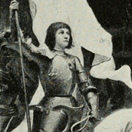
Saint Joan of Arc timeline

Timeline of the Saint Joan of Arc
Back to Saint Joan of Arc main page
Notes:
- dates of Feast Days will not align with the modern calendar, as the Julian calendar was in use until 1582 when the Gregorian calendar was adopted. For example, using today's Gregorian calendar, Easter Sunday, 1431 would be April 10, whereas at the time, under the Julian calendar, it was April 1.
Summary of Joan's life
Saint Joan of Arc was born in a small village in a French fief in eastern France along the Germanic border. Throughout her childhood, France is caught in a civil war
<< todo
Short timeline of the life of Saint Joan of Arc
| 1412 |
|
| 1415 | English victory at Agincourt. |
| 1420 | Treaty of Troyes signed between Charles VI of France and Henry V of England, ceding succession to Henry V and disinheriting the French Dauphin (prince) Charles. |
| 1424 | Joan experiences her Visions and Voices. |
| 1428 |
|
| 1429 |
|
| 1430 |
|
| 1431 |
|
Extended timeline of the life of Saint Joan of Arc, 1412-1431
| DATE | EVENT | NOTES |
|---|---|---|
| 1337–1453 | Hundred Years War between France and England | Not a continuous war, but a series of events, battles, alliances, treaties, etc. that decided control of France |
1410s | ||
| 1412 | Jeanne born to Jacques and Isabelle Darc (or similar surname) | Her birth date was given by a contemporary as Feb 12, but she never claimed that day; Joan said that she was never called by her last name, so she never heard the words, "Jeanne d'Arc". |
| Jan 6 | Joan's birthdate corresponding to the Epiphany. | Per a contemporary but never affirmed by Joan |
| Jan | We know she was born sometime in January, as she was baptized that month. | << confirm |
| 1415: October 25 | Battle of Agincourt marks an overwhelming English victory; the Burgundian faction of France had stayed neutral in the invasion, leaving the Armagnac faction to fight the English on its own, which suffered a tremendous defeat | Henry V of England re-asserts English claims on France and commences accumulation of territory in northern France |
| 1417 | Pope Martin V elected, ending the Western Schism | the Avignon antipope continues his claim on the office, although without French backing (which he lost several years before, which allowed for the eventual settlement in 1417) |
| 1418 | The French Burgundian faction seizes Paris | |
| Sept 10 1419 | The Duke of Burgundy, John the Fearless, is killed by guards of the Dauphin Charles | The Burgundians and the Dauphin's representatives were meeting to re-align themselves against the English; an argument broke out and the Duke was killed, which ended changes of a rapprochement. |
| 1419 | The Burgundian-English alliance begins | |
1420-1423 | ||
| 1420, May 21 | Treaty of Troyes gives French succession to English King Henry V and also making him Regent of France1 | the English maintain their claim on the French throne through the infant king, Henry VI, who assumed the title upon the death of French King Charles VI. He would be crowned King of France in Paris in 1431 under English-Burgundian control of the city. |
| 1422 | Charles VI of France and Henry V of England die; the infant king Henry VI declared by the English to be King of France | |
| 1423 | Domrémy forced to pay a protection fee to a commander who had in 1419 sacked a nearby Burgundian village[1] | |
| Jul 13 1423 | English-Burgundian victory at the Battle of Cravant | |
| Sep 26 1423 | In one of the first battles between the English and French since Agincourt in 1415, the French victory at the Battle of La Brossinière gives confidence to the French cause. | Charles VII, the Dauphin, sends a letter to the city of Tournai trumpeting the victory[2];
Shortly before defeating the English at La Brossinière, the French had won a smaller battle against the Burgundians at La Buissiere. |
1424-1427 | ||
| Spring 1424 | A Scottish army arrives to assist the French | |
| Summer 1424 | Joan experiences her first visions, starting with the Archangel Michael and then with Saints Catherine and Margaret | Possibly 1425; Joan said she was 13, so the year depends on assumptions of her birth year |
| Aug 17 | Devastating English victory at Battle of Verneuil in northern France marks tremendous setback for France | Called the "Second Aigencourt" |
1428 | ||
| May | Joan's father allows her to visit a cousin at Burey-le-Petit, who was expecting | the location was near to Vaucouleurs, to where her uncle brought her |
| May 13 | Joan's first trip to Vaucouleurs to meet Robert de Baudricourt; he rebuffs her and sends her home | May 13, 1428 was the Feast of the Ascension of the Lord (40 days after Easter Sunday) |
| June | Domreme raided by Burgundian forces and burnt and ransacked. | Domréme villagers flee to Neufchateau for protection from bandits; there, a man sues Joan for breach of marital contract |
| July | Joan and her family escape to Neufchâteau and stay at an inn run by a woman known as "la Rousse" for an extended period. | Joan helps her host run the property |
| Oct 12 | The siege of Orleans begins | |
| Fall | ||
1429 | ||
| January | Joan stays with her uncle , Durand Laxart at Burey-le-Petit | She visits under the pretext of assisting is pregnant wife |
| January-February | Second visit to Vaucouleurs; Joan is again rebuffed by Baudricourt; however her notoriety rises, leading to great curiosity about he in the region. | Joan says "farewell" to a friend |
| early February | Joan is summoned by the Duke of Lorraine | |
| February 12 | Joan tells Baudricourt the French would lose another battle. | |
| February 12 | French forces lose the Battle of the Herrings | The French had attacked an English supply convoy that was carrying salted herring to their troops at Orléans. |
| February 13 | Baudricourt sends Joan away for the second time | It was the first Sunday of Lent that year, and Joan had returned to Vaucouleurs |
| February 13/14(?) | Joan, her uncle and another supporter try to go to Chinon by themselves | They turn back, realizing that they need Baudricourt's introduction |
| February 22 | Joan returns and Baudricourt, now convinced by her prediciton of the Battle of Herrings, agrees to send Joan to see the Dauphin | |
| February 22 | Joan departs for Chinon to meet the Dauphin; Baudricourt supplies her with a horse and gear; she also acquires men's clothing and cuts her hair | Joan stated, " I had with me a Knight, a Squire, and four servants" She continues, "Robert de Baudricourt made those who went with me swear to conduct me well and safely. ‘Go,’ said Robert de Baudricourt to me, ‘Go! and let come what may!’[3] |
| March 4 | Joan and her party arrive at Chinon[4] | |
| March 9 | Joan meets the Dauphin | |
| March | Joan sent to Poitiers for examination by ecclesticcal tribunal | Before or after the inquiry, Joan is also examined by ladies of the Court to confirm her virginity |
| March 22 | Joan dictates her audacious "Letter to the Englsh" warning the English King and his commander in France, the Duke of Bedford, to surrender their French holdings and join Joan in common cause. | Likely written from Poitiers where she was under interrogation by the King's counselors |
| March 25 | Joan goes on traditional pilgrimage to Le Puy-en-Vley when Good Friday and Annunciation coincide | Her mother was also on a pilgrimage there |
| The Dauphin orders armor plate for Joan (very specialized); | Joan asks for the sword from Sainte-Catherine-de-Fierbois, which was found behind the altar where, from afar, she had instructed them to find it. | |
| April 15 | The English Privy Council discusses a letter from the Duke of Bedford that warned that the French now intended to crown Charles VII King of France[5] | Bedford's concern can only come from |
Relief of Orléans April-May 1429 | ||
| April | Joan travels to Tours where she receives battle gear, including her banner (standard) | |
| April 24 | Joan arrives to Blois to lead the army gathered there | |
| April 27 or 29 | Joan leads the army towards Orléans | |
| April 29 | Joan meets the Bastard or Orléans, the Count of Dunois, who was in charge of the city's defense during the siege | |
| April 29 | Joan enters Orléans at 8:00 pm | She enters through the "Burgundy gate" and stays at the home of Jacques Boucher |

| ||
| April 29 | Joan leads the French army across the Loire and into the city of Orléans. | Joan prays at the Cathedral of Orleans |
| May 1 | The Bastard of Orléans, the Count of Dunois, heads to Blois for reinforcements, leaving Orléans under the command of La Hire, with Joan there | Joan tours the city walls and exchanges words with the English commander William Glasdale, who insults her, |
| May 3 | Dunois leads reinforcements from Blois towards Orléans | |
| May 4
(Monday) |
Early that morning Dunois' forces arrive to the north bank of the Loire, to the east of the city, near to an English garrison at St. Laurent; Joan rides out of the city to greet the French forces | |
| At noon, Dunois leads an attack upon 400 English troops near the church of Saint-Loupe, to the east of the city (on the north bank) and defeats 400 English; Joan learns of the assault and joins it just in time to rally faltering French troops. | Joan demands the sparing the lives of captured soldiers | |
| May 5 | Feast of the Ascension of the LordL Joan refuses to fight or even put on her armor; | Fighting is suspended in honor of the Feast of the Ascension of the Lord; it is unclear how the 5th marks the Feast Day, as 40 days after Easter Sunday of 1429 would land on May 7 |
| She does write a letter to the English, which is sent to their camp by arrow at Les Tourelles | ||
| May 6 | Dunois and his commanders plan an assault upon the south bank of the river, across from the city; Joan insists upon allowing a militia from the city to join the battle, to which the professional soldiers disagree. Joan prevails in the decision. | |
| The army crosses the Loire River, but before a complete landing, La Hire attacks English positions near Les Tourelles, which is the strongest English fortification directly across from the city (to protect the city the bridge was partly dismantled on the far side by the French). | Exposed English fire from Les Tourelles, the French retreat, dragging Joan back with them; as the English commence a pursuit, Joan turns, raises her standard and declares, "Au nom de Dieu!" ("In the name of God!"), which startles the English and ignites the French, so the English counter-attack is turned away. | |
| The French then launch an attack upon an English hold to the south of Les Tourelles, called "Les Augustins", which succumbs to the French by nightfall. | Joan injures her foot by stepping on a spike and does not participate in the military council that night.
She tells her confessor, Jean Pasquerel, "Tomorrow blood will flow from my body above my breast." | |
| May 7 | Against the wishes of the commanders and to great exclamation in the city, Joan leaves the city and joins the French army on the southern bank. | To support the attack, citizens commence repair of the bridge and station artillery on the island of Saint-Antoine. |
| Outside of Tourelles, Joan is hit by a longbow arrow between her neck and left shoulder; she is taken back to the city. | At news of her injury and perhaps death, French morale drops and that of the English rises, and the assault on Les Tourelles falters. | |
| Upon learning the Dunois planned to call off the attack, Joan goes into prayer, then returns to the army, telling the solders that when her standard touched the fortress wall it would be theirs, that the "telling the troops that when her banner touched the fortress wall the place would be theirs. Amidst the commotion of battle and English missiles, she made her way to the wall. A French solder yelled, "It's touching!" to which Joan responded, "Tout est vostre – et y entrez!" ("All is yours, – go in!"). The French rushed forward with ladders and breached the walls. | Forced to the back of the fort complex on a drawbridge, the English commander falls into the river and drowns; | |
| Into the evening, the French continue to clear out the fortress and redoubts from the south, while an assault is launched from the city itself across the quickly-repaired bridge. 1,000 English are killed, 600 taken prisoner, and 200 French prisoners are released. | ||
| May 8 | English abandon Orléans | Joan counsels mercy and not to chase after the English. |
Loire Campaign, June 1429 | ||
| June 11-12 | Battle of Jargeau: Joan personally leads the assault upon the walls and takes the fortified town. | The Duke d'Alencon said the French killed 1,000 English soldiers while pursuing them out of the town.[6] |
| June 15 | Battle of Meung-sur-Loire | French forces easily take a strategic bridge and run the English out of the town |
| June 16-17 | Battle of Beaugency | Count of Richemont arrives night of the first day, and is welcomed by Joan over the objections of other leaders |
| June 18 | Battle of Patay: tremendous French victory that opens the path to Reims | |
Reims & the Coronation of Charles VII | ||
| June 30 | French minister La Trémoïlle begins negotiations with the Burgundians | The deception and undermining of Joan by the French court begins |
| July 17 | Dauphin coronated as King Charles VII at Reims; Joan is given prominent placement in the ceremony along with her battle flag | Charles VII lingers at Reims while Joan urges an attack on Paris. |
| July 17 | The same day of the Coronation of Charles VII, Joan sends a letter to the Duke of Burgundy. | |
| July 22 | Soissons surrenders to Joan | |
Paris Campaign and Truces | ||
| August 4 | Charles signs 15 day truce with Duke of Burgundy | |
| mid-August | The English commander Bedford names the Duke of Burgundy governor of Paris[7] | |
| August 15 | English and French armies led by their respective heads, the English Duke of Bedford and the French King Charles VII, line up at Montépilloy outside of Paris | on August 16, the English army moves back to Paris |
| August 26 | Joan at St. Denis outside of Paris | |
| August 28 | Charles VII signs secret pact with Duke of Burgundy to halt military operations through Christmas | |
| September 8 | Joan leads assault upon walls of Paris and is injured | |
| September 10 | Charles VII orders retreat from the advance upon Paris | |
| September 18 | Charles signs another treay with the Duke of Burgundy | In November, the truce is agreed to be extended through Easter |
| October 10 | Chancellor of France Regnault de Chartres heads to St. Denis to secretly negotiate directly with the English on behalf of Charles VII. | Chartres was also the Archbishop of Rheims who had coronated Charles VII. |
| November 4 | Joan leads the assault upon the fortified town of Saint-Pierre-le-Moûtier. | Charles VII enobles Joan following the battle. |
| Nov 9: Joan fails to take the city of La Charité; Charles signs extended truce with Duke of Burgundy | ||
| November 24 | Joan's defeat at La Charité | |
1430 | ||
| April | Joan prays for a dead baby who revives long enough to be baptized before dying again. | |
| April 16 | Easter Sunday | |
| April 23 | The English child King Henry VI lands a Calais; he goes to Rouen | |
| May 23 | Joan captured by Burgundians at the siege of Compiègne | Joan was delivered to the Duke of Luxumbourg |
| She is held at the Castle of Clairoix | ||
| Charles VII refuses to pay her ranson | ||
| September 18 | Joan, the Demoiselle of Luxumbourg, dies, freeing the John, the Duke of Luxembourg to ransom Joan to the English. He immediately cuts the deal. | The Demoiselle had befriended Joan during her imprisonment at Beaurevoir, and used a promise of inheritance to the Duke as lever for him not to ransom her to the English. |
| September 30 | The mystic supporter of Joan, Pierronne la Brettone, burned at the stake as a heretic by pro-English University of Paris clerics. She had been arrested in March outside of Paris for preaching support for Joan (who had not yet been captured). | |
| Sept or early Oct | On realizing that she will be handed over to the English, Joan attempts to escape from Beaurevoir Castle | She tumbles 60 feet to the ground, laying there stunned, but alive. She credits God with saving her life. |
| Mid-Summer | Joan moved to Beaurevoir Castle, which was more secure | |
| Sep or Oct | Joan moved to Arras under Burgundian control as they negotiated the ransom for her from the English | |
| Oct 25- early Nov | A French relief army is sent to Compiègne, under Count de Vendome; the Burgundian of the city siege is lifted in early November.[8] | |
| Late Nov | English pay the ransom and she is transferred to Crotoy, a coastal English fortress | |
| Late 1430/ early 1431 | Joan is taken to Rouen, the English administrative center | Henry VI was at Rouen; |
1431 | ||
| Feb 21 | Joan's show trial at Rouen commences with the first of six "public examinations" (the court later moved to "private examinations" as it was getting embarrassed by Joan's testimonies). Present on the 21st at the Castle of Rouen was Bishop Cauchon and forty-two "Assessors", made up of clerics and theologians from Rouen and Paris. | The English hand Joan over to a French ecclesiastical court, but, in violation of that transfer of authority, keep her in an English prison; normally she would be held in a Church prison for women |
| March 27-28 | The Seventy Articles read to Joan over two days, and she is required to respond to each. | |
| Six Public Examinations | ||
| Private Examinations | ||
| April 1 | Easter Sunday | |
| May 9 | Joan is brought before torture instruments and threatened with their use | Joan responds, "Truly if you were to tear me limb from limb, and separate soul and body, I will tell you nothing more; and, if I were to say anything else, I should always afterwards declare that you made me say it by force."[9] |
| May 12 | The fourteen court "Assessors" (judges) decide not to submit Joan to torture, which, one of the two who argued for it said would be “a salutary medicine for her soul."[10] | |
| May 23, Wednesday | The formal sentence consisting of 77 is read to Joan | University of Paris theologian Pierre Maurice admonishes Joan to save her soul |
| May 24 Thursday | Joan signs the abjuration document | |
| She is sent back to the English military prison, where she puts on women's garments | ||
| May 24-27, Thurs-Sunday | At some point over the weekend, the English guards assault or molest, or threaten to assault or molest her in the prison; afterwards, they throw a set of men's clothes to her, which she puts on for her protection. | |
| May 28, Monday | Cauchon leads Judges to see Joan in prison wearing men's clothing again. | |
| Joan rescinds her abjuration | ||
| May | Joan is convicted of heresy in ecclesiastical court | |
| May 30, Wednesday | Joan is burned at the stake | |
| June 7 | Testimonies of several Judges recorded in the highly dubious "Subsequent Examinations" about confessions and interrogations with Joan on May 30th. | |
1434 | ||
| Nov 30 | A deep freeze settled on France and England starting on the Feast Day of the Saint Andrew, Patron Saint of the Burgundian, leading to hardship across Normandy and discontent with the English occupation. | The Thames Froze[11] |
1435 | ||
| January | Local revolts against English erupt between Falaise, Carentan, and Bayeux[12] | La Hire continued raids, and the Duke d'Alencon (Bastard of Orleans) led the rebel army |
| June 1 | The Bastard of Orleans takes Saint Denis | English defenders were "slaughtered without mercy"[13] |
| September 21 | After almost two months negotiation at the "Congress of Arras (August 5-September 21), the Treaty of Arras is completed between the Burgundian and French | The English abandoned the Congress; the English Regent of France, John, the Duke of Bedford, dies on Sept 14, a week before the Treaty was signed. |
1436 | ||
| February 28 | The French army led by Arthur de Richemont and Jean de Dunois surrounds Paris | |
| April 13 |
|
|
1437 | ||
| November 12 | Charles VII enters Paris, formally reclaiming the city within France | |
1438 | ||
| July 7 | Charles VII issues the Pragmatic Council of Bourges | |
1450s | ||
| 1450, February 15 | Charles VII orders the priest Guillaume Bouillé to open an investigation into 1431 condemnation of Joan of Arc, | |
| 1456, July 7 | The conviction is invalidated and Joan is declared a martyr for France | |
Post-15th Century | ||
| 1905, April 11 | Joan beatified by Pope Pius X | |
| 1920, May 16 | Saint Joan canonized by Pope Benedict XVI | |
Sources
- Pernoud, Regine, Joan of Arc: her story, Appendix 11
- Murray, T, Douglas, Jeanne D‘arc, The Trials, starting p. 377, "CHRONOLOGICAL TABLE OF PRINCIPAL EVENTS IN THE LIFE OF JEANNE D’ARC"
- ↑ See Joan of Arc Biography - Visions
- ↑ See The Battle of Verneuil (17 August 1424): Towards a History of Courage by Michael K. Jones (archive.org wayback machine; accessed 1/17/2025; the original website is no longer available).
- ↑ Jeanne D‘arc, by T. Douglas Murray_The Trials_The Project Gutenberg eBook.pdf, p 12
- ↑ Arrival date elsewhere listed as March 6. This date conforms to the "eleven days" journey as testified by Jean de Metz at the Trial of Rehabilitation (Murray, p. 223).
- ↑ Proceedings and ordinances of the Privy Council of England : England. Privy Council (Archive.org) The text states that Bedford warned of "the desire of the council of France and other subjects there to have their king crowned, so that the nobles of that kingdom and others might do homage and fealty to him."
- ↑ Murray, p. 278
- ↑ Pernoud, Her Story, p. 74
- ↑ See FN 76 in Jeanne D‘arc, by T. Douglas Murray_The Trials_The Project Gutenberg eBook.pdf
- ↑ Jeanne D‘arc, by T. Douglas Murray_The Trials_The Project Gutenberg eBook.pdf, p. 118
- ↑ Jeanne D‘arc, by T. Douglas Murray_The Trials_The Project Gutenberg eBook.pdf. p. 119
- ↑ On 30 November (ironically the feast of Saint Andrew, patron saint of the Burgundians) ‘it began to freeze extraordinarily hard. This frost lasted a quarter of a year, less nine days, without ever thawing, and it snowed as well for forty days without stopping night or day.’ In England the Thames and its estuary froze, so that wine ships from Bordeaux had to be unloaded at Sandwich. Barker, Juliet. Conquest: The English Kingdom of France, 1417–1450 (p. 215). Harvard University Press. Kindle Edition.
- ↑ At the turn of the new year, 1435, the area between Falaise, Carentan and Bayeux erupted in the first popular uprising in the history of the English kingdom of France. Barker, Juliet. Conquest: The English Kingdom of France, 1417–1450 (p. 216). Harvard University Press. Kindle Edition.
- ↑ the ‘English’ garrison was slaughtered without mercy, Barker, Juliet. Conquest: The English Kingdom of France, 1417–1450 (p. 219). Harvard University Press. Kindle Edition.