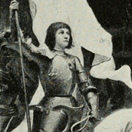
Saint Joan of Arc glossary
Glossary of people, places, events and terms related to Saint Joan of Arc
Contact the author for questions, suggestions or access to the book.
back to Saint Joan of Arc main page
Important terminology
- Armagnac/s
- named for the Bernard VII, Count d'Armagnac, who, in the French factional split, remained loyal to the House of Orlėans and, subsequently the young prince, or "Dauphin," Charles.
- sources and historians may also refer to the Dauphin Charles and his supporters as "Valois," for the ruling House of Valois dynasty that Charles as heir represented and which would have ended had Henry V of England become King. (See Kings of France and England for chart of royal lineage.)
- Bernard was murdered during the 1418 Burgundian takeover of Paris and subsequent massacre of several thousand Armagnacs.
- Armagnac-Burgundian Civil War, 1407-1435
- refers to the factional split of the Kingdom of France between the Houses of Orlėans and Burgundy, which became outright warfare, especially in Paris, in 1410-1412, 1413-1414, 1418 and from 1420 to 1435 when the Burgundians were allied with the English.
- Burgundian/s
- The House of Burgundy was a large, central-western Duchy of France that was assumed by the King of France, John II in 1363, who then gave it (ceded) to his younger son, Philip, who expanded the Duchy through marriage and his son, John, who expanded its territories and treated the Duchy, in part a French fief, as an autonomous state. The "Burgundians" were his subjects, followers, and allies.
- Charles VII, King of France
- The direct heir to the French throne that was contested by the English King Henry.
- Also referred to as “the Dauphin Charles,” or “the Dauphin,” until he sacramentally crowned at Reims following the entry of Joan of Arc.
- Charles' enemies referred to him as the "King of Bourges," for the regional capital of the loyalist region that Charles controlled. He kept a principle residence at Chinon.
- Henry V, King of England
- English king who claimed the French throne based upon his linage through
- Henry V invaded France in 1415 and engineered the Treaty of Troyes with the French King Charles VI that established Henry as Regent of France and heir to the throne,.
- Henry V died shortly before Charles VI so he never assumed the French throne; his young son became Henry VI of England and assumed the throne of France at the death of Charles VI in 1422; he was crowned at Paris as Henry II of France in 1431.
- England/ English
- Following old English royal claims on Normandy, Gascony, and the kingdom of France itself, Henry V of England invaded France in 1415 and assumed title as heir to France at the Treaty of Troyes in 1420.
- Henry died in 1422 and "English France" was ruled by his brother, the Duke of Bedford who was regent for the young Henry VI.
- France / French
- “France” and “the French” refer to the people and land ruled by or loyal to Charles VI.
- as opposed to “England” and “the English” who ruled areas of northern France.
- formal documents under English-ruled areas referred to the King of France as Henry VI.
- The the “Kingdom of France” as ruled by Charles VI had been reduced mostly to central France below the Loire Valley.·
- The English directly controlled Normandy, but ruled the rest of northern France through their alliance with the Duke of Burgundy who controlled Paris and northwestern France.
- “France” and “the French” refer to the people and land ruled by or loyal to Charles VI.
- House of Plantagenet
- I won't much use the term, but it is helpful to understand the context of the Hundred Years War in that the English invaders and claimants upon the French throne, including Henry V, were from the the House of Plantagenet (named for a gold-colored flowering plant called genista), which has its origins in the County of (Compte d') Anjou in central France, and which is the burial location of the first Plantagenet English King, the Anglo-Norman, Henry II, and his queen, Eleanor of Aquitaine, who was previously Queen of France.[1]
- The Plantagenet rule ended with Henry Tudor's defeat of Richard III, the last of the Plantagenets, using French troops, as the French wanted to remove English ties and potential claims to the Duchy of Burgundy, which at the time was in the hands of Margaret of Burgundy, the sister of the last two Plantagenet kings Edward IV and Richard III. There were three "branches" of Plantagenets, with the House of Lancaster of the most concern to us, consisting of Henries IV, V, and VI. We can see in all this the origins of French and English modern statehood coming out of the Hundred Years War and the French victory in it, due, of course, to Saint Joan of Arc.
- House of Valois
- Line of French Kings that started with Philp VI in 1328 following the death Charles IV who had no male heir.
- The closest male her to Charles IV was Philip of Valois, who was crowned King Philip VI
- The closest male heir to Charles IV was his sister’s son, the English King Henry III
- The two French contestants during the time of Joan of Arc, Charles VII and Philip, Duke of Burgundy were both of the House of Valois.
- Line of French Kings that started with Philp VI in 1328 following the death Charles IV who had no male heir.
- Hundred Years War terminology
- A tradition is to make the "Hundred Years" possessive, so that, like the "Thirty Year's War" it is the war that had one hundred years, "Hundred Years' War."
- Here, however, I will use the attributive, or adjective, compound noun, "Hundred Years" to describe the "War," thus "Hundred Years War" without the possessive. Academic articles use both forms, although Wikipedia, which considers itself -- but is not -- definitive, uses the possessive form, "Hundred Year's War." It's just ugly, so I'm sticking with the more elegant and grammatically correct "Hundred Years War."
Other resources
- Saint Joan of Arc Timeline
- Kings of France and England
- Popes & antipopes (to do)
- List of all pages regarding Saint Joan of Arc
The Hundred Years War
- Generally, a war between the English and the French
- Generally, a war over control of various parts of France, and, ultimately, most of what is today modern France.
- Variously, a ware between factions and regions in France
The French
The English's French Allies
The English
Places
People
Regnault de Chartres, Archbishop of Reims and Chancellor of France
Served as Chancellor of France, starting 1428, and was a principal advisor to Charles VII. De Chartres was the primary instigator of the failed diplomacy of 1429-1432. He resented Joan and as head of largely Burgundian region and former member of the University of Paris, he sought reconciliation of the French factions.
La Hire
Étienne de Vignolles. His nicknam "La Hire" possibly came from the English "the Hire-God" for "wrath of God" and shortened by the French into "La Hire". Or the name was a reflection of his personality from the French for hedgehog, hérisson. Or, it meant direclty "the growler".
Étienne's titles were Sieur de Montmorillon and Chatelain de Longueville.
He was a significant ally of Joan of Arc and following her death in prosecution of the remainder of the Hundred Years War. His most notable battlefield victory was at the 1429 Battle of Patay, in which the English commander Lord John Talbot was captured.
Dynasties
Valois / House of Valois (1328-1589)
The line of French Kings starting with Philip VI who was the cousin (once removed) of Charles IV who died without a male heir. Since Philip VI's father, Charles, was of the "House of Valois," with the reign of Philip VI, the royal House changes from Capetian dynasty to Valois.
Terms
Salic Law
Laws declared by King of the Franks Clovis in 500 AD that, among things, barred female inheritance of property and royal lineage. "Salic" is from the homeland of the "Salic Franks" along the IJssel River in modern Netherlands. Clovis wrote the laws in Latin, although the document contains notations or fragments in either "Old Frankish" or "Old Dutch" words.
The tradition held in France that if a female was the only living successor, the royal line should be transferred to the nearest male relative, such as happened with Louis X, whose daughter inherited his throne of Navarre but not that of France.
Vassal
- ↑ Queen to Louis VII from 1137 to 1152, but who produced no male heirs, so he had the marriage annulled, not for failure to produce an heir, but on grounds of consanguinity, or being too closely related. Her marriage to the English Henry II sealed his rule and lands, and she produced five male heirs.